Your Facebook page is rented space. Your website is your digital home.
A practical guide for small businesses, service providers, retailers, startups and growing brands.
Imagine a potential customer hears about your business from a friend. They unlock their phone, type your business name into Google, and decide within moments whether you look credible enough to contact. If they find only a Facebook page with scattered posts, an old cover photo, incomplete service details and no clear path to buy or enquire, they may hesitate. Then they search your competitor and discover a clean website with services, prices, testimonials, FAQs, location details, a WhatsApp button and a simple quotation form. Nothing dramatic has happened, yet the buying decision may already be moving in your competitor’s direction.
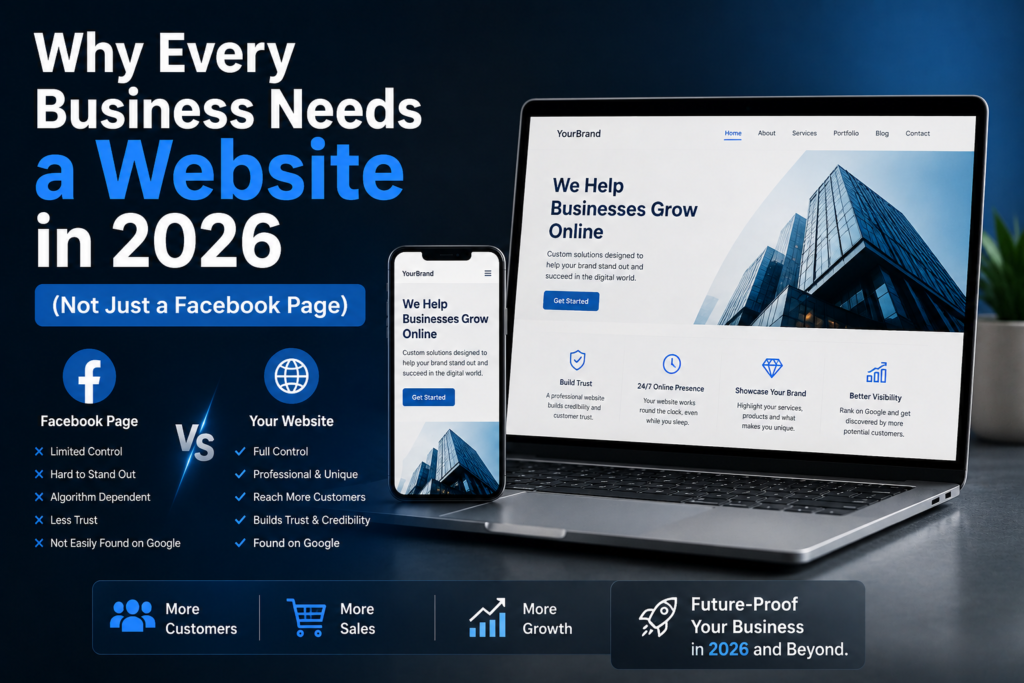
That is the real reason every serious business needs a website in 2026. It is not because Facebook is useless. Facebook remains valuable for community, conversations, advertising, updates and social proof. The problem begins when a business treats a Facebook Page as a complete replacement for an owned website. Social media is a channel. A website is infrastructure. One helps you join a conversation; the other gives your business a permanent digital base that you can shape around your goals.
The scale of the opportunity is enormous. DataReportal’s Digital 2026 Mid-Year Global Update reported 6.12 billion internet users in April 2026, close to three-quarters of the world’s population. In Pakistan, Digital 2026 reported 117 million internet users at the end of 2025. Those figures do not mean every person is your customer, but they underline a simple commercial reality: discovery, comparison, trust-building and purchasing increasingly happen online.
A Facebook Page is useful because it allows businesses to publish updates, communicate with followers, respond to comments, run campaigns and share visual content quickly. For restaurants, salons, local retailers, consultants and many other businesses, that daily social activity can be extremely valuable. But your Page still exists inside another company’s platform. The layout, features, reach, rules and user experience are controlled by Meta. You can customize parts of your presence, but you cannot redesign Facebook around your customer’s buying journey.
Your website gives you much greater control. You decide what customers see first. You can create separate pages for each service, add booking tools, showcase case studies, explain your process, collect leads, sell products, publish detailed articles and connect analytics. Most importantly, all of those elements can work together instead of being buried among unrelated posts in a social feed.
Think of Facebook as a busy market where you rent a stall. Your website is the shop you own and design around your customers. |
Customers often research before they call, message or visit. Your website becomes part of that silent first interview. A professional domain name, clear branding, complete contact information, well-written service pages and genuine testimonials reduce uncertainty. They tell the visitor that the business has invested in its identity and has thought seriously about how customers should find information.
Consider two accounting firms. Firm A has only a Facebook Page containing tax reminders, festival greetings and phone numbers. Firm B has a website explaining tax filing, bookkeeping, payroll and company registration, along with staff profiles, client reviews, common questions and a consultation form. Even if both firms are equally competent, Firm B makes it easier for a new customer to understand the offer and evaluate the business. In many industries, that clarity is part of credibility.
This does not mean every business needs a huge corporate website. A small company can begin with five strong pages – Home, About, Services, Testimonials or Portfolio, and Contact – and expand later. What matters is that those pages answer the questions a real customer asks before making contact: Who are you? What do you offer? Can you solve my problem? Can I trust you? What should I do next?
A major weakness of relying only on Facebook is that customers do not always begin their journey on Facebook. Someone with a leaking pipe may search ’emergency plumber near me.’ A parent may search ‘best tuition centre in Islamabad.’ A business owner may search ‘payroll software for small company.’ A bride may search ‘wedding photographer in Lahore.’ These searches express intent: the person is actively looking for an answer, product or service.
Google’s official SEO Starter Guide explains that search engine optimization helps search engines understand website content and helps users discover a site through search. With a properly structured website, a business can create useful pages around the exact services, locations and questions customers search for. A Facebook feed, by contrast, is not designed to give you the same level of control over individual, search-focused pages.
Local businesses should also connect their site with a Google Business Profile. Google states that a verified Business Profile can help customers find a business on Search and Maps. The combination is stronger than either asset alone: the profile supports local discovery, while the website provides depth, proof and a controlled path toward enquiry or purchase.
Search is changing. People increasingly encounter AI-generated summaries, conversational search experiences and answer-style interfaces. That makes high-quality website content even more strategically important. Google’s current guidance for AI features in Search says that the same fundamental SEO principles continue to apply to AI experiences such as AI Overviews and AI Mode. Businesses still benefit from creating accessible, useful, original content that search systems can understand.
For a business, this means your website can become a structured source of truth about what you do. A page can clearly describe your services, locations, pricing approach, expertise, frequently asked questions and contact process. If all your business knowledge lives only inside occasional Facebook posts, it is fragmented, time-sensitive and harder to organize into a coherent resource.
Example: imagine a solar installation company. Instead of posting only ‘Contact us for solar solutions,’ its website could contain dedicated pages such as Residential Solar Installation, Commercial Solar Systems, Solar Maintenance, How Net Metering Works, and Questions to Ask Before Choosing a Solar Provider. Those pages help human visitors, traditional search engines and AI-assisted discovery understand the business more clearly.
A good website is an employee that never goes off duty. At 2:00 a.m., a visitor can read your services, compare options, check FAQs, download a brochure, submit an enquiry, request a quotation or place an order. They do not need to wait for someone to reply to a Facebook message before learning the basics.
A website does not remove human interaction; it removes unnecessary friction before that interaction. By the time a qualified lead contacts you, they can already understand what you offer and whether it fits their needs.
Social media is excellent at generating attention. The challenge is converting that attention into measurable business action. A website lets you design dedicated landing pages for specific campaigns. Instead of sending every advertisement to a general social profile, you can send people to a page created for one offer with one clear objective.
For example, a gym running a ’30-Day Transformation Program’ could direct visitors to a landing page containing the program benefits, schedule, trainer profiles, success stories, pricing and a registration button. A property agency could create a page for a new development with floor plans, location information, gallery images and a viewing-request form. A software company could offer a demo page with product features, screenshots, FAQs and a booking calendar.
Business Need | Facebook Only | Website + Social Media |
Brand control | Limited to platform layout and rules | High control over design, content and customer journey |
Google visibility | Can appear, but limited page-level SEO control | Dedicated pages can target services, locations and questions |
Lead generation | Messages, comments and platform forms | Custom forms, landing pages, bookings, calls, WhatsApp and email |
Content lifespan | Posts can disappear quickly in the feed | Evergreen pages and articles remain organized and searchable |
Analytics | Platform-focused analytics | Website analytics can track traffic, pages, campaigns and conversions |
Ownership | Presence depends on a third-party platform | Domain and website become core owned digital assets |
Selling online | Platform-dependent options | Flexible e-commerce, payment and catalogue integrations |
A modern website can show more than traffic numbers. With privacy-conscious analytics and conversion tracking, businesses can learn which pages attract visitors, which services receive the most interest, where people leave, which campaigns generate enquiries and which content contributes to sales. This turns marketing from guesswork into a process of observation and improvement.
Google Search Console, for example, allows website owners to understand how their site performs in Google Search, including the queries and pages that receive visibility. PageSpeed Insights can help evaluate page performance on different devices. These tools give a business direct feedback about an asset it controls.
Followers are valuable, but they are not the same as a customer database. Algorithms determine how many followers see a social post. A website can help you invite interested visitors to subscribe to useful updates, download a guide, request a quote or join a loyalty program. With proper consent and data practices, those interactions can build a direct relationship rather than depending entirely on a social feed.
For product-based businesses, the difference becomes even clearer. Facebook and Instagram can inspire discovery, but an e-commerce website can organize the actual shopping experience: categories, filters, search, product specifications, stock status, delivery information, payment methods, order confirmation and customer support.
Imagine a clothing brand launches ten new designs. On Facebook, customers may comment ‘price?’ dozens of times, search through photos and message for sizes. On a properly built website, each design can have its own product page with price, size choices, fabric details, colour options, delivery information and an Add to Cart button. Social media then does what it does best – generates attention – while the website handles structured commerce.
The same principle applies to services. A dentist can accept appointment requests, a restaurant can show a full menu, a salon can list packages, a travel company can display itineraries, and a software provider can let prospects request a demo. Your site should make the next step obvious.
Most social posts have a short attention cycle. They may perform well for a day or two and then become difficult to find. A useful website article can continue attracting visitors for months or years if the topic remains relevant and the content stays updated.
Google recommends creating helpful, reliable, people-first content rather than content written only to manipulate rankings. That principle is ideal for businesses: answer customers well, demonstrate expertise naturally and create a resource worth visiting.
No sensible business would build its entire operation on a single supplier if failure of that supplier could instantly interrupt sales. Digital presence deserves the same risk thinking. Social platforms can experience outages. Policies change. Account access can be disrupted. Organic reach can fluctuate. Features can be redesigned or removed. None of this means businesses should abandon social media; it means they should avoid unnecessary dependence on one channel.
A resilient digital presence uses several connected assets: website, Google Business Profile, email, Facebook, Instagram, LinkedIn, YouTube or other channels appropriate to the audience. The website acts as the central hub. If one social platform changes tomorrow, customers still have a direct place to find your products, services and contact details.
Some business owners avoid building a website because they imagine a six-month project with dozens of pages and complex technology. In reality, the right website should match the business. A small local service company may need only a focused brochure-style site. A retailer may need e-commerce. A growing company may need CRM integrations, customer portals or custom software. Start with the customer journey, not with features for the sake of features.
For many small businesses, a strong starting structure is simple: Home, About, Services or Products, Testimonials or Portfolio, FAQs, and Contact. Add clear calls to action such as Call Now, WhatsApp Us, Get a Quote, Book a Consultation or Shop Now. Make the site mobile-responsive, easy to navigate and fast enough that visitors are not waiting unnecessarily. Google’s Web Vitals guidance emphasizes measuring real-world user experience, including loading performance, responsiveness and visual stability.
You can also test individual pages using Google’s PageSpeed Insights. A beautiful site that is painfully slow, confusing on mobile or difficult to contact through is not doing its job. Design should support business outcomes, not compete with them.
Most social posts have a short attention cycle. They may perform a
The goal is not to choose one platform and delete the other. The smartest approach is to let each channel do what it does best. Use Facebook to stay visible, publish updates, share behind-the-scenes content, answer comments, promote offers and create community. Use your website to explain, organize, persuade, capture leads, support search visibility and convert attention into action.
Social media creates moments of attention. A good website turns those moments into a business system. |
well for a day or two and then become difficult to find. A useful website article can continue attracting visitors for months or years if the topic remains relevant and the content stays updated.
Google recommends creating helpful, reliable, people-first content rather than content written only to manipulate rankings. That principle is ideal for businesses: answer customers well, demonstrate expertise naturally and create a resource worth visiting.
Picture a small café that has operated for three years using only Facebook and Instagram. The owner posts new drinks, photos of desserts and holiday opening hours. Customers like the content, but the same questions appear every week: Where are you located? Do you have a full menu? Is there parking? Do you take reservations? Can I order a birthday cake? Are you open on Sunday? Do you have Wi-Fi? Is the space suitable for meetings?
Now the café launches a simple website. The homepage immediately shows location, opening hours and signature items. The Menu page lists drinks and food. A Celebration Cakes page explains sizes, notice periods and ordering. The FAQ answers parking and Wi-Fi questions. Google Maps is embedded. A WhatsApp button opens a pre-filled enquiry. The café continues using Facebook exactly as before, but every post can now direct interested people to a reliable information hub.
Nothing about that example requires an enormous technology budget. It requires thinking about repeated customer questions and designing a convenient path to the answer. That is what a useful website does.
A useful business website should be designed around trust, discoverability and action. At minimum, visitors should be able to understand your offer quickly, navigate comfortably on a phone, verify how to contact you and know what to do next. Depending on your industry, the site may also need online payments, appointment booking, live chat, maps, multilingual content, a customer portal, downloadable documents or integrations with internal systems.
There are situations where a Facebook Page may be enough temporarily. A brand-new side project validating demand, a short-lived community initiative or a hobby seller with very limited operations may reasonably begin on social media. The mistake is allowing a temporary shortcut to become a permanent ceiling after the business starts growing.
If customers regularly ask for information you have already posted, if you cannot explain all your services clearly, if Google searches show competitors instead of you, if you are spending money on ads without a strong landing page, if you want to sell or take bookings online, or if you want your business to look more established, it is probably time for a website.
In 2026, a website is not simply an online brochure. It is your digital headquarters: a searchable source of information, a trust-building tool, a lead-generation system, a sales channel and a platform you can continue improving as your business grows. Facebook can remain an important part of your marketing, but it should lead customers toward a digital presence that your business controls.
The question is no longer, ‘Do people still visit websites?’ The better question is, ‘What does a customer find when they become interested enough to investigate my business?’ If the answer is only a stream of social posts, you may be making the customer work too hard. A strong website organizes the story for them: what you do, why you are worth considering, what proof you can offer and how they can take the next step.
If your business has outgrown a Facebook-only presence, you do not need to build something complicated just to look modern. Start with a website that fits your actual goals and gives customers a clearer, faster path to trust and action. KM Software Services supports businesses with professional web development, WordPress solutions, digital marketing and custom software services, with an emphasis on practical digital solutions rather than technology for its own sake. You can explore KM Software Services’ web development services or broader digital marketing solutions when you are ready to turn your social-media presence into a stronger, more complete digital foundation.
Your Trusted Marketing Partner!
KM Marketers is a digital marketing solutions provider helping businesses grow through SEO, social media, content marketing, and paid advertising. Our focus is on delivering measurable results, building strong online visibility, and driving quality leads for clients across different industries.
Email: info@kmassignmentservices.com
kmdigitalmarketing2025@gmail.com
WhatsApp: +60 16-522 4321
Head Office: Galleria Cyberjaya, Parking lot, Jalan Teknokrat 6, Cyber 5, 63000 Cyberjaya, Selangor, Malaysia.
Hours: Mon–Sat 10:00 AM to 07:00 PM
© 2026 KM Marketers. Powered by KM Software Services Sdn. Bhd. (1308207-U). All Rights Reserved.