
A practical 2026 guide to finding a partner who can build more than a pretty homepage
The expensive mistake is not always choosing the expensive agency A beautiful portfolio can hide a weak process. A cheap quote can become expensive after change requests, delays, missing features and rebuilds. The right question is not “Who can make the nicest design?” It is “Who can understand our business, build the right website, protect our ownership and support the result after launch?” |
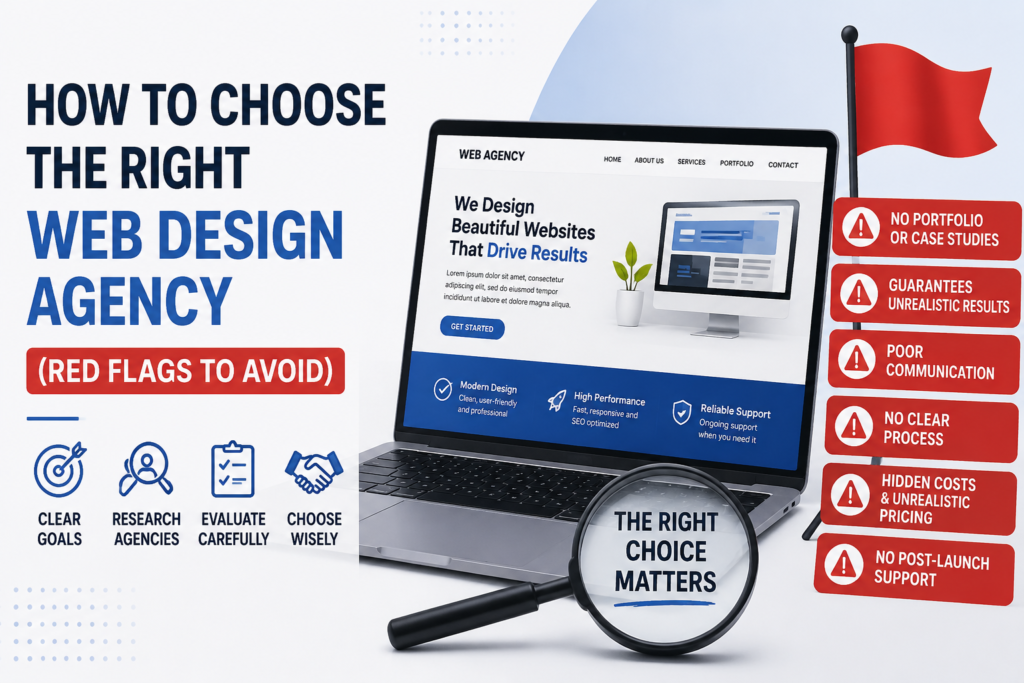
Choosing a web design agency can feel strangely difficult. Almost every agency website promises the same things: stunning design, responsive development, SEO-friendly pages, fast delivery and measurable growth. Portfolios look polished. Sales calls sound confident. Proposals use impressive language. Yet two agencies offering what appears to be the same five-page business website can differ dramatically in price, process, technical quality and long-term value.
The reason is simple: you are not only buying a visual design. You are buying decisions about structure, messaging, user experience, mobile behaviour, performance, accessibility, search visibility, analytics, security, content management, ownership and future maintenance. A weak decision in any one of those areas may not be obvious on launch day, but it can become painfully visible six months later when the site is slow, difficult to edit, invisible in search or dependent on the original agency for every small change.
Current market pricing also shows why comparison needs context. Clutch’s June 2026 web design pricing guide notes that agency projects can range from roughly $2,000 to $100,000 depending on scope, complexity, features and location. That does not mean you should spend at the top of the range. It means that comparing quotes without comparing what is actually included can be misleading.
This guide explains how to evaluate a web design agency before signing the contract, which questions reveal a strong partner, and which red flags should make you slow down or walk away.
The easiest way to choose the wrong agency is to begin with a vague brief such as “we need a modern website.” Modern is subjective. A useful website has a job. It may need to generate qualified leads, support a sales team, sell products, explain a complex service, attract local customers, recruit employees, reduce support enquiries or strengthen credibility before a prospect requests a quotation.
Before evaluating agencies, write down the three most important outcomes. Also identify your must-have functionality, the people who will maintain the site, any systems it must connect to, the languages it needs to support, your approximate budget range and any deadline that is genuinely fixed. The clearer your business goal, the easier it becomes to distinguish a thoughtful agency from one that simply sells a standard package.
Example A law firm does not simply need “a professional website.” It may need service pages that explain practice areas clearly, attorney profiles that build trust, local search visibility, secure enquiry forms and a content workflow that allows staff to publish legal updates. An agency that immediately talks about fonts and animations without asking about those goals is starting in the wrong place. |
A portfolio is useful, but it is one of the easiest things to misread. Attractive screenshots prove that an agency can produce attractive screenshots. They do not prove that the website solved the client’s problem, loaded quickly, generated leads, was easy to manage or remained successful after launch.
Look for projects that resemble your challenge, not necessarily your industry. If you need a complex product catalogue, an agency that has built large structured catalogues may be more relevant than one that has designed dozens of websites for companies in your sector. If you need appointment booking, multilingual content or custom integrations, ask to see work where those requirements were actually delivered.
Good agencies are curious before they are creative. They ask who your customers are, what competitors are doing, how leads currently arrive, what content exists, which pages matter most, where users get confused and how success will be measured. That discovery work may feel slower than jumping directly into mockups, but it reduces expensive guessing later.
A sales call that is almost entirely a presentation about the agency is a warning sign. You should leave early conversations feeling that the team understands your business better than when the call began. If an agency can quote a complex project after a five-minute conversation without asking meaningful questions, the quote is probably based on assumptions. Those assumptions usually reappear later as scope disputes or change fees.
Ask each shortlisted agency to explain the project from kickoff to launch. A credible process normally includes discovery, information architecture or sitemap planning, content responsibilities, wireframes or UX planning, visual design, development, testing, review, launch and post-launch support. The exact labels can vary, but there should be a clear sequence and clear decision points.
You also need to know how feedback works. Who approves designs? How many review rounds are included? Where are comments recorded? What happens if your team is late providing content? What counts as a change in scope? Vague answers to these questions can turn a friendly project into a frustrating one.
In 2026, responsive design should be assumed, not treated as a premium add-on. But “responsive” does not automatically mean the mobile experience is good. Ask how the team tests navigation, forms, calls to action, typography and tap targets on smaller screens. Ask whether designs are reviewed on actual devices rather than only inside a design tool.
Performance matters too. Google Search Central’s Core Web Vitals guidance recommends good real-world loading, responsiveness and visual stability because these metrics reflect user experience and are part of Google’s broader page-experience considerations. An agency should be able to discuss image optimisation, code weight, hosting, third-party scripts and performance testing without treating speed as something to think about after launch.
Accessibility is another indicator of professional maturity. WCAG 2.2 provides internationally recognised guidance for making web content more perceivable, operable, understandable and robust. You do not need every sales representative to quote accessibility criteria from memory, but the agency should have a clear approach to keyboard use, colour contrast, form labels, headings, alternative text and accessible components.
“SEO-friendly website” appears in countless proposals because it sounds valuable while remaining vague. Ask the agency to define it. At a minimum, the site should support sensible URLs, crawlable navigation, editable titles and descriptions, heading structure, mobile usability, performance, structured content, image optimisation, redirects when URLs change, analytics and search-console setup where agreed.
Be cautious with agencies that promise a number-one Google ranking. Search rankings depend on competition, content quality, authority, intent, technical health and many factors outside a designer’s control. Google itself emphasises helpful, reliable, people-first content rather than tactics designed primarily to manipulate rankings. A professional agency can improve your foundation and execute an SEO strategy; it cannot honestly guarantee a specific organic position.
Ownership questions are easy to ignore while everyone is excited about a new design. They become much more important when you want to change agencies. Your contract should make clear who owns the final design files, website code, content, custom graphics, domain, hosting account, analytics account and any custom functionality after invoices are paid.
Ideally, critical accounts should be registered in the client’s name or transferred to the client. You should not discover later that your domain is controlled by a freelancer’s personal account, your analytics data belongs to an agency profile, or your website can only operate on a proprietary platform that cannot be moved without rebuilding it.
A $4,000 proposal is not automatically cheaper than a $7,000 proposal. The first may exclude copywriting, content migration, SEO setup, analytics, accessibility testing, premium licences, training and post-launch support. By the time those items are added, it can cost more. Conversely, a large agency proposal may include services your business does not need.
Ask for a scope that identifies pages or templates, features, integrations, content responsibilities, revision rounds, testing, training, launch support, hosting and ongoing costs. If the proposal uses words such as “basic SEO,” “standard integrations” or “reasonable revisions,” ask for definitions. Ambiguous scope is one of the most common sources of disagreement.
There is no single correct price because a brochure website, a high-converting lead-generation site and a complex e-commerce platform are different products. Current guides show extremely broad ranges. Clutch reports agency pricing from about $2,000 to $100,000 depending on scope and complexity, while WebFX publishes 2026 estimates that likewise vary from low thousands into much larger budgets for complex work.
Use those figures as context, not as a shopping list. The better question is whether the proposed investment matches the business value, complexity and risk of the website. A local one-person consultancy does not need the same project team as an international retailer. At the same time, choosing the cheapest option for a website expected to generate a significant share of your leads can be false economy.
The sales process is a preview of the working relationship. Notice whether emails are clear, questions are answered directly, meeting notes are accurate and commitments are followed. If communication is disorganised while the agency is trying to win your business, it rarely becomes better after the deposit is paid.
Ask who your day-to-day contact will be. The senior strategist who impresses you during the pitch may not be involved in delivery. Find out who manages the project, who designs, who develops, who handles content and who has authority when something goes wrong. For outsourced or distributed teams, ask how handoffs and time-zone differences are managed rather than assuming they are either a problem or an advantage.
You do not need to conduct a penetration test during the sales call, but you should expect sensible answers about security. A business website may collect contact details, customer accounts, payments or confidential enquiries. Security therefore belongs in planning, development and maintenance rather than being added at the end.
The principle is consistent with CISA’s Secure by Design guidance, which encourages technology providers to make security a core product requirement. Ask how the agency handles software updates, access control, backups, HTTPS, form spam, dependency management, administrator accounts and incident recovery. For e-commerce or sensitive systems, the questions should become more detailed.
A website that requires a developer for every text change may be appropriate for some specialised systems, but it is a poor surprise for a marketing team expecting independence. Ask for a demonstration of the content management system before choosing the platform. Can staff edit service pages, publish articles, replace images, change team profiles and update SEO fields without breaking the layout?
Also ask what training and documentation are included. A polished handover might include a live training session, recorded walkthroughs, an administrator guide and a list of recurring licences. That work is not glamorous, but it can save dozens of support requests and make your website more valuable over its lifetime.
Launch should not be the moment the agency disappears. Even a well-tested site may need small adjustments when real users arrive. Ask whether the project includes a warranty period for defects, how urgent problems are handled, whether maintenance plans are optional, what response times apply and what routine maintenance actually includes.
Do not confuse maintenance with unlimited future development. Security updates, backups and monitoring are different from adding a new booking system or redesigning a product section. A good agency makes that boundary clear rather than using a vague monthly package that no one fully understands.
Third-party platforms such as Clutch can help you discover agencies and review client feedback, but star ratings should not replace due diligence. Read the written reviews. Look for repeated comments about communication, deadlines, problem solving and post-launch support. A negative review is not automatically disqualifying if the agency responds professionally and the broader pattern is strong.
For a significant project, ask to speak with one or two recent clients whose work resembles yours. Useful questions are simple: Did the final invoice match expectations? Was the website delivered close to schedule? How were problems handled? Could your internal team manage the site afterward? Would you hire the agency again?
Red flag | Why it matters |
1. A price before understanding the project | A fast ballpark is fine; a firm quote with no discovery usually means hidden assumptions. |
2. “We guarantee #1 on Google” | No legitimate web agency controls Google’s ranking results. |
3. The portfolio has no live links or project detail | You need evidence of functioning work, not only curated screenshots. |
4. The proposal does not define what is included | Vague terms create room for surprise fees and scope arguments. |
5. They will not explain who owns the site | Ownership, domains, code and accounts should be clear before payment. |
6. They insist on controlling your domain | Your domain is a critical business asset and should remain under your control. |
7. Communication is slow or confusing before signing | The sales phase is usually the agency at its most attentive. |
8. Every project looks almost identical | Templates are not inherently bad, but the agency should adapt to the business rather than force every client into one layout. |
9. Accessibility and mobile usability are dismissed | These are mainstream quality requirements, not optional extras for “special” websites. |
10. Security answers are vague | “The platform handles it” is not enough when the agency is responsible for configuration, updates or custom code. |
11. The timeline sounds impossibly fast | Speed may come from a mature process, but it can also mean skipped discovery, content planning and testing. |
12. There is pressure to sign immediately | Artificial urgency makes it harder to compare scope, references and contract terms. |
When several agencies seem capable, use a weighted scorecard rather than deciding based on one impressive presentation. Adjust the weights to your priorities, score each agency from 1 to 5 and multiply the score by the weight. The numbers will not make the decision for you, but they expose where your preference is coming from.
Evaluation area | Suggested weight | What to assess |
Business understanding | 20% | Discovery quality, clarity about goals and users |
Relevant experience | 15% | Comparable challenges, live work, case-study evidence |
UX & design quality | 15% | Clarity, usability, brand fit, mobile design |
Technical quality | 15% | Performance, CMS, integrations, accessibility, SEO foundation |
Communication & process | 15% | Project ownership, feedback process, transparency |
Ownership & risk | 10% | IP, domains, credentials, security, handover |
Price & value | 10% | Scope completeness, recurring costs, commercial fit |
Imagine a growing professional-services business comparing three proposals. Agency A offers the lowest price and promises launch in three weeks. Its portfolio is attractive, but the proposal contains a five-line scope and says nothing about content migration, redirects, analytics or ownership. Agency B is the most expensive and proposes extensive brand strategy, research and custom animation, even though the company already has a strong brand and mainly needs a clearer lead-generation website. Agency C sits in the middle. It asks detailed questions about lead quality, proposes a sitemap based on service priorities, explains what content the client must provide, includes mobile and accessibility testing, defines ownership and offers optional maintenance.
The cheapest agency might still be excellent and the middle agency might still fail. But based on the evidence available before signing, Agency C has reduced more uncertainty. That is what a good selection process should do. You are not searching for a perfect promise; you are searching for the partner that demonstrates the clearest thinking, the best fit and the lowest avoidable risk.
A strong web design agency should make your project feel clearer, not more mysterious. Its team should be able to explain trade-offs in plain language, challenge weak assumptions without dismissing your goals, show relevant evidence, define responsibilities and tell you what is not included. Good partners do not need to pretend every feature is easy or every outcome is guaranteed.
Before signing, read the final scope and contract one more time without the excitement of the sales presentation. Confirm deliverables, milestones, payment terms, ownership, licences, cancellation terms, post-launch responsibilities and any recurring fees. Then ask yourself a simple question: if something goes wrong halfway through the project, is this a team we trust to tell us early and solve it professionally? That answer can matter more than the most impressive homepage mockup.
The right web design agency is not simply the team that can make your company look good online. It is the team that can translate business goals into a usable, secure, maintainable and measurable digital experience — while giving you clear ownership and a realistic path after launch. If your business is planning a new website or redesign and wants a practical conversation about strategy, UX, development and long-term support, KM Marketers can help you evaluate the right approach and build a solution around your actual business needs. The goal is not to sell you the biggest website; it is to help you invest in the website your business can genuinely use and grow with.
Your Trusted Marketing Partner!
KM Marketers is a digital marketing solutions provider helping businesses grow through SEO, social media, content marketing, and paid advertising. Our focus is on delivering measurable results, building strong online visibility, and driving quality leads for clients across different industries.
Email: info@kmassignmentservices.com
kmdigitalmarketing2025@gmail.com
WhatsApp: +60 16-522 4321
Head Office: Galleria Cyberjaya, Parking lot, Jalan Teknokrat 6, Cyber 5, 63000 Cyberjaya, Selangor, Malaysia.
Hours: Mon–Sat 10:00 AM to 07:00 PM
© 2026 KM Marketers. Powered by KM Software Services Sdn. Bhd. (1308207-U). All Rights Reserved.