
Every year, businesses pour thousands of dollars into search engine optimization based on advice that sounded credible but was never actually true. Some of it was accurate a decade ago and has since become outdated. Some of it was never true at all, just repeated so often it started to feel like fact. Either way, believing in these SEO myths quietly drains marketing budgets on tactics that do little or nothing to improve rankings, traffic, or revenue.
This article breaks down the most persistent SEO myths still circulating today, explains why each one is wrong or outdated, and shows you where your budget would actually be better spent instead.
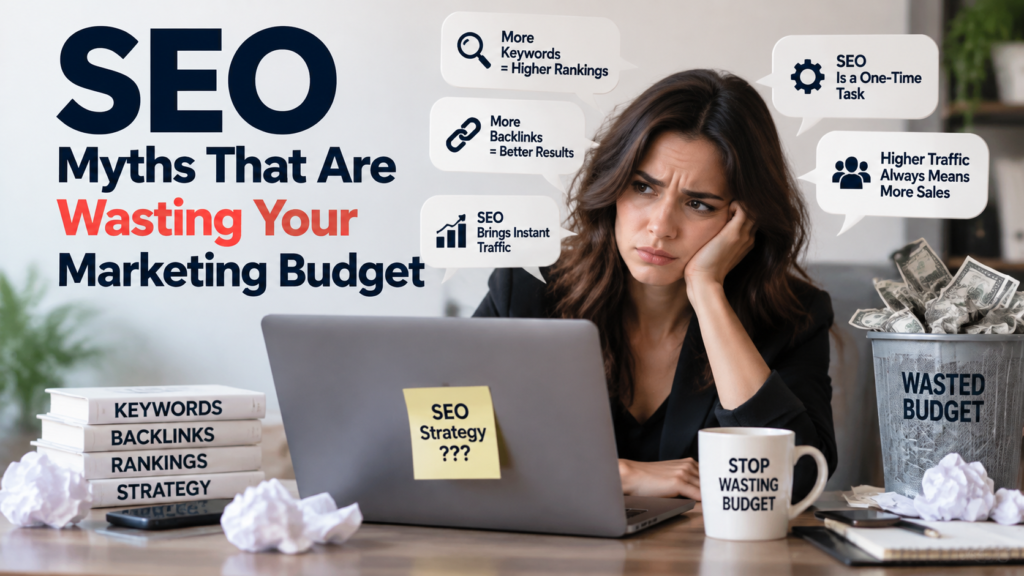
Why SEO Myths Persist for So Long
Search engines rarely publish their exact ranking algorithms, which leaves a vacuum that speculation, outdated case studies, and confident-sounding blog posts happily fill. Many SEO myths started as reasonable theories based on limited data, then spread through the industry faster than anyone could correct them. Others were once true but never got updated as algorithms evolved, leaving businesses optimizing for signals that stopped mattering years ago.
The financial cost of these SEO myths is easy to underestimate. Every hour spent chasing a tactic that does not move the needle is an hour not spent on something that would. Every dollar spent on a service built around outdated assumptions is a dollar that could have funded content, technical fixes, or campaigns that actually drive results.
Myth 1: Keyword Density Is a Ranking Factor
One of the oldest SEO myths is the idea that stuffing a target keyword into your content a specific number of times will boost your rankings. This belief dates back to an earlier era of search engines that relied heavily on simple keyword matching, long before modern algorithms could understand context, synonyms, and search intent.
Today, search engines evaluate content based on relevance, and depth. In addition, how well it satisfies what a searcher is actually looking for, not on hitting an arbitrary keyword percentage. Content that repeats a phrase unnaturally to chase a density target often reads poorly and can actually hurt engagement metrics, which matter far more than keyword frequency ever did. Businesses still investing time in keyword density calculators are spending effort on one of the most outdated SEO myths in the entire industry.
Myth 2: More Backlinks Always Means Better Rankings
Backlinks still matter, but the myth that link quantity alone drives rankings has cost businesses enormous amounts of money on low-quality link-building services. Purchasing hundreds of links from irrelevant, low-authority, or spammy websites does not reliably improve rankings, and in many cases it actively increases the risk of a search engine penalty.
Modern search algorithms are far more sophisticated at evaluating link quality, relevance, and the authenticity of the linking site than they were when this idea first took hold. A handful of links from genuinely authoritative, topically relevant sources will typically outperform hundreds of links from low-quality directories or link farms. Continuing to believe this particular myth leads many businesses to waste budget on link packages that provide little real value and carry real downside risk.
Myth 3: Meta Keywords Still Matter
Despite being publicly confirmed as irrelevant to rankings by major search engines years ago, the meta keywords tag remains one of the more stubborn SEO myths still floating around in outdated guides and templates. Some agencies still bill clients for meticulously crafted meta keyword tags that search engines simply ignore entirely.
If you are paying for a service that emphasizes meta keyword optimization as a core deliverable, that budget is being spent on something with essentially zero impact on your actual search visibility. Time would be far better spent on meta descriptions, which do influence click-through rates even though they are not a direct ranking factor, or on the actual content quality that modern algorithms do evaluate.
Myth 4: SEO Delivers Instant Results
Among the most damaging SEO myths for marketing budgets is the expectation that organic search improvements should happen within days or a few short weeks. This misunderstanding leads to two costly mistakes: abandoning genuinely effective strategies too early because results have not appeared yet, or falling for services that promise unrealistic speed and often rely on risky, penalty-prone shortcuts to deliver something quickly.
Search engines need time to crawl, index, and evaluate new or updated content, and rankings typically shift gradually rather than overnight, especially for competitive terms. Businesses that understand this timeline invest patiently in sustainable strategies. Businesses that believe this particular myth among common SEO myths often churn through agencies every few months, paying setup and onboarding costs repeatedly without ever giving any single strategy the time it needs to actually work.
Myth 5: More Content Is Always Better
The idea that publishing content constantly, regardless of quality or relevance, will automatically improve rankings is one of the more expensive SEO myths in terms of wasted production budget. Some businesses pump out dozens of low-value, thin articles each month, assuming volume alone will move the needle.
In reality, search engines increasingly reward content depth, expertise, and genuine usefulness over sheer quantity. A smaller number of thorough, well-researched pieces that fully address a topic will typically outperform a large volume of shallow content covering the same ground. Businesses that abandon this myth among common SEO myths often find they can cut their content production budget significantly while actually improving results, simply by redirecting resources toward fewer, better pieces.
Myth 6: Social Media Signals Directly Boost Rankings
It is widely believed that likes, shares, and social media engagement directly influence search rankings. While social signals can indirectly help by increasing content visibility and the likelihood of earning genuine backlinks, there is little solid evidence that search engines use raw social engagement numbers as a direct ranking factor.
Businesses that pour disproportionate budget into social media specifically for SEO benefit, rather than for its own legitimate marketing value, are chasing one of the more persistent SEO myths in the industry. Social media remains valuable for brand building, audience engagement, and driving referral traffic, but treating it as a primary lever for search rankings misallocates budget that could go toward more directly impactful search optimization work.
Myth 7: Mobile Optimization Is Optional
Some businesses still treat mobile responsiveness as a nice-to-have rather than a necessity, which has become an increasingly costly assumption. Search engines now largely evaluate the mobile version of a site for ranking purposes, meaning a poor mobile experience directly and significantly affects visibility, not just user satisfaction.
Believing that mobile optimization is optional is one of the more consequential SEO myths, because it does not just waste budget on the wrong priorities and it actively suppresses rankings and conversions for a large and growing share of total search traffic, which increasingly comes from mobile devices across nearly every industry.
Myth 8: You Only Need to Optimize Once
A particularly costly assumption is that SEO is a one-time project rather than an ongoing effort. Once a site is optimized, some businesses assume the work is essentially finished and shift their entire budget elsewhere. This is one of the more financially damaging SEO myths, since competitors continue optimizing, algorithms continue evolving, and content that was once fresh and comprehensive gradually becomes outdated relative to what is currently ranking well.
Sites that stop investing after an initial optimization push often see their rankings slowly decline over the following months and years, eventually requiring a much larger investment to recover lost ground than would have been needed to simply maintain steady, ongoing effort in the first place.
Myth 9: Paid Ads Improve Organic Rankings
Some businesses believe that running paid search campaigns gives their organic listings a ranking boost, assuming search engines reward advertisers with better free placement. There is no credible evidence supporting this connection, and search engines have been explicit that these two systems operate independently of each other.
Believing this particular myth can lead businesses to over-invest in paid campaigns under the mistaken assumption that the spending carries a dual benefit. While paid and organic search can complement each other strategically for example, by revealing which keywords convert well and the budgets and mechanics behind each are fundamentally separate.
Myth 10: Exact-Match Domains Guarantee Rankings
Years ago, owning a domain name that exactly matched a target keyword provided a meaningful ranking advantage, leading to an entire industry built around acquiring and flipping such domains. Search engines have since significantly reduced the weight given to this signal, specifically to combat low-quality sites built purely to exploit it.
Businesses still paying premium prices for exact-match domains, believing this will meaningfully boost rankings, are investing in one of the more outdated misconceptions, when that same budget would almost always deliver better returns invested in content quality, technical performance, or a legitimate link-building strategy.
How to Identify SEO Myths Before They Cost You
Given how persistent these misconceptions are, it helps to have a practical filter for evaluating new advice before committing budget to it.
Check the source and date. Advice from several years ago may have been accurate at the time but outdated by subsequent algorithm changes. Always check when a piece of SEO advice was published and whether it has been updated since.
Be skeptical of guaranteed results. Legitimate SEO work cannot guarantee specific rankings, since search engines control that outcome and factor in signals no outside party fully controls. Any service guaranteeing a specific ranking position is very likely relying on outdated tactics or false assumptions to make that promise sound plausible.
Look for alignment with official guidance. Major search engines publish official guidelines and periodically clarify what does and does not influence rankings. Advice that directly contradicts this official guidance should be treated with significant skepticism.
Ask for the reasoning, not just the tactic. A credible SEO recommendation should come with a clear explanation of why it works and how it aligns with how modern search engines actually evaluate content. Vague explanations or reasoning based purely on anecdote are a warning sign that you may be dealing with recycled misconceptions rather than current best practice.
Myth 11: Duplicate Content Automatically Triggers a Penalty
Many businesses live in fear of a “duplicate content penalty,” avoiding legitimate practices like syndicating content to other sites or using standard product descriptions across similar pages, out of concern it will tank their rankings. In most cases, there is no direct penalty specifically for duplicate content. Instead, search engines simply choose which version of similar content to show in results, which can dilute visibility but is a very different problem from an outright penalty.
This misunderstanding leads some businesses to spend unnecessary budget rewriting perfectly reasonable content variations, or avoiding beneficial syndication opportunities entirely. Understanding the real mechanism and consolidation rather than punishment that allows for smarter decisions about when duplication is actually a problem worth solving and when it is a non-issue not worth the spend.
Myth 12: Longer Content Always Outranks Shorter Content
Because some studies have shown a correlation between longer content and higher rankings, many businesses now assume length itself is a ranking factor, leading to bloated articles padded with unnecessary sections simply to hit a word count target. In reality, length is usually a byproduct of thoroughness on complex topics, not a cause of good rankings on its own.
A concise, well-structured page that fully and efficiently answers a simple question can outperform a padded five-thousand-word article on the same topic. Budget spent artificially inflating word counts, rather than matching content depth to what the topic and searcher intent actually require, is often better redirected toward more precise, genuinely useful writing.
Myth 13: Local SEO Doesn’t Require Ongoing Investment
Businesses with a physical location sometimes assume that once their business listing is set up, local search visibility takes care of itself. In reality, local search rankings are influenced by ongoing factors including review volume and recency, listing consistency across directories, and regularly updated local content, all of which require continued attention rather than a one-time setup.
Treating local search presence as a “set and forget” task, rather than an ongoing part of the marketing budget, causes many local businesses to gradually lose visibility to competitors who continue actively managing their listings, responding to reviews, and publishing locally relevant content.
How to Measure Whether Your SEO Investment Is Actually Working
Once you have redirected budget away from outdated tactics, it becomes important to track whether the new approach is genuinely delivering results, rather than simply assuming better practices automatically translate into better outcomes.
Organic traffic trends over time give a broad view of whether visibility is improving, though this metric should be viewed over months rather than days, given how gradually search rankings typically shift. Keyword ranking movement for terms directly tied to your business goals offers a more targeted view than overall traffic alone, especially when tracked for a consistent set of priority terms rather than every keyword a site happens to rank for. Conversion rate from organic traffic matters just as much as raw visitor counts, since an increase in traffic that does not convert provides limited business value. Technical health metrics, such as page speed, crawl errors, and mobile usability scores, offer leading indicators that often predict future ranking changes before they show up in traffic numbers.
Reviewing these metrics on a consistent schedule, rather than only when something appears to be going wrong, makes it much easier to catch problems early and to demonstrate the value of budget that has been redirected away from outdated tactics toward genuinely effective work.
Where Your SEO Budget Is Actually Better Spent
Once you stop funding these misconceptions, redirecting that budget toward genuinely effective work tends to produce far better returns.
Content depth and quality. Investing in fewer, more comprehensive pieces that genuinely address what searchers are looking for consistently outperforms high-volume, low-depth content strategies built around outdated assumptions.
Technical site health. Site speed, mobile usability, clean site structure, and crawlability all have a demonstrable, well-documented impact on search performance, unlike many of the more speculative tactics still being sold as essential.
Genuine link earning. Rather than purchasing bulk links, investing in content and outreach that naturally earns links from relevant, authoritative sources produces more durable, lower-risk results.
User experience improvements. Since search engines increasingly evaluate how users actually interact with a page, investing in genuine usability improvements tends to support both rankings and conversions simultaneously.
Ongoing measurement and iteration. Rather than treating SEO as a one-time project, allocating consistent, ongoing budget toward monitoring performance and adjusting strategy keeps a site competitive as both algorithms and competitors continue to evolve.
A Quick Checklist for Auditing Your Current SEO Spend
Running through this checklist regularly helps ensure your marketing budget is funding current best practices rather than outdated misconceptions that quietly drain resources without producing meaningful results.
Frequently Asked Questions
How can I tell if my current SEO agency is relying on outdated tactics? Ask them to explain the reasoning behind specific recommendations. How those recommendations align with current, publicly available search engine guidance. Vague answers or promises of guaranteed rankings are red flags.
Is it ever too late to correct a strategy built on SEO myths? No. While recovering from wasted budget and lost time is frustrating, shifting toward legitimate, sustainable practices almost always produces meaningful improvement, even if a site has been misallocating resources for years.
Are all of these myths equally damaging? No. Some, like exact-match domain obsession, mostly waste money on overpriced assets. Others, like mobile optimization neglect, actively suppress visibility and conversions, making them considerably more costly in practice.
How often do SEO best practices actually change? Search engines update their algorithms frequently, though major shifts significant enough to require strategy changes happen less often. Staying informed through official channels, rather than relying on static advice from years ago, is the best way to keep pace.
Final Thoughts
Believing in outdated or false SEO myths costs businesses real money, not just in wasted direct spend, but in the opportunity cost of not investing that same budget in strategies that actually work. The businesses that consistently outperform their competitors in organic search are rarely the ones chasing the newest trick or the oldest recycled tactic, they are the ones grounding their strategy in genuine content quality, technical health, and a realistic understanding of how modern search actually evaluates a site.
Auditing your current SEO spend against the misconceptions covered in this article is one of the fastest ways to identify where your marketing budget is being wasted, and where it could be doing far more for your business instead.
Take an hour this week to walk through every SEO-related line item in your current budget and ask, honestly, whether it is grounded in current best practice or in advice that never should have outlived the algorithm era it came from. That single audit often uncovers more immediate savings, and more obvious opportunities for reinvestment, than any new tactic you could add on top of an already flawed strategy.
If you want a clear, honest assessment of whether your current strategy is built on outdated tactics or genuinely effective practices, KM Marketers offers professional SEO auditing and strategy support designed to help businesses stop wasting budget on SEO myths and start investing in what actually moves rankings, traffic, and revenue. Learn more at KM Marketers.
Your Trusted Marketing Partner!
KM Marketers is a digital marketing solutions provider helping businesses grow through SEO, social media, content marketing, and paid advertising. Our focus is on delivering measurable results, building strong online visibility, and driving quality leads for clients across different industries.
Email: info@kmassignmentservices.com
kmdigitalmarketing2025@gmail.com
WhatsApp: +60 16-522 4321
Head Office: Galleria Cyberjaya, Parking lot, Jalan Teknokrat 6, Cyber 5, 63000 Cyberjaya, Selangor, Malaysia.
Hours: Mon–Sat 10:00 AM to 07:00 PM
© 2026 KM Marketers. Powered by KM Software Services Sdn. Bhd. (1308207-U). All Rights Reserved.