
Publishing content can bring visitors to a website, but traffic alone does not automatically make a business trusted. A company can publish dozens of articles, target hundreds of keywords, and still struggle to become a recognized source in its industry. The difference often comes down to whether the content consistently helps the right audience understand problems, make decisions, and see the business as a credible source of expertise.
This is where SEO-Optimized Content becomes valuable.
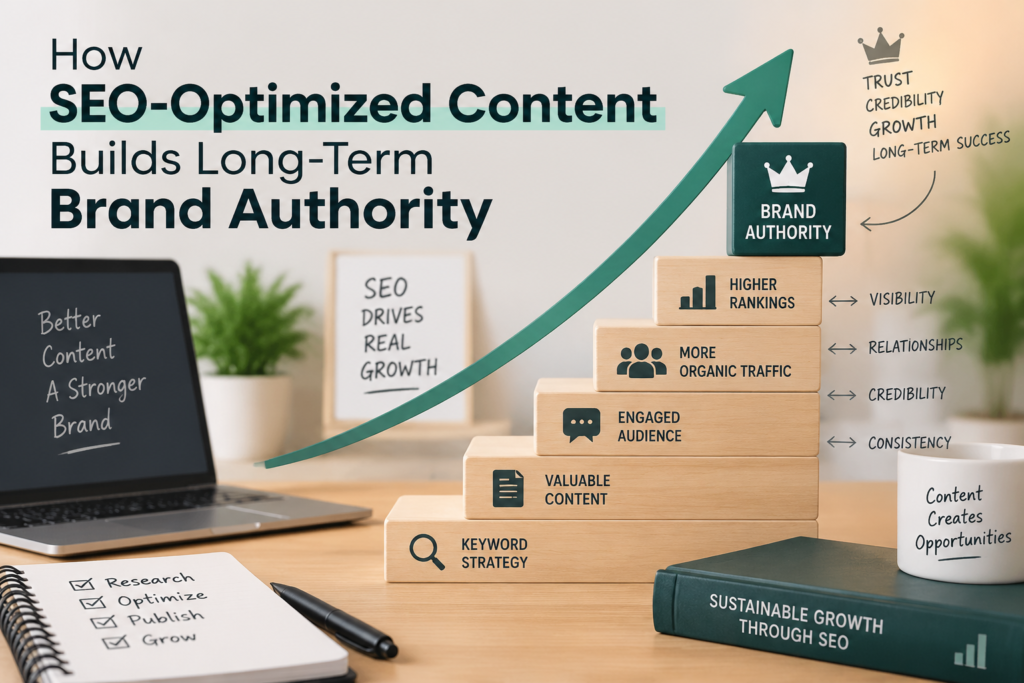
Good SEO content is not simply an article with a keyword inserted several times. It combines search intent, useful information, clear structure, credible evidence, internal linking, technical accessibility, and a genuine understanding of what the audience needs.
Google’s current guidance on creating helpful, reliable, people-first content specifically recommends creating information primarily for people rather than producing pages mainly to manipulate search rankings. Google also encourages original information, substantial coverage, clear sourcing, expertise, and content that leaves readers feeling they have learned enough to achieve their goal.
When businesses follow that principle consistently, SEO-Optimized Content can do more than attract search traffic. It can strengthen brand recognition, demonstrate expertise, earn links and mentions, support the sales journey, and build an archive of useful information that continues working long after publication.
This guide explains how that process works and why content should be treated as a long-term business asset rather than a short-term ranking tactic.
Brand authority is the degree to which people recognize and trust a company as a knowledgeable source within a specific area.
It does not come from calling yourself “the leading expert.”
It develops when customers repeatedly encounter useful information from the business.
Imagine two software companies.
Company A has a website containing a homepage, five service pages, and a contact form.
Company B has the same core pages but also publishes detailed guides explaining implementation problems, product comparisons, security considerations, industry changes, customer questions, and practical decision-making advice.
Over time, potential customers may encounter Company B repeatedly while researching their problems.
They read one article today.
A comparison guide next month.
A checklist several weeks later.
Eventually, when they need a provider, the company is already familiar.
That is one way SEO-Optimized Content helps build authority. It creates repeated useful contact before a direct sales conversation begins.
Expertise has limited marketing value if nobody can find it.
A company may have twenty years of industry experience, but if its website does not explain that knowledge in ways customers search for, much of that expertise remains invisible online.
Google’s current SEO Starter Guide describes SEO as helping search engines understand content and helping users find a site and decide whether they should visit it.
This is an important distinction.
SEO is not only about ranking a page.
It is also about connecting the business’s knowledge with the questions potential customers are already asking.
Suppose an HR consultancy provides employee-retention services.
Potential customers may search for:
Why are employees leaving our company?
How do we reduce employee turnover?
What causes poor employee engagement?
How do employee retention strategies work?
A useful article answering one of those questions creates a discovery opportunity.
The visitor may not be ready to hire an HR consultancy that day.
But they now know the company exists.
Consistent SEO-Optimized Content expands the number of relevant situations in which customers can discover the brand.
Keyword research should not stop at finding phrases with search volume.
Businesses also need to understand why someone is searching.
Consider these queries:
“What is CRM software?”
“Best CRM for small construction companies.”
“Salesforce vs HubSpot for a 20-person company.”
“CRM implementation consultant near me.”
All four relate to CRM, but the searcher’s situation is very different.
The first is learning.
The second is comparing solutions.
The third is evaluating specific products.
The fourth is much closer to purchasing professional help.
Strong SEO-Optimized Content recognizes those differences.
An educational search should receive a useful explanation.
A comparison search needs clear differences, trade-offs, and decision criteria.
A high-intent commercial search may need service details, evidence, FAQs, pricing context, and an obvious next step.
When content accurately matches intent, visitors are more likely to stay, read, trust the information, and continue exploring the website.
That behaviour is valuable even before the visitor becomes a lead.
For businesses that need help aligning keyword strategy with content and wider organic visibility, KM Marketers SEO Services focuses on keyword research, on-page optimization, link building, technical SEO, and long-term search growth.
Brand authority is difficult to build with shallow information.
Consider a cybersecurity company publishing an article called:
“10 Ways to Protect Your Business Online.”
If every point contains only one generic sentence such as “use strong passwords” and “install antivirus,” the article provides little evidence that the company has deep expertise.
Now compare that with a guide explaining administrative access, multi-factor authentication, employee permissions, backups, phishing, web application security, incident response, and practical implementation steps.
The second article gives readers more reason to trust the company.
Google’s people-first content guidance encourages creators to ask whether content provides original information or analysis, gives substantial coverage, demonstrates first-hand expertise where relevant, and provides greater value than simply rewriting existing sources.
This should be central to SEO-Optimized Content.
Do not only ask:
“What keyword can we rank for?”
Also ask:
“What can our company contribute that makes this genuinely worth reading?”
The answer may come from experience, examples, proprietary data, technical knowledge, customer questions, internal research, or a clearer explanation than competitors provide.
One excellent article can generate traffic.
Authority usually requires more than one.
A business becomes more recognizable when it repeatedly publishes strong material around a defined area.
A digital agency might create content around:
SEO.
Content strategy.
Paid advertising.
Social media.
Conversion optimization.
Website design.
Analytics.
These topics support one another and reinforce what the company wants to be known for.
A random article about cryptocurrency prices would make less strategic sense unless cryptocurrency marketing was genuinely part of the agency’s expertise.
Google’s guidance asks publishers whether their site has a clear primary purpose or focus and warns against producing large amounts of content on unrelated subjects simply in the hope that some of it attracts search traffic.
Long-term SEO-Optimized Content should therefore build depth around a company’s real areas of knowledge.
The more high-quality resources a brand creates around those areas, the easier it becomes for customers to associate the company with that subject.
A company website may have only five service pages.
That means there are relatively few search entry points.
A well-planned content library can create dozens or hundreds of additional opportunities.
Imagine a web-development agency.
Its main service page may target people already looking for web development.
But potential customers may also search:
How much does a business website cost?
Static vs dynamic website.
How often should a website be maintained?
Shared vs VPS hosting.
Why is my website slow?
How do payment gateways work?
How long does website development take?
Each useful article introduces the business during a different stage of research.
That is one of the major long-term benefits of SEO-Optimized Content.
Instead of depending on one service page to attract every type of customer, the website develops a network of pages covering the questions customers ask before they are ready to buy.
Some articles may generate direct leads.
Others may support brand awareness.
Others help customers compare options.
Together, they create a much broader search presence.
SEO discussions frequently mention E-E-A-T: experience, expertise, authoritativeness, and trustworthiness.
It is important to describe this accurately.
Google explicitly states that E-E-A-T itself is not a single specific ranking factor. Instead, its systems use multiple signals to identify content displaying qualities associated with useful and trustworthy information. Google also says trust is the most important aspect within the E-E-A-T concept.
Businesses should therefore avoid treating E-E-A-T as a checklist where adding an author biography automatically improves rankings.
A better approach is to make genuine credibility visible.
Show who created the article.
Explain relevant experience.
Cite trustworthy sources.
Correct factual errors.
Include original examples.
Be transparent about the business.
Update genuinely outdated material.
Link to useful evidence.
This makes SEO-Optimized Content more convincing to readers while aligning with the broader quality principles Google describes.
Authority is strongest when it is demonstrated rather than claimed.
Readers often want to know who is giving them advice.
This matters especially for technical, legal, financial, medical, and other subjects where poor information can have serious consequences.
Google recommends making authorship clear where readers would reasonably expect it and suggests using bylines that lead to additional background about the author.
For a business blog, that might mean including:
The writer’s name.
Professional role.
Relevant experience.
Area of specialization.
A short biography.
Links to appropriate professional profiles.
This does not mean every article needs a long biography.
The goal is transparency.
If SEO-Optimized Content contains specialist advice, the reader should be able to understand why the source is credible.
Anonymous generic publishing may make that harder.
Internal links help people move from one useful resource to another.
Suppose someone reads an article about technical SEO.
The article might naturally link to resources about:
Website speed.
Mobile usability.
Structured data.
Content optimization.
SEO audits.
A relevant service page.
Those links help visitors continue learning without returning to Google after every question.
Google’s Search Essentials also recommends using crawlable links so Google can discover other pages on a website.
This makes internal linking an important part of SEO-Optimized Content.
Do not add links randomly.
Use them where they genuinely help the reader continue the topic.
A strong content library begins to function like a connected knowledge base rather than a collection of isolated blog posts.
That can also help important commercial pages receive contextual internal links from relevant educational content.
Some businesses avoid external links because they worry about sending visitors away from their website.
That can be a mistake.
When a claim depends on official information, research, data, or industry guidance, linking to the original source can make the article more credible.
For example, an SEO article discussing Google’s policies should ideally reference Google Search Central rather than relying entirely on another marketing blog’s interpretation.
A cybersecurity article may link to OWASP or NIST.
A payments article may link to PCI SSC.
A social advertising article may link directly to LinkedIn, Meta, or TikTok documentation.
High-quality SEO-Optimized Content should help readers verify important claims.
External links are not a weakness when they support the user’s understanding.
The goal is to become a reliable guide, not pretend the company is the only source of information on the internet.
Backlinks are difficult to earn when the content provides nothing worth referencing.
A generic article that repeats the same ten ideas found across hundreds of websites gives people little reason to link to it.
More distinctive content creates better opportunities.
Examples include:
Original research.
Industry statistics.
Detailed tutorials.
Unique data.
Templates.
Calculators.
Case studies.
Original frameworks.
Expert interviews.
Useful comparison tables.
Comprehensive reference guides.
When SEO-Optimized Content provides something genuinely useful, journalists, bloggers, companies, educators, or industry websites may choose to reference it.
Those links can introduce new audiences as well as support search visibility.
This is why link building and content strategy should not always be treated as separate activities.
Content can give outreach campaigns something worth promoting.
KM Marketers describes its SEO approach as combining keyword research, content, ethical link building, and broader digital strategy to support sustainable search growth.
Longer content is not automatically better.
Google explicitly says it does not have a preferred word count and warns publishers against writing to a particular length simply because they believe search engines prefer it.
That is important.
A 700-word answer can be better than a 3,000-word article when the question is simple.
However, some topics genuinely require depth.
A guide explaining e-commerce development may need to cover platforms, payments, security, mobile usability, SEO, shipping, integrations, analytics, and maintenance.
Trying to compress that into five paragraphs may leave readers with more questions than answers.
The correct length for SEO-Optimized Content is therefore the length required to solve the searcher’s problem properly.
Do not add paragraphs merely to make the article longer.
Do not remove useful explanations simply to keep the page short.
Depth should come from usefulness.
SEO content is sometimes treated purely as a traffic channel.
That overlooks its role in sales.
Imagine a business considering a digital marketing agency.
The customer may first read an article about declining organic traffic.
Later, they find another guide comparing SEO and paid advertising.
They then read a case study.
Finally, they visit the agency’s SEO service page and request a consultation.
Which page created the sale?
The answer may be all of them.
Good SEO-Optimized Content reduces the amount of education the sales team needs to provide manually.
Potential customers can understand terminology, evaluate options, identify problems, and learn about solutions before speaking with the business.
That can produce better-informed sales conversations.
This is particularly valuable for services where the customer journey is longer than one website visit.
Businesses that need ongoing blogs, website copy, social content, and other material can explore KM Marketers Content Creation Services.
Every industry has recurring questions.
A legal consultancy may repeatedly answer questions about contracts.
A software company may answer implementation questions.
A property company may explain mortgages, buying processes, and locations.
A logistics provider may answer customs and shipping questions.
When a company publishes the strongest resources around those recurring topics, it becomes increasingly associated with the answers.
That is a powerful form of brand authority.
The business is no longer visible only when somebody searches for its company name.
It becomes visible when people search for the problems it solves.
Strategic SEO-Optimized Content should therefore begin with customer questions.
Ask sales teams what prospects repeatedly ask.
Review customer-service conversations.
Study Search Console queries.
Look at sales objections.
Review website search data.
Speak with customers.
Those sources often reveal much better content opportunities than simply copying topics competitors already publish.
Social posts normally have a short visibility cycle.
Paid advertisements stop when the budget stops.
A strong search article can continue attracting readers long after publication.
That does not mean every article will rank forever.
Search behaviour changes.
Competitors publish better resources.
Products change.
Facts become outdated.
Google’s systems evolve.
But useful evergreen content can continue contributing for years when it remains relevant and properly maintained.
That makes SEO-Optimized Content different from many short-term marketing activities.
The business is gradually building an owned library.
An article published today may generate:
Search traffic this month.
Newsletter sign-ups next quarter.
Backlinks next year.
Sales support two years later.
Content becomes an asset when it continues doing useful work after the original production cost has already been paid.
Publishing new articles is not the only way to strengthen authority.
Existing content should also be reviewed.
A page may contain outdated statistics.
Screenshots may no longer match the software.
Links can break.
Regulations may change.
Product names may change.
A searcher’s expectations may become different.
Updating SEO-Optimized Content can preserve its usefulness.
But updates should be real.
Google specifically warns against changing publication dates merely to make old content appear fresh when the information has not been substantially updated.
Review important pages periodically and ask:
Is the advice still correct?
Are the sources current?
Does the article answer the question completely?
Are examples outdated?
Are there new internal resources worth linking?
Can confusing sections be improved?
Does the call to action still make sense?
Content maintenance should improve the reader’s experience, not just change the date displayed at the top.
Content strategy should improve as the website collects data.
Google Search Console helps website owners understand how their pages perform in Google Search, including queries, impressions, clicks, indexing issues, and other search information. Google recommends Search Console as one of its main tools for monitoring search performance.
This makes it valuable for improving SEO-Optimized Content.
Suppose an article receives impressions for a useful question that the page only answers briefly.
That may indicate an opportunity to expand the relevant section.
Another page may rank well but receive few clicks.
Its title or search appearance may need review.
A third article may attract significant traffic but send almost nobody toward another part of the website.
Internal links or next steps may be weak.
Data helps turn content from a publishing exercise into a continuous learning system.
Search is changing as AI-generated experiences become more visible.
The answer is not to create thousands of near-identical pages designed around every possible wording of a query.
Google’s current guidance for generative AI features in Search emphasizes unique, useful, non-commodity content. Google advises publishers to provide a distinctive perspective, first-hand expertise where appropriate, and information that goes beyond material that could easily be reproduced from existing sources or generated generically.
Google also warns against creating large numbers of pages around query variations mainly to manipulate rankings or AI search visibility.
This strengthens the long-term case for high-quality SEO-Optimized Content.
The objective should not be to produce more words than everyone else.
The objective should be to contribute something useful enough that both people and search systems can understand why the page deserves attention.
Experience, original analysis, unique examples, proprietary knowledge, good explanations, and trustworthy sourcing become increasingly valuable in a world where generic information is easy to produce.
Keywords still help communicate topic relevance.
Google’s Search Essentials recommends using words people would use to search for the content and placing them in useful locations such as page titles, main headings, alt text, and descriptive link text.
That does not mean repeating one phrase in every paragraph.
Keyword stuffing makes content uncomfortable to read and can make the writing feel artificial.
A better SEO-Optimized Content strategy uses the primary topic naturally while also covering related concepts and questions.
For an article about content marketing, relevant language may naturally include:
Search intent.
Organic traffic.
Audience research.
Keyword research.
Content strategy.
Authority.
Backlinks.
Search visibility.
Internal linking.
Conversions.
These terms help create a complete discussion without forcing the exact same phrase repeatedly.
Write for comprehension first.
Optimization should make good content easier to discover, not make good writing harder to read.
Publishing more pages is not automatically a growth strategy.
Google’s spam policies prohibit scaled content abuse when large amounts of pages are generated primarily to manipulate rankings rather than help users. This can include content created through automation, human writers, or combinations of both when the purpose is search manipulation rather than genuine value.
That distinction matters as AI makes production easier.
Using AI tools during research, brainstorming, drafting, or editing is not automatically a problem. Google has separately stated that not all automated or AI-assisted content is spam. The key issue is whether the resulting material is useful, original, reliable, and created primarily to help people rather than manipulate rankings.
For businesses investing in SEO-Optimized Content, quality control becomes more important as publishing becomes easier.
Ask whether every page deserves to exist.
If the answer is no, producing it probably does not strengthen the brand.
An excellent article can still frustrate readers if the page itself is difficult to use.
Large popups.
Slow loading.
Poor mobile formatting.
Aggressive advertising.
Confusing navigation.
Tiny text.
Broken layouts.
These issues reduce the value of the content.
Google’s guidance on people-first content specifically encourages providing a good overall page experience, while its developer SEO guidance recommends secure, fast, accessible websites that work across devices.
This means SEO-Optimized Content should not be separated from website quality.
The article, design, hosting, technical SEO, mobile usability, navigation, and conversion journey work together.
The reader should be able to find the answer without fighting the website.
The process can be summarized like this:
Stage | What the Content Does | Brand Benefit |
Discovery | Appears for relevant searches | Introduces the brand |
Education | Answers customer questions | Demonstrates knowledge |
Trust | Provides evidence and credible sourcing | Reduces uncertainty |
Exploration | Links to related resources | Deepens brand interaction |
Consideration | Explains solutions and comparisons | Supports buying decisions |
Conversion | Connects readers with relevant services | Generates enquiries |
Retention | Continues helping customers after purchase | Strengthens loyalty |
Authority | Builds a growing library of useful resources | Positions the brand as a trusted source |
Authority does not appear after publishing three articles.
It compounds as quality information accumulates.
One common mistake is writing only for keywords.
Another is producing generic articles that add nothing beyond what already ranks.
Businesses also target topics unrelated to their expertise because the search volume looks attractive.
Some publish dozens of articles but never create internal links between them.
Others include no credible sources.
Another mistake is creating only informational content without connecting any of it to the company’s actual products or services.
Some businesses stop publishing after a few months because they do not see immediate sales.
Others never update content after publication.
Another problem is assuming longer automatically means better.
And increasingly, companies may be tempted to use automation to publish hundreds of thin pages without meaningful editorial review.
All of these approaches can weaken the value of SEO-Optimized Content.
A smaller library of genuinely useful pages can be more valuable than thousands of pages nobody trusts.
Start by defining what your brand wants to be known for.
Choose three to five main topic areas closely connected to your services.
For each area, identify the questions customers ask during awareness, consideration, and purchase.
Create a small number of strong pillar resources around the major topics.
Then create supporting articles answering narrower questions.
Link them logically.
Add trustworthy external references where appropriate.
Make authorship clear.
Include real examples and experience.
Connect relevant articles to service pages without turning every paragraph into a sales pitch.
Use Search Console and analytics to understand which content gets discovered and what readers do next.
Update important resources when information changes.
Promote useful content through social media, newsletters, communities, and outreach.
Over time, this creates a connected body of SEO-Optimized Content that reflects the company’s real expertise.
Search visibility and brand authority should not be treated as separate goals.
The strongest content strategies help achieve both.
SEO allows the right people to discover the business.
Useful content gives them a reason to stay.
Expertise gives them a reason to trust.
Consistency gives them a reason to remember the brand.
Internal linking encourages further exploration.
Credible external sourcing strengthens confidence.
Original insight gives others something worth referencing.
And a growing library of high-quality resources creates value long after individual articles are published.
That is the long-term strength of SEO-Optimized Content.
The goal is not to publish as many articles as possible.
It is to build the most useful body of information your business can realistically maintain around the subjects it genuinely understands.
When customers repeatedly encounter that expertise through search, the company stops being just another result.
It starts becoming a source they recognize.
If your business needs a stronger organic content strategy, KM Marketers provides SEO, content creation, web development, social media, and broader digital marketing support. Its SEO Services focus on sustainable organic visibility through keyword research, on-page optimization, technical SEO, content, and ethical link-building, while KM Marketers Content Creation Services support blogs, website content, social material, and conversion-focused copy. KM Marketers describes quality, SEO-focused content as an important part of strengthening brand credibility, visibility, and long-term digital growth.
Your Trusted Marketing Partner!
KM Marketers is a digital marketing solutions provider helping businesses grow through SEO, social media, content marketing, and paid advertising. Our focus is on delivering measurable results, building strong online visibility, and driving quality leads for clients across different industries.
Email: info@kmassignmentservices.com
kmdigitalmarketing2025@gmail.com
WhatsApp: +60 16-522 4321
Head Office: Galleria Cyberjaya, Parking lot, Jalan Teknokrat 6, Cyber 5, 63000 Cyberjaya, Selangor, Malaysia.
Hours: Mon–Sat 10:00 AM to 07:00 PM
© 2026 KM Marketers. Powered by KM Software Services Sdn. Bhd. (1308207-U). All Rights Reserved.