
Learn how to rank higher in your city’s search results with this local SEO guide covering Google Business Profile, local keywords, reviews, citations, and proven optimization strategies.
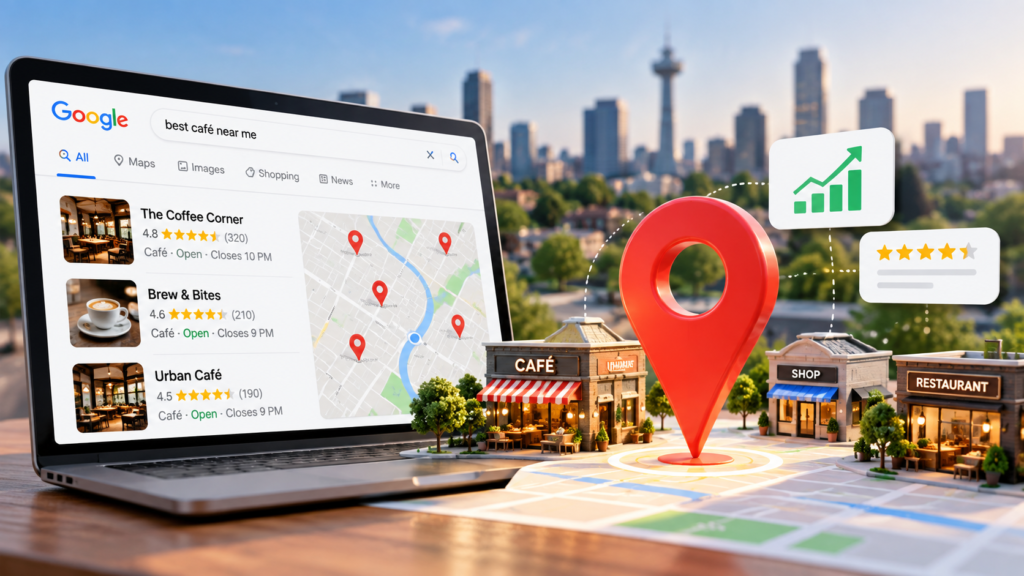
If you run a business that depends on customers walking through your door or picking up the phone, you already know that showing up online in your own city matters more than showing up anywhere else. You do not need to rank number one in the entire country. You need to rank number one when someone types “plumber near me” or “best bakery in [your city]” while standing three streets away from your shop. This is local SEO, and it is one of the most misunderstood parts of digital marketing.
Most business owners have heard the term but assume it is something only large companies with big budgets can figure out. That is not true. Local SEO is actually one of the most accessible forms of marketing because it does not require you to outrank massive national brands. It only requires you to outrank the other businesses in your immediate area, and that is a much smaller, much more winnable race.
Why Local SEO Deserves Its Own Strategy
A lot of business owners lump local SEO in with general SEO and assume the same rules apply. They do not. General SEO is about ranking for broad topics across the entire internet. Local SEO is about ranking for searches tied to a specific location, and Google treats those searches very differently.
When someone searches “coffee shop” without mentioning a city, Google still tries to guess where they are and shows results nearby. This means your business is competing in a completely different arena than a national chain with a massive marketing budget. You are competing with the five other coffee shops within a two kilometer radius, and that is a fight you can actually win.
This is exactly why local SEO deserves its own dedicated plan instead of being treated as an afterthought inside a broader SEO strategy.
The Three Factors Google Actually Uses to Rank You Locally
Before diving into what to do, it helps to understand how Google actually decides who shows up first. Local rankings come down to three main factors: relevance, distance, and prominence.
Relevance is how well your business profile and website match what someone is searching for. If someone searches for a family dentist and your listing clearly identifies you as one, with the right category and services listed, you are more relevant than a generic listing that never mentions dentistry directly.
Distance is fairly self explanatory. Google estimates how far your business is from the person searching, or from the location they typed in. You cannot change where your business physically sits, but you can make sure Google has the correct address so it calculates this accurately.
Prominence is the trickiest of the three, and it is where most of your ongoing local SEO work actually lives. It reflects how well known and well regarded your business is, both online and offline. Reviews, backlinks, press mentions, and overall online presence all feed into prominence. This is the factor you have the most control over, and it is the one that separates businesses that dominate local search from those that stay buried on page two.
Understanding these three factors changes how you think about local SEO. It is not a single checklist item. It is an ongoing effort to be more relevant, appear closer through accurate information, and become more prominent through genuine reputation building.
Start With Your Google Business Profile
If there is one single thing that has the biggest impact on local SEO, it is your Google Business Profile, previously known as Google My Business. This is the listing that shows up on the right side of search results with your address, hours, reviews, and photos, and it is often the very first thing a potential customer sees about you.
Claiming and fully completing this profile is non negotiable. Fill in every section, not just the basics. Add your business category correctly, list your services, upload real photos of your location and your team, and keep your hours updated, especially around holidays. An incomplete profile signals to Google that your business information cannot be fully trusted, and incomplete signals lead to lower rankings.
Once your profile is set up, do not treat it as a one time task. Post updates regularly, respond to questions in the Q&A section, and keep an eye on anything customers might be saying that needs a response.
Keep Your Business Information Consistent Everywhere
This next part sounds small, but it quietly makes or breaks a lot of local SEO efforts. Your business name, address, and phone number, usually shortened to NAP, need to match exactly across every single place they appear online. This includes your website, your Google Business Profile, your Facebook page, directory listings, and any other platform where your business is mentioned.
If your website says Street 12, but your Google listing says St. 12, that small inconsistency confuses Google’s systems. Search engines use these details to confirm your business is real, legitimate, and located where you say it is. When the information does not match, trust drops, and so does your ranking.
Take an afternoon to search your own business name and go through every listing you can find. Fix anything that does not match exactly. It is tedious work, but it is one of the most overlooked reasons businesses fail to rank locally.
Reviews Matter More Than Most Business Owners Realize
Ask any local customer how they choose between two similar businesses nearby, and reviews almost always come up. Google knows this too, which is why review count, review quality, and how recently reviews were left all factor into local rankings.
Do not wait passively for reviews to appear. Ask happy customers directly, right after a positive interaction, when the experience is still fresh. A simple message or a QR code at checkout pointing to your review link can make a noticeable difference over time.
Just as important as collecting reviews is responding to them. Reply to positive reviews with genuine thanks, and respond calmly and professionally to negative ones. This is not just about the one unhappy customer. Every future customer reading your reviews is also watching how you handle criticism, and Google notices ongoing engagement on your profile as a positive signal too.
Build Location Specific Content on Your Website
Many businesses make the mistake of having one generic homepage and expecting it to rank for every city or neighborhood they serve. If you genuinely serve multiple areas, each one deserves its own dedicated page with content written specifically for that location.
Instead of a single vague sentence like “we serve the greater metro area,” create a page for each city or district you operate in, mentioning local landmarks, neighborhoods, and specific details that show you actually understand and serve that area. This is not about stuffing a city name into a paragraph. It is about giving Google, and your visitors, a genuinely useful page tailored to that location.
If you only operate in one location, you do not need multiple pages, but your homepage and key service pages should still clearly and naturally mention your city and surrounding areas throughout the content.
Get Listed in Local Directories
Beyond Google, there are countless local directories and citation sites where your business should appear. These include general directories as well as industry specific ones relevant to your field. Each consistent listing acts as another vote of confidence telling search engines that your business is real and established in that location.
This does not mean signing up for every random directory you can find. Focus on reputable, relevant ones, and make sure the information you submit matches your NAP details exactly, as mentioned earlier. Quality and consistency matter far more than quantity here.
Earn Local Backlinks
Backlinks, meaning other websites linking back to yours, have always mattered for SEO, but local backlinks carry extra weight for local rankings specifically. A link from a well known local news site, a community blog, or a local business association tells Google that your business is genuinely embedded in that community.
Look for opportunities like sponsoring a local event, partnering with nearby businesses for cross promotion, or getting featured in local news for something newsworthy your business is doing. These backlinks are harder to earn than a random directory listing, but they carry significantly more weight because of it.
Study the Businesses Already Ranking Above You
Before you assume you need an entirely new strategy, spend some time actually looking at who currently ranks above you for the searches that matter most to your business. Search the exact terms your customers would use and pay attention to the businesses that consistently appear in the top three local results.
Look at their Google Business Profile. How many reviews do they have, and how recently were the most recent ones left? What categories have they chosen? Are they posting updates regularly? Then look at their website. Do they have dedicated pages for different services or locations? What kind of language do they use?
This is not about copying anyone directly. It is about identifying the gap between where you currently stand and where the businesses ahead of you already are. Sometimes the gap is obvious, like a competitor having three times as many reviews. Other times it is subtler, like a competitor having far more complete and specific information across every listing. Either way, this kind of research gives you a realistic, specific target instead of a vague sense that you should probably be doing more.
Optimize for Mobile and Local Keywords Together
Most local searches happen on a phone, often while someone is already out and about looking for something nearby. If your website is slow to load or difficult to navigate on a mobile screen, you are losing potential customers before they even see what you offer.
At the same time, make sure your website naturally uses the phrases people actually search for. Someone looking for local SEO help is far more likely to type something specific to their situation than a generic term. Weaving in relevant, natural language throughout your headings, page titles, and content helps search engines understand exactly what you offer and where you offer it.
Add Local Business Schema Markup to Your Website
This part sounds technical, and it is, but it is worth understanding even at a basic level. Schema markup is a small piece of code added to your website that explicitly tells search engines what your business is, where it is located, what your hours are, and other structured details, rather than leaving Google to guess by reading your page like a human would.
Adding local business schema markup does not guarantee a ranking boost on its own, but it removes ambiguity. It confirms the same details you have listed elsewhere, reinforcing the consistency Google is already looking for. If you are not comfortable editing website code yourself, this is a task worth handing to a developer or an agency, since even small errors in the markup can cause more confusion than not having it at all.
Do Not Ignore Social Media’s Role in Local Visibility
Social media is not a direct local SEO ranking factor in the same way a Google Business Profile is, but it plays a supporting role that is easy to underestimate. An active, location tagged social media presence reinforces the same signals search engines are already looking for. Tagging your location in posts, engaging with local followers, and keeping your profile information consistent with your other listings all add up.
Social platforms are also often where potential customers go to double check a business before visiting, especially if they found you through a search result and want a second opinion. A neglected or outdated social profile can undo some of the trust your local SEO work has built elsewhere, so treat it as part of the same overall picture rather than a separate task.
Think About Voice Search Too
More people are searching by speaking into their phones or smart speakers than ever before, and voice searches tend to be more conversational than typed ones. Instead of typing “bakery downtown,” someone might ask their phone, “where is a good bakery near me that is open right now.”
This shift matters for local SEO because it rewards businesses whose information is accurate and complete in the exact way voice assistants pull answers, which is usually directly from your Google Business Profile and structured website content. Keeping your hours, services, and location details accurate and specific helps you show up in these more natural, spoken searches, even though you cannot directly optimize for every possible phrasing someone might use.
Track What Is Actually Working
Local SEO is not something you set up once and forget. Rankings shift, competitors adjust their own strategies, and Google updates how it evaluates local signals fairly often. Keep an eye on your Google Business Profile insights to see how people are finding you, what actions they take after finding your listing, and which searches are actually bringing in customers.
If something is not working, whether that is a particular type of content, a directory listing, or your review response strategy, be willing to adjust. Local SEO rewards businesses that stay consistent and pay attention over time far more than those looking for a one time fix.
Common Local SEO Mistakes to Avoid
A few mistakes come up again and again. Businesses create multiple Google Business Profiles for the same location, which confuses search engines and can even get listings suspended. Others use a virtual office address instead of a real physical one, which violates Google’s guidelines and risks the same outcome. Some businesses keyword stuff their business name field, adding things like “Best Plumber in the City” directly into their name, which is against Google’s policies and often backfires with penalties instead of better rankings.
Avoiding these mistakes is often just as important as actively doing the right things. A clean, honest, consistent presence tends to outperform a rushed, shortcut heavy one every time.
A Note for Businesses With Multiple Locations
Everything covered so far applies whether you run one location or several, but businesses with multiple branches face an extra layer of complexity worth addressing directly. Each physical location needs its own individual Google Business Profile, its own accurate address and phone number, and its own dedicated page on your website rather than one shared page trying to represent every branch at once.
It can be tempting to treat your locations as interchangeable, especially if your branding and services are identical across all of them, but Google treats each one as a separate entity tied to a separate place. A customer searching in one city should land on a page built specifically for that city, with that location’s hours, that location’s reviews, and directions that actually make sense for someone standing nearby. Trying to shortcut this with a single generic page usually means none of your locations rank particularly well, because the page cannot fully satisfy the specific intent behind any single search.
Why Local SEO Is a Long Game Worth Playing
None of this happens overnight. Local SEO is built through consistency over weeks and months, not a single weekend project. But unlike paid ads, where visibility disappears the moment you stop paying, the work you put into local SEO keeps compounding. A well optimized Google Business Profile, a steady stream of genuine reviews, and consistent local content continue working for you long after you have set them up.
For small and medium businesses especially, this makes local SEO one of the highest return marketing investments available. You are not competing against the entire internet. You are competing against the businesses down the street, and with the right consistent approach, that is a competition you can win.
Final Thoughts
Ranking in your city’s search results is not about chasing a secret trick or a one time fix. It comes down to the fundamentals done consistently: a complete and active Google Business Profile, consistent business information everywhere you appear, genuine reviews, location specific content, relevant local backlinks, and a mobile friendly website that actually reflects what your customers are searching for.
Get these pieces right, keep at them consistently, and your business stops being invisible in local search results and starts becoming the obvious choice for customers searching nearby.
If you want expert help turning your local presence into consistent, ranked visibility, KM Marketers specializes in building local SEO strategies that actually bring customers through your door. You can learn more or get in touch at [kmmarketers.com](https://kmmarketers.com/).
Useful SEO Resources
Google Search Central: [Best practices for e-commerce sites] (https://developers.google.com/search/docs/specialty/ecommerce) — official guidance on structuring an online store for discoverability in Google Search.
Google Search Central: [Product structured data](https://developers.google.com/search/docs/appearance/structured-data/product-snippet) — required and recommended schema properties for product pages.
Google Merchant Center: [Structured data markup for product data] (https://support.google.com/merchants/answer/7331077) — how structured data connects a store’s website to its Merchant Center feed.
KM Marketers [SEO Services] (https://kmmarketers.com/search-engine-optimization/) — keyword research, technical SEO, and content optimization for growing online visibility.
KM Marketers [Content Creation Services] (https://kmmarketers.com/content-creation/) — SEO-optimized product storytelling, blogs, and buying guides for digital brands.
Your Trusted Marketing Partner!
KM Marketers is a digital marketing solutions provider helping businesses grow through SEO, social media, content marketing, and paid advertising. Our focus is on delivering measurable results, building strong online visibility, and driving quality leads for clients across different industries.
Email: info@kmassignmentservices.com
kmdigitalmarketing2025@gmail.com
WhatsApp: +60 16-522 4321
Head Office: Galleria Cyberjaya, Parking lot, Jalan Teknokrat 6, Cyber 5, 63000 Cyberjaya, Selangor, Malaysia.
Hours: Mon–Sat 10:00 AM to 07:00 PM
© 2026 KM Marketers. Powered by KM Software Services Sdn. Bhd. (1308207-U). All Rights Reserved.