
Retargeting ads are one way that small businesses can reconnect with visitors to their websites, recover missed business, segment audiences, make ads more relevant, and convert more interested visitors into customers.
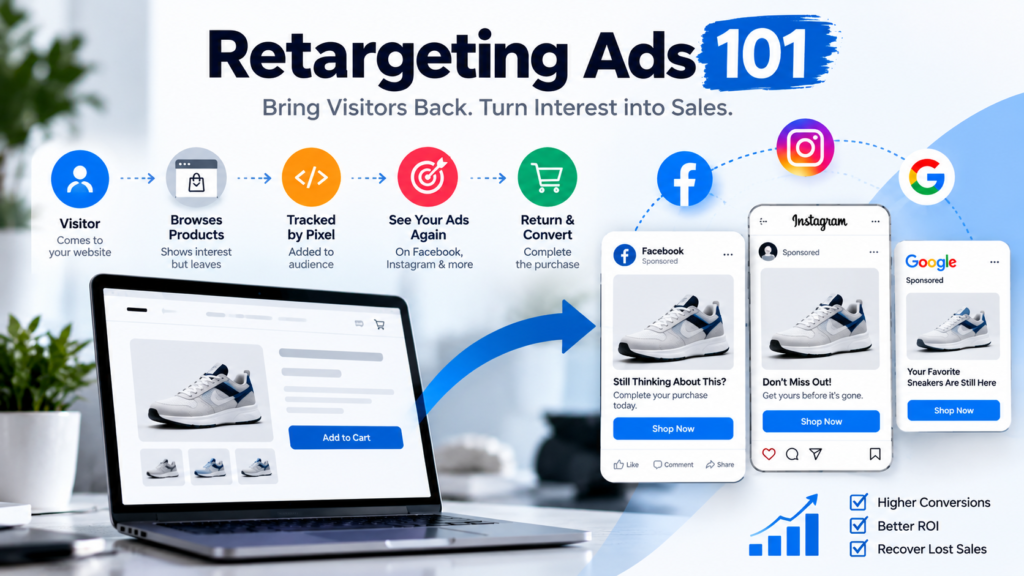
Retargeting Ads 101: Turning Website Visitors Into Buyers
Bringing people to your site is just the start.
A prospective client learns about your company on Google, social media, online advertisement, or referral. They visit your web site, navigate a couple of pages, view a product, and maybe even place something in their cart.
Then they leave.
No purchase.
No enquiry.
No booking.
To most companies, that visitor just gets lost in the traffic report.
But leaving your website does not necessarily mean they were not interested.
Perhaps they were seeking to compare prices. Perhaps something, I know not what, distracted them. The reason could have been they wished to read the reviews first, they wanted to check their budget or they could have just needed to think on it.
It is here that retargeting advertising is useful.
Rather than considering each visitor of the site as a lost opportunity, retargeting provides business with a mechanism of reaching out to individuals who have already shown some interest.
These individuals are not so much a total stranger anymore. They already know about your business. The following advert can thus resume the discussion instead of having to begin afresh.
That makes retargeting worth considering to small businesses that are attempting to extract additional worth out of the current traffic to their websites.
What Exactly Is Retargeting?
Retargeting is an online advertising method to target individuals who have already been in contact with your business over the Internet.
The easiest one is that a person accesses your site and does not buy anything.
That visitor can later join an audience that can be advertised to by your business depending on your advertising platform, technical configuration, available data, user consent and the privacy needs of that user.
According to Google, this form of audience is your data segments. They may involve individuals who have visited a site or an application previously, or current customers where suitable, and individuals who have used a business via some Google properties. A good introduction to how a business can reconnect with past visitors is the official description of data segments by Google.
Another term that you might come across is remarketing.
The terms retargeting and remarketing are used interchangeably in the daily digital marketing discourse. The terminology on platforms, however, may vary. What used to be referred to as remarketing audiences have now been renamed to Google Ads as your data.
Whichever terms are employed, the fundamental concept is simple:
Someone showed interest before. Your advertising gives them another opportunity to return.
Why Do Website Visitors Leave Without Buying?
It is best to establish what problem is being addressed by retargeting strategy, before going any further.
Individuals abandon sites due to myriad reasons.
A customer might be interested in the product and not willing to make a purchase.
They might desire to check out your offer with a rival.
There can be uncertainty on delivery cost.
They might be required to be approved by another person.
They might be surfing as part of a lunch break and just become time-strapped.
Maybe, they are interested in your services but are not willing to make a consultation today.
Or they might have been interrupted by a phone call half way through checkout.
Not all visits that are abandoned are rejections.
It matters that there is such a difference.
In case a person took time to view a product, service, price page or any other significant content then there is still a chance to keep the relationship.
Retargeting enables companies to create advertisements based on that potential.
Retargeting Is Different From Advertising to a Cold Audience
Imagine two people.
Your business is unknown to the first person.
The second went to your site yesterday, and viewed the same product thrice and walked away.
Is it possible that they will see an identical advert?
Probably not.
The first individual might have to know who you are and why your product is important.
The second has already known about the existence of the product.
They might require assurance, an extra feature of the product, peer testimony, more details, or just a reminder.
This is the reason why retargeting cannot be considered as:
“Show the same ad again to everyone who visited the website.”
An effective retargeting plan takes into account what the visitor is already aware of.
This is what makes the advertising more applicable.
Not All Website Visitors Have the Same Intent
This is among the significant concepts in retargeting.
It is not always true that a person who has read one blog article is as near to purchasing as one who has gotten to the checkout screen.
Consider these visitors:
Visitor A: Visits a blog and departs.
Visitor B: Goes to the service page and home page.
Visitor C: Repeatedly looks at the same product.
Visitor D: Puts a product in the shopping cart but fails to buy.
Visitor E: Goes to the pricing page and opens an enquiry form.
The five of them visited the site.
But their demeanor indicates varying degrees of interest.
Lumping them all in a single audience and presenting them with a similar advertisement does not take into consideration those differences.
Google Ads, in particular, enables the visitors of the site to be grouped into data groups based on the rules. Its official website visitor data-segment guidance clarifies how regulations and membership periods can be applied to identify which visitors are in the specific segments.
In the case of a business, segmentation presents a chance to make the following message more pertinent.
Start With Your Most Valuable Visitors
A small business might not require a detailed retargeting system at this point.
Begin with the individuals whose actions indicate that they are interested.
In the case of an e-commerce business, this may be:
people who viewed product pages;
individuals who put items in their carts;
that of persons who began to check out;
or previous customers where appropriate.
The useful groups that might be applied to a service business could be:
individuals that visited an important service page;
individuals who considered prices;
people who visited the contact page;
or people who started but did not complete an enquiry.
It varies according to your business model.
The idea is not to treat all the visits to the websites as the same valuable ones.
Match the Ad to What the Visitor Did
When a person goes to an online furniture shop and spends some minutes browsing dining tables.
They leave.
They are then presented with an office chair advert a day later by the business.
That would be retargeting, but it is not very considerate.
A more pertinent advert would carry on with the interest that they had already shown.
This is especially potent in the e-commerce arena, where dynamic advertising can assist in displaying products or services to people based on what they had already looked at.
Google dynamic remarketing guidance describes how dynamic campaigns can reconnect with past visitors by using product or service-related information to reconnect with them depending on how they were previously interacted with.
The same can be implemented manually to smaller businesses that do not have such a large product catalogue.
Provided that someone has come to your bookkeeping service, promote bookkeeping.
In case they enquired about wedding photography, do not present them with your corporate photography package.
In case they checked a specific course, proceed to discuss the course.
One of the largest benefits that retargeting offers is relevance.
Use it.
Cart Abandoners Deserve Special Attention
A consumer who has put something in his or her shopping cart has gone a long way along the purchasing process as compared to a consumer who just visited the home page.
This is not an assurance that they will make purchases.
However, it is worthwhile to realize why one needs to leave.
You can enquire why customers might be leaving the cart before giving an instant discount.
Is delivery expensive?
Do you have ambiguous delivery times?
Is it complex to check out?
Is there concern with returns?
Are forms of payment restricted?
Does the site not have trust signals?
Is the final price surprisingly increased?
Retargeting can serve as a reminder that one has not completed the purchase yet, however, advertising will never be able to make up for a bad checkout experience.
Get apparent conversion issues fixed.
Then do retargeting to get involved customers back.
Google Ads can automatically make some data segments based on appropriate website tagging, like shopping-cart abandoners. More details can be found in the guide to segments. Created by Google.
Don’t Reach for a Discount Immediately
This is another typical retargeting error.
A visitor is viewing a 100 pound product.
They leave.
They are seen five minutes later by the business:
“Come back for 20% off!”
What has the customer learned by the business?
That would leave the site could be getting them a better price.
Discounts may indeed come in handy some campaigns, but it should not be the default solution to all the abandoned visits.
Reminder is sufficient at times.
In some instances the customer requires evidence.
In some cases they require additional information.
In some cases, the real obstacle might be overcome by free delivery.
Sometimes a testimonial or product demonstration may be more persuasive than reducing the price.
Take into account why one may be indecisive when choosing what the retargeting advertisement will say.
Use Retargeting to Answer Objections
The initial visit to the website makes the offer known.
Uncertainty can be eliminated by the next interaction.
Let us assume that an individual goes to the site of a software company and views the price page.
Rather than presenting them with another generic:
“Try Our Software Today”
advertisement, the business might counter a probable worry.
“Worried about switching? Import your existing customer data and get started without rebuilding everything manually.”
Something new is done in that message.
Or consider a person who watched a course on the Internet without enrolling.
The retargeted ad might emphasize the knowledge of the instructor, course results, convenient access, or a question that is frequently asked.
This is far more effective than just reiterating the initial ad.
The retargeting conversation moves the conversation along.
Retargeting Can Work for Service Businesses Too
The concept of retargeting has frequently been applied to online shopping, but it can also apply to most service organizations.
Suppose that a person is searching a web development company.
They will pay you a visit.
Find out about your services.
See your portfolio.
Look on the contact page.
Then leave.
It can be a big step to employ a web developer. The customer might go to various agencies before contact.
An advertisement with a relevant retargeting could then appear later that includes an example of a project, client review, free consultation, or a clear description of the process that the company uses.
It is not aimed at stalking the visitor over the internet.
It is to be of some use and to stick in the mind till they are making up their minds.
Such a strategy will be especially effective as a part of a broader digital marketing plan, which includes paid advertising, as well as the experience of the website, its content, SEO, and social media. The latter is also the main focus of the marketing services and content provided by KM Marketers, where advertising is seen as a component of the entire digital experience of the customer.
Think Carefully About How Long You Retarget People
A person who saw a product last day can still be of the utmost relevance.
And what about a person that came 9 months ago?
It depends.
The buying cycle should be reflected in the amount of time the audience should be.
An individual who is buying a cheap consumer commodity can make a decision in a comparatively short time period.
A person buying enterprise software, property, professional services, or any other high-consideration thing might have to take a lot longer.
The data of Google site visitors that is broken down into segments enables the advertisers to specify the membership duration, i.e., businesses can choose the length of time that the eligible visitors will be in this or that segment.
It is not that one should randomly select a duration.
Consider the real buying behavior of your customers.
How long do they normally take to decide?
Careen your audience windows around the same.
Frequency Matters
Targeting can be annoying because customers may think that the business is stalking them everywhere they go.
Once you visit a site.
Then here is the same advertisement once again.
And again.
And again.
The plan purported to be used to develop familiarity begins to cause annoyance.
Exposing is not necessarily good.
Track performance of your campaigns and update creatives when you need to.
When an individual has been exposed to the same message a number of times already, but failed to act on it, then displaying it twenty times more will not help.
Experiment with another angle.
Answer another objection.
Use another creative.
Or cease to fire on individuals no longer pertinent.
Retargeting must not be electronic bullying but a helpful reminder.
Exclude People When the Message No Longer Makes Sense
Consider purchasing a shoe.
Then, these two weeks you keep on watching commercials telling you to purchase the very same pair.
The company has squandered money and has developed a bad experience.
Consider exclusions where you can in your campaign setup and available data.
In case a person has already done the thing the campaign is supposed to stimulate, he or she might have to abandon that specific group.
It does not imply that advertising should not be done to existing customers.
They can be some of the best repeats, complements, renewals or loyalty programs.
However the message must be different.
A customer is a customer and not a person with an abandoned cart.
Dynamic Retargeting Can Be Powerful for E-Commerce
Consider that you are shopping three pairs of running shoes in a web shop.
You later come across an advert with products that you have seen.
That is far more pertinent than a generic ad such as:
“Visit Our Shoe Store.”
This process can be made scalable by dynamic retargeting in businesses that have larger product catalogues.
The advertising system can use product information and past visitor activity to assist in providing more relevant creative as opposed to manually producing a separate advertisement to each product.
The dynamic remarketing arrangement of Google is that of product or service based ads, which have been viewed by people in the past, using website tagging and a product or service feed.
This may be very handy when dealing with e-commerce businesses, travel businesses, property listings and other companies that have numerous individual products or offers.
Yet there is still strategy required with automation.
There should be accurate product feeds.
Tracking of websites must work.
Rules of the audience should be sensible.
Creative must be appealing.
Even with automation, there is no end to good marketing decisions.
Retargeting Can Continue Into Search
Display advertisements are not the only retargeting option.
A person might go to your site, exit and come back to Google to do further research.
Google Ads enables companies to leverage the data set of visitors to their site in qualified Search campaigns, enabling advertisers to modify the way they target individuals who have already visited their site.
The official Google guide to data segments for Search ads talks about how past visitors to the website can be included in Search campaign strategies.
This comes in handy since a customer journey seldom remains in a single platform.
A person may:
find you on social media;
visit your website;
leave;
go to Google and type your company;
watch a video;
go back to the site;
and finally enquire.
Good marketing understands that journey and not all interactions are unrelated.
The Landing Page Still Matters
Retargeting is able to revive someone.
It cannot coerce them to be converted.
In case the visitor exited your site due to a confusing landing page, taking them to the same confusing page could also have the same effect.
Prior to spending more on retargeting, examine the online experience.
Is the offer clear?
Is it comprehensible in terms of pricing?
Is the page mobile friendly?
Does the following step become apparent?
Do significant questions get answered?
Is checkout unnecessarily complicated?
Is the advert consistent with what the visitor gets on clicking?
Often it is more valuable to enhance the site rather than to have more advertising.
Measure More Than Clicks
Even a retargeting advertisement will generate a high click-through rate and not achieve commercially.
The big issue is what occurs post- click.
The measurements that are useful depending on your campaign goal can be the conversion rate, cost per lead, cost per acquisition, purchases, revenue, return on advertising spend, bookings, or any other appropriate business action.
Suppose that Campaign A yields three sales and 300 cheap clicks.
campaign B is generating 120 higher-priced clicks and 18 sales.
The less expensive traffic is by no means the superior campaign.
Your measurements should remain related to the initial business objective.
This is especially necessary in case of retargeting since they might have heard of your business. They should not be directly compared to the totally cold audiences without the consideration of that context which can cause misleading conclusions.
Privacy Is Part of Retargeting Strategy
Data is essential in retargeting, hence privacy is not something to be considered afterward.
Companies should take into account the relevant privacy regulations, consent, policies of the platforms, cookies, and the manner in which their websites adopt advertising technologies.
The specific requirements are determined by where you are, where your customers are, the technologies you employ and the data being processed.
Google does give some privacy settings regarding advertising tags, such as consent mode, where websites can notify Google tags about the consent preferences of users. Its documentation Consent Mode documentation describes the ways in which consent states can influence the collection of advertising and analytics data.
There is also the wider Security and Privacy Hub offered by Google to businesses and developers that may be involved in its tagging technologies.
The digital experience can be developed through respecting customer decisions.
Instead of assuming that an advertising tag placed on your computer will automatically make all forms of data collection lawful, businesses ought to seek the proper legal or privacy advice where necessary.
Don’t Let Retargeting Become Your Entire Advertising Strategy
There is one limitation of retargeting.
You have to have people to retaliate against.
When your site gets a very low amount of relevant traffic, then a detailed retargeting campaign will not be able to build a huge audience in a vacuum.
Companies cannot afford to lose means of appeal to new prospective clients.
That could involve:
search advertising;
social media advertising;
SEO;
content marketing;
YouTube;
email;
organic social media;
partnerships;
or other channels of acquisition.
Retargeting then assists the businesses to get additional worth of the attention that those channels create.
Consider the relationship by the following:
Acquisition brings new people in. Retargeting continues the conversation.
You must have one leg and the other.
Common Retargeting Mistakes That Waste Budget
In theory, retargeting is easy, but a number of errors may diminish its performance.
One is to display the same advert to each visitor.
Continuing to target people after they have converted is another.
Other typical issues are audience windows that do not fit the buying cycle, presenting the same creative multiple times, providing discounts without comprehending why the customer is hesitant, neglecting issues with the websites, not tracking conversions, and gathering or utilizing information without paying enough attention to privacy and consent.
There is one such strategic error which is simple to miss:
Retargeting people who were never good prospects in the first place.
Not all visitors to the site are worth advertising to.
Others might have come by chance.
It could be that others came to get information that is not related to purchasing.
There might be customers who are already there.
The improved segmentation of the audience will ensure that budget is not distributed to people who are highly dissimilar in terms of commercial interest.
A Practical Retargeting Funnel for a Small Business
You need not dozens of audiences to start with.
A basic design could resemble the following:
Stage 1: General Website Visitors
These are individuals who have information about the business, but could be still in the decision-making stage.
Display helpful brand, product or service messages which enhance familiarity.
Stage 2: High-Intent Visitors
These visitors were viewing important products, pricing, and critical service pages, or other high-value materials.
Provide them with more details, evidence, advantages, or responses to the objections.
Stage 3: Cart or Enquiry Abandoners
These people came close to taking action.
Remind them of what they left behind and confront potential obstacles where necessary.
Stage 4: Customers
Eliminate already acquired customers of campaigns that continue informing them to buy the already acquired item.
Where relevant, develop individual campaigns on complementary products, repeat services, renewals, or retaining customers.
This is a simple structure that is easy to comprehend but at the same time acknowledges that visitors at various stages require different messages.
The Best Retargeting Ads Don’t Feel Like Repetition
A poor retargeting strategy states:
“You saw us before. Here we are again.”
An effective approach states:
“You saw us before. Here is something useful that may help you decide.”
That difference matters.
The second advert ought to bring in something.
A product demonstration.
A customer review.
A comparison.
An FAQ.
A new benefit.
A case study.
Reminder of the problem.
An incentive to use when warranted.
Another reason why to trust the business.
It is even more convincing when the customer is brought a step closer to a decision with every interaction and not just repeating the same sales message as before.
Retargeting Works Best as Part of the Whole Customer Journey
An individual hardly becomes a customer due to a single advertisement.
They can learn about your business by searching.
Read an article.
Access a product page.
Leave.
View a retargeting advertisement.
Watch a video.
Older than 40, check your social media.
Read reviews.
Return through Google.
Then purchase.
That is why the retargeting must be related to the other elements of your digital marketing.
Advertising, website, content, and SEO, social media, branding, and conversion experience should complement each other.
The wider perspective is particularly significant to small enterprises since small marketing budgets must be effective throughout the customer journey.
It also happens to be the methodology of the digital marketing effort made by KM Marketers in which the paid advertising is a subset of a broader plan that incorporates social media, content, SEO, web solutions, and online growth.
Retargeting is not concerning the incessant pursuit of online visitors.
It is not about the first interaction but the next one that should be more relevant.
Final Thoughts
The majority of visitors to the websites will not be able to turn into customers on the first encounter with a company.
That does not necessarily render the visit a waste.
Retargeting provides a second chance to businesses to re-engage with individuals who have already expressed interest, yet success will be achieved by doing more than just showing the same ad again and again.
Divide visitors based on meaningful behavior. Correlate the message with the known. Eliminate individuals when the initial message does not hold anymore. Monitor frequency. Quantify business results and not just clicks. And include privacy and consent as a plan at the start.
Above all, keep in mind that retargeting will not be able to fix a poor customer journey alone.
The advert is able to revive a person.
They still need to be given a reason to remain in your site, offer, content, credibility and customer experience.
To businesses interested in linking retargeting to a more extensive paid advertising, social media, content, SEO, and digital growth strategy, KM Marketers offer a more comprehensive digital marketing strategy that aims at converting online attention into customer action.
Frequently Asked Questions
What is retargeting advertising?
Retargeting is a marketing strategy to engage with individuals who have already been in contact with a business, including visiting a webpage or application. Specific capabilities differ depending on the advertising platform and are dependent on tracking, consent, eligibility of the audience, and platform policies.
Is retargeting the same as remarketing?
In the day-to-day marketing, the terms are used interchangeably. The terms used on platforms may vary. In the case of Google Ads, terms like your data and data segments have become the common usage in regards to audience capabilities traditionally defined as remarketing.
Can I retarget everyone who visits my website?
Not necessarily. The ability of a person to be part of an advertising audience is determined by the platform, technical execution, consent options, the relevant laws, policies, and audience eligibility criteria. The businesses must not think that all visitors can be automatically utilised in the personalized advertising.
How long should a retargeting campaign last?
Audience membership windows are to be given to reflect the average buying cycle. The decision period of a low-cost consumer purchase can be shorter than in property, B2B software, professional services or any high-consideration purchase.
Should retargeting ads always offer a discount?
No. One of the possible approaches is a discount. Reminders, demonstrations of the product, testimonials, objection answers, extra benefits, delivery details or any other helpful information can also be used as retargeting to aid customers in their decision making process.
What is dynamic retargeting?
Dynamic retargeting involves utilization of information on the previous activity of a visitor in order to facilitate the display of relevant products or services. An example is Google, which facilitates Dynamic Remarketing guide through product or service feeds and website tagging. How it is set up is described in detail in its official guide to Dynamic Remarketing.
Why am I getting retargeting clicks but no sales?
The issue can be at another point within the customer journey. Test your landing page, checkout, prices, and delivery details, trust signals, offer, website speed, and audience quality. Re-conversion of a visitor will not resolve the initial goal of not wanting to convert.
Is retargeting suitable for small businesses?
It may be helpful especially when a small business already has relevant traffic on its web pages but a significant number of people visit and fail to take the required action. Begin with easy, high-purpose audience groups and grow only when it is supported by the available information and business argument.
Where can I learn more about setting up retargeting?
In the case of Google Ads, begin by Googles own advice on how website visitor data segments work website are organized, and its more general description of your your data segments. The Consent Mode documentation of Google is also a valuable technical resource in the case of privacy-related implementation.
Your Trusted Marketing Partner!
KM Marketers is a digital marketing solutions provider helping businesses grow through SEO, social media, content marketing, and paid advertising. Our focus is on delivering measurable results, building strong online visibility, and driving quality leads for clients across different industries.
Email: info@kmassignmentservices.com
kmdigitalmarketing2025@gmail.com
WhatsApp: +60 16-522 4321
Head Office: Galleria Cyberjaya, Parking lot, Jalan Teknokrat 6, Cyber 5, 63000 Cyberjaya, Selangor, Malaysia.
Hours: Mon–Sat 10:00 AM to 07:00 PM
© 2026 KM Marketers. Powered by KM Software Services Sdn. Bhd. (1308207-U). All Rights Reserved.