
Most businesses do not have a content problem. They have a direction problem.
They publish blogs because competitors publish blogs. They post on social media because everyone says consistency matters. They create videos when a trend looks promising, then switch topics two weeks later. Content keeps going out, but traffic barely moves.
That is the difference between content production and a content strategy.
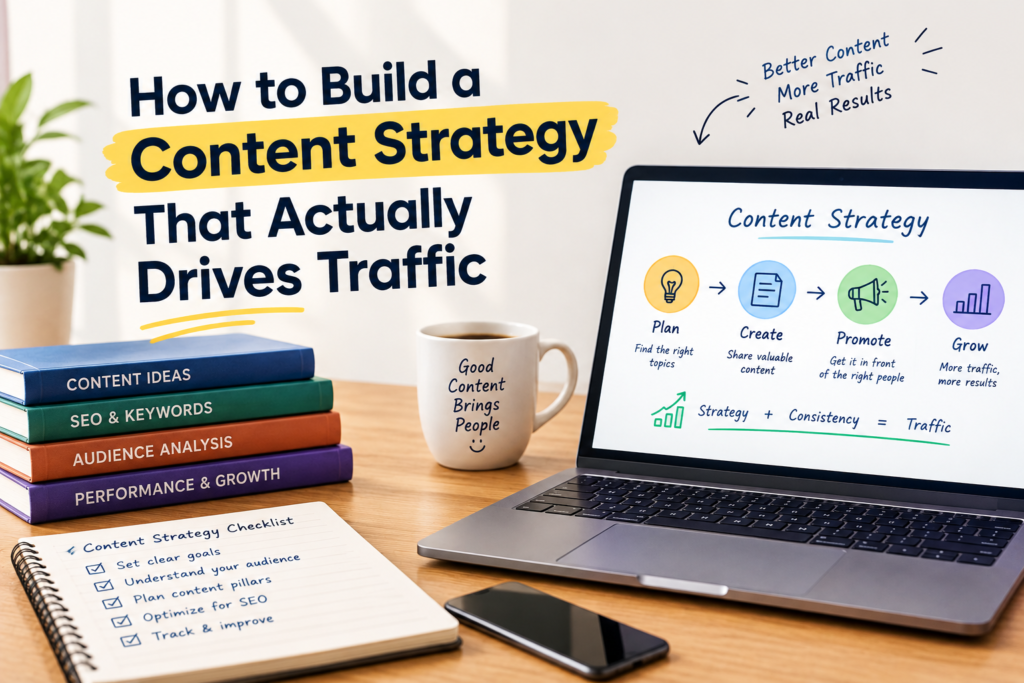
A strong content strategy does not begin with, “What should we post this week?” It begins with, “Who are we trying to attract, what do they need, where do they look for it, and what content can move them closer to our business?”
In 2026, discovery is spread across Google, AI search, video, social platforms, communities, and newsletters. Search still matters enormously, but a content strategy that depends on one channel alone can become fragile.
The goal is to build a content strategy that earns attention repeatedly and turns that attention into measurable business value.
Traffic is easy to celebrate because it is visible. A graph goes up, a page gets more clicks, and the team feels progress.
But traffic by itself is not a content strategy.
A website can attract thousands of visitors who never become customers. Another website can receive fewer visits but attract people who are actively comparing solutions, reading service pages, joining an email list, or requesting a quote.
A content strategy therefore needs two questions at the same time.
Can this topic attract attention?
Can this attention matter to the business?
The best content strategy connects audience demand with business relevance.
“Get more traffic” is too vague to guide a content strategy.
More traffic from where? From non-branded Google searches? From social discovery? From referral links? From email? From people researching a category for the first time?
And what should happen after they arrive?
A useful content strategy begins with a business outcome. A local company may want more qualified visits to service pages. A software brand may want more trial sign-ups from educational content. An ecommerce brand may want more discovery traffic to category pages. A consultancy may want content that builds authority before a high-value enquiry.
The more precise the objective, the easier it becomes to decide what belongs in the content plan and what does not.
One of the fastest ways to weaken a content strategy is to brainstorm only inside the company.
Teams naturally think in product names, service categories, industry language, and internal priorities. Customers often think differently. They search with problems, frustrations, desired outcomes, comparisons, and questions.
A digital agency may think in terms of “conversion rate optimization.” A business owner may search, “why are people visiting my website but not contacting me?”
Those phrases may describe the same problem, but one sounds like the agency and one sounds like the customer.
Search queries, sales calls, support tickets, contact form questions, reviews, community discussions, and customer interviews can all reveal useful language. Google’s people-first also emphasizes creating useful material for an intended audience rather than producing pages mainly to manipulate rankings.
That principle should sit at the center of a strong content strategy.
Keyword research is part of a content strategy, but it should not become the whole strategy.
Search data can show what people look for, how they phrase questions, and which topics have measurable demand. But numbers need interpretation.
A keyword with ten thousand searches may have weak business relevance. A query with four hundred searches may be perfect for a valuable service. A low-volume topic may still matter because it answers an important customer objection.
Judge topics across audience relevance, search demand, business value, search intent, competition, conversion potential, and format fit.
A topic becomes powerful when several of those factors align.
Search intent is one of the most important filters in a traffic-focused content strategy.
Someone searching “best CRM for a small law firm” is probably comparing solutions. Someone searching “what is a CRM” is still learning. Someone searching a specific CRM plus “pricing” is closer to a decision.
Those searches should not lead to the same page.
A strong content strategy matches the format and angle to what the searcher is trying to accomplish.
Look at the current results. Are the strongest pages tutorials, landing pages, videos, comparisons, tools, category pages, or definitions? What level of detail do they provide? What problem are they solving?
Ahrefs’ search intent guidance recommends reviewing the content type, content format, and dominant angle in search results. You do not need to copy competitors. You need to understand what the searcher expects.
A weak content strategy often looks like a spreadsheet with hundreds of disconnected keywords.
That can lead to several articles that overlap, compete with each other, or repeat the same advice under slightly different titles.
A better content strategy groups related searches into meaningful topics.
Imagine an email marketing company. Instead of separate articles for “email open rate,” “increase email open rate,” “good email open rate,” and “why email open rates are low,” the team can decide whether these searches belong in one strong guide or a connected topic group.
Think in terms of subject ownership rather than keyword ownership.
One broad resource can be supported by more specific pages that answer related questions. The pages can link naturally, helping users move through the topic without returning to search.
A calendar tells you when something will be published.
A content strategy tells you why that piece deserves to exist.
Some content should attract new people. Some should deepen trust. Some should answer objections. Some should demonstrate expertise. Some should support conversion.
For example, a marketing agency might publish a broad guide on creating a digital marketing plan. That can attract early-stage searchers. A comparison of SEO and paid ads can help readers evaluate channels. A case study can provide proof. A service page can support conversion.
These assets work together instead of acting like isolated posts.
That is a far more useful content strategy than filling four weekly publishing slots because the calendar demands it.
Your website already contains clues about what people respond to.
Some pages attract impressions but few clicks. Some rank just below stronger visibility. Some older articles still receive traffic but no longer reflect current information. Some pages attract visitors but do not guide them anywhere useful.
The Search Console Performance report shows queries, pages, clicks, impressions, and click-through rate. This makes it a valuable source for improving a content strategy based on real audience behavior.
Look for high-impression pages with weak clicks, pages sitting close to stronger visibility, and older articles that still receive traffic. Better titles, deeper answers, stronger internal links, or a timely update may create more value than publishing another similar post.
A mature content strategy decides what to improve, combine, repurpose, redirect, or remove, not only what to create.
A good content strategy behaves more like a loop than a production line.
You create something useful. You connect it to related pages. You distribute it where the audience spends time. You measure what happens. You learn from the response.
Then the next decision becomes smarter.
If a guide earns impressions but few clicks, its positioning may be weak. If a social post performs strongly, the subject may deserve a larger article, video, or email. If a detailed guide earns backlinks or AI citations, the topic may deserve expansion.
A content strategy improves when performance feeds planning.
One of the biggest content mistakes happens after an article is published.
Nothing.
The team uploads it, shares it once, and starts writing the next piece.
A strong content strategy asks how the idea can travel.
Could the article become several short social posts? Could the main framework become a carousel? Could one section become a video? Could the insight become an email? Could a sales team send the article to prospects who ask the same question?
Semrush’s current content marketing strategy guide reflects this broader discovery reality, encouraging planning across search, social, AI systems, video, communities, and other channels.
A content strategy should build distribution into the idea before production begins.
A trending subject can look irresistible.
It has huge search interest. Competitors are discussing it. Social platforms are full of it.
But the better question is not only, “Can we get traffic from this?”
It is, “Why should our brand be publishing this?”
Google warns against producing large amounts of content across many topics mainly in hopes that some of it performs in search. A strong content strategy stays close to the audience the business actually serves and the expertise the brand can demonstrate.
Relevance compounds.
A cybersecurity company can build authority around security risks, compliance, incident response, employee behavior, and protection strategies. Publishing generic travel trends may attract visitors, but those visitors have little reason to trust the brand for cybersecurity.
Traffic is useful when it belongs to the right audience.
The internet does not need another article that says exactly what the first ten results already say.
A strong content strategy asks what extra value you can contribute.
Can you include internal data? A better framework? A real process? A case study? Screenshots? Calculations? Templates? Expert insight? A clearer comparison?
Google’s helpful content guidance encourages original information, analysis, and substantial treatment of a topic.
The best content strategy does not simply target demand. It gives the reader a reason to choose your page after the click.
Traffic without direction leaks value.
A visitor reaches your article, learns something useful, and then what?
A content strategy should create a sensible next step based on what the reader is likely to need.
An early-stage reader may want another guide. A comparison stage reader may need a case study. A buyer may need pricing, a consultation, or a contact route.
The next step should feel useful rather than forced. You are helping the right visitor move one stage forward.
If traffic is the only metric, a content strategy can reward the wrong work.
A broad article may attract fifty thousand visitors and create almost no business impact. A specialist comparison page may attract two thousand visitors and generate qualified leads.
For search visibility, track impressions, clicks, click-through rate, and relevant query growth.
For engagement, look at meaningful interactions, downloads, internal navigation, or returning visitors.
For business impact, track qualified leads, trials, enquiries, purchases, or assisted conversions where possible.
For authority, monitor links, brand mentions, citations, newsletter growth, and direct traffic trends.
A content strategy should include both discovery signals and business outcomes.
Content does not become a permanent asset just because it ranked once.
Search results change. Competitors improve. Statistics age. Tools update. Examples become outdated.
That is why maintenance belongs inside content strategy.
Ahrefs’ content audit process recommends reviewing existing pages to decide which should be improved, consolidated, redirected, or removed. This can reveal opportunities that a publishing-only mindset misses.
Create a review rhythm for important pages. Investigate pages losing impressions. Update time-sensitive information. Expand strong pages into related topics. Protect previous wins instead of constantly abandoning them for new URLs.
AI-assisted search is changing discovery. Some users may receive direct answers before visiting a website, while others may discover brands through citations, summaries, or recommendations.
The response should not be more generic content.
Content Marketing Institute’s 2026 discussion of content strategy for AI search emphasizes authority, relevance, and content that attracts the right audience rather than simply maximizing volume.
If your work offers clear expertise, original evidence, useful structure, and credible answers, it has more reasons to be referenced, shared, remembered, and visited across different discovery systems.
A modern content strategy should optimize for discoverability without becoming dependent on one type of result page.
Before approving a new piece, ask seven questions.
If several answers are weak, the idea probably needs more development.
This filter protects your content strategy from becoming a list of topics that sounded good in a meeting.
Imagine a home renovation company publishing four blogs every month.
The topics include office productivity, interior design trends, employee wellbeing, home insurance, kitchen colors, and property news.
Some pages receive traffic, but there is no pattern. The company cannot tell which visitors might actually become renovation customers.
A stronger content strategy starts with the buying journey.
Potential customers may search for renovation costs, project timelines, kitchen remodeling ideas, planning permission, contractor selection, budget mistakes, material comparisons, and questions about living in a home during construction.
Now the content has a reason to exist.
A planning guide can attract early research. Cost guides can answer budget questions. Case studies can build confidence. Material comparisons can support decisions. Service pages can explain what the company offers. Internal links can connect those stages.
The traffic may be narrower than a random viral topic, but it is far more valuable.
That is what a content strategy should do.
During the first month, audit existing content, review Search Console data, study customer questions, identify topic groups, and map important pages to search intent and business goals.
During the second month, create or improve the highest value assets using a mix of traffic potential, business relevance, realistic competition, and customer journey value.
During the third month, focus on distribution, internal linking, repurposing, and measurement. Improve weak titles, connect new pages with existing resources, and capture new questions from customers and sales teams.
A 90-day content strategy should end with better evidence for the next 90 days.
Publishing without a clear audience is one.
Another is targeting keywords without understanding intent.
Creating multiple pages for the same topic can split relevance.
Ignoring old content wastes existing authority.
Using AI to scale generic articles without expert review can create volume without value.
Writing only for search can make content lifeless.
Writing only for trends can create short attention with no lasting discovery.
Forgetting distribution leaves good work unseen.
Tracking only pageviews hides whether traffic is useful.
A strong content strategy avoids these problems by treating content as a connected business system.
There is no universal timeline. Existing authority, competition, technical SEO, publishing quality, promotion, and topic selection all matter. Updating established pages can sometimes show movement faster than building visibility for new content.
There is no ideal number for every company. Publishing frequency should match the ability to create useful content consistently. Two strong pieces can outperform eight weak ones.
No. SEO is an important part of discovery, but content strategy is broader. It includes audience needs, business goals, formats, distribution, internal connections, maintenance, and measurement.
No. Search-focused pages usually need a clear search opportunity, but some content may exist for sales enablement, customer education, thought leadership, email, social engagement, or retention.
Blogs remain useful when the audience wants detailed, searchable information. A content strategy may also include video, tools, newsletters, landing pages, case studies, webinars, reports, and social content.
Publishing because the calendar says something is due. Every important piece should have a clear audience, purpose, discovery path, and next step.
A content strategy that actually drives traffic is not a monthly list of blog titles.
It is a system for choosing the right audience, problems, topics, formats, distribution, and measures of success.
Start with business outcomes. Listen to customer language. Use search data as evidence. Match search intent. Build connected topics. Improve existing pages. Add original value. Plan distribution before publication. Measure whether traffic leads anywhere useful.
Most importantly, stop treating content volume as proof of progress.
A smaller library of useful, connected, well-maintained content can become far more valuable than hundreds of pages created without a clear purpose.
The strongest content strategy does not ask, “How much can we publish?”
It asks, “What can we create that our audience will actively look for, genuinely value, and remember us for?”
If your business is publishing regularly but traffic is inconsistent, disconnected from leads, or dependent on a few old pages, KM Marketers can help turn content activity into a clearer growth system. KM Marketers supports businesses with SEO, content creation, social media marketing, website strategy, and performance-focused digital campaigns. The aim is not simply to publish more. It is to build content around the audience, search opportunities, business goals, and measurable outcomes that matter. Learn more at KM Marketers.
Your Trusted Marketing Partner!
KM Marketers is a digital marketing solutions provider helping businesses grow through SEO, social media, content marketing, and paid advertising. Our focus is on delivering measurable results, building strong online visibility, and driving quality leads for clients across different industries.
Email: info@kmassignmentservices.com
kmdigitalmarketing2025@gmail.com
WhatsApp: +60 16-522 4321
Head Office: Galleria Cyberjaya, Parking lot, Jalan Teknokrat 6, Cyber 5, 63000 Cyberjaya, Selangor, Malaysia.
Hours: Mon–Sat 10:00 AM to 07:00 PM
© 2026 KM Marketers. Powered by KM Software Services Sdn. Bhd. (1308207-U). All Rights Reserved.