
Handling a social media crisis well requires five things: verify what happened, activate the right people, acknowledge the issue, communicate what is known, and keep updating the audience as the situation changes.
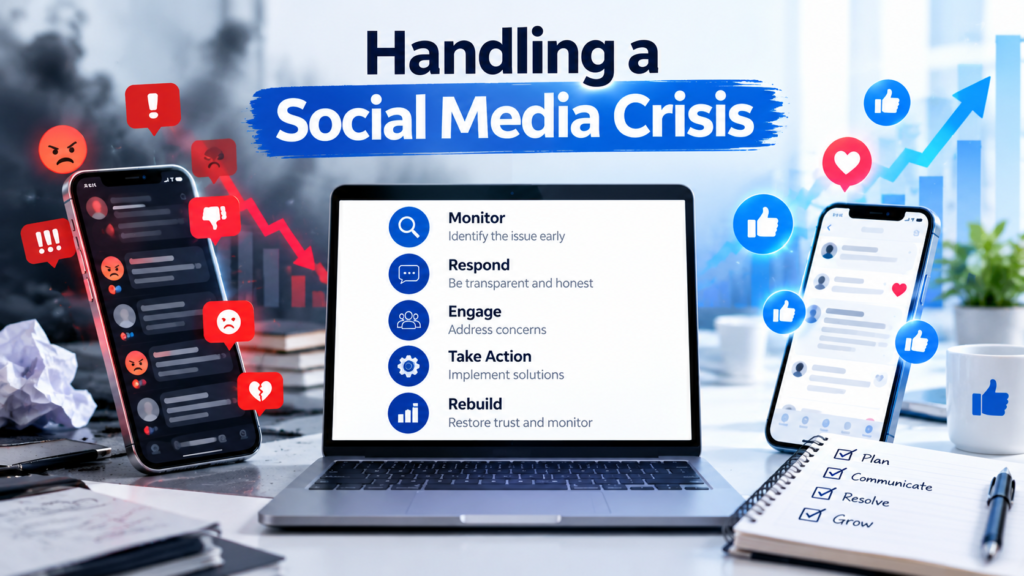
Handling a Social Media Crisis: Do’s and Don’ts
A social media crisis rarely begins with a neat warning.
It may start with one angry customer post, an employee mistake, a badly timed campaign, a product complaint, an account security problem, or a video that suddenly reaches thousands of people. Within a short time, comments multiply, screenshots travel, journalists may notice, and internal teams begin asking different questions at once.
That is why handling a social media crisis is not simply about writing a clever reply. It is about protecting trust while the facts are still developing.
The strongest response is calm, coordinated, factual, human, and proportionate to what actually happened. The weakest response is usually the opposite: rushed, defensive, inconsistent, silent for too long, or driven by whoever has access to the account.
This guide explains the practical do’s and don’ts of handling a social media crisis so businesses can respond without creating a second crisis through poor communication.
Handling a social media crisis well requires five things: verify what happened, activate the right people, acknowledge the issue, communicate what is known, and keep updating the audience as the situation changes.
Do not argue with users, guess at facts, delete criticism just because it is uncomfortable, continue cheerful scheduled posts as though nothing happened, or allow several departments to publish competing explanations.
Most importantly, handling a social media crisis should begin before the crisis. Clear roles, escalation rules, account security, response templates, and monitoring make the live response faster and more consistent.
One unhappy review is not automatically a crisis.
A customer may complain about delivery. Someone may dislike an advert. A post may receive criticism from a small group. These situations still need attention, but escalating every complaint into full crisis mode can waste resources and make the brand sound alarmed.
Handling a social media crisis starts with classification.
Ask whether the issue is spreading beyond the original post, whether it involves safety, legality, discrimination, privacy, data, leadership conduct, product failure, misinformation, or a large service disruption, and whether media or influential accounts are amplifying it.
Also ask whether the online conversation is beginning to affect customers, employees, operations, or public trust.
The faster the issue is spreading and the more serious the underlying harm, the more likely it is that handling a social media crisis requires a coordinated response rather than normal community management.
The worst time to decide who approves a statement is when thousands of people are waiting for one.
Handling a social media crisis becomes much easier when responsibilities are already clear.
A practical crisis group may include the social media lead, communications or public relations, a senior decision maker, customer support, operations, legal counsel when relevant, and technical or security teams if the issue involves systems or data.
The Public Relations Society of America emphasizes clear crisis roles, centralized messaging, speed, honesty, and consistency. Those principles matter because social media teams often see the problem first but may not own the facts needed to explain it.
Before a crisis, decide who can pause posts, who gathers facts, who drafts the message, who approves it, who speaks publicly, and who monitors reactions.
Handling a social media crisis should never depend on finding the chief executive in a group chat while the story is spreading.
When pressure rises, helpful people can accidentally make the situation worse.
A sales manager may reply from a personal account. A customer support agent may give an explanation that has not been confirmed. An employee may share internal screenshots. A senior leader may post emotionally before the communication team has checked the facts.
Handling a social media crisis requires one agreed source of truth.
Internal teams should know where approved updates are stored and which questions must be escalated. Employees should not be expected to improvise public explanations.
This does not mean hiding information. It means making sure the information released is accurate, consistent, and authorized.
A brand can appear completely disconnected when a serious complaint is trending while its account automatically posts a cheerful promotion.
One of the simplest steps in handling a social media crisis is reviewing scheduled content immediately.
Sprout Social recommends reviewing or pausing planned posts during a crisis so routine publishing does not appear insensitive or distract from the response.
Pause does not always mean silence across every channel. It means stopping content that could clash with the situation.
Handling a social media crisis requires the tone of the account to match the reality the audience is experiencing.
Speed matters, but inaccurate speed creates a new problem.
The CDC’s crisis communication principles emphasize being first, right, and credible. For handling a social media crisis, that balance is essential.
The social team should quickly establish what is confirmed, what is still being checked, who is affected, what action is already underway, and when the next update can realistically be provided.
If the facts are incomplete, say that.
A simple message such as “We are aware of the issue and are investigating. We will share confirmed information here as soon as it is available” is better than inventing an explanation to fill the silence.
Handling a social media crisis does not require pretending to know everything immediately. It requires being clear about what is known and what is not.
Speculation is especially dangerous when the situation involves an employee, customer, partner, security incident, accident, or legal allegation.
Do not guess why something happened. Do not accuse a customer of lying before checking records. Do not blame a supplier because someone internally thinks the supplier is responsible. Do not promise that no data was affected until the technical team knows that.
Handling a social media crisis should separate facts from assumptions. If the cause is still under investigation, say exactly that.
An early incorrect statement can remain visible in screenshots long after the brand deletes or corrects it.
Waiting for a perfect statement can create a vacuum.
If the issue is already visible and serious, handling a social media crisis usually requires an acknowledgement while a fuller response is being prepared.
Hootsuite’s current social media crisis guidance recommends having escalation levels and preapproved response structures in place so teams can acknowledge issues without losing time to basic process questions.
A holding statement should acknowledge the issue, show that the organization understands the concern, state what action is taking place, and tell people when or where they should expect another update.
Handling a social media crisis is often easier when the audience knows the company is present and actively working on the problem.
“We regret any inconvenience.”
“We are sorry you feel this way.”
“Mistakes were made.”
These phrases can sound evasive when people are asking what actually happened.
Handling a social media crisis requires language that matches the level of responsibility.
If the company made a confirmed mistake, say so clearly. If people were harmed or seriously inconvenienced, acknowledge their experience. If facts are still uncertain, do not manufacture an admission that the evidence does not support.
A useful apology can explain what happened, who was affected, what the company takes responsibility for, what is being done now, and what will change.
During a serious crisis, customers may be worried about their money, safety, privacy, access to a service, order, job, or personal information.
Handling a social media crisis should therefore begin with the audience’s most urgent need.
If a product may be unsafe, explain what customers should do. If a service is unavailable, tell people what is affected and where updates will appear. If accounts may be compromised, explain the immediate security steps users should take.
PRSA crisis communication guidance stresses putting people first and giving them information that helps them protect themselves when safety is involved.
Handling a social media crisis becomes more credible when useful action comes before reputation management language.
A brand account should not win arguments. It should resolve problems.
When hundreds of critical replies arrive, it can be tempting to answer sarcasm with sarcasm or defend every accusation individually.
Handling a social media crisis requires deciding which public questions deserve a factual answer, which individual cases should move to private support, and which abusive or irrelevant messages do not need engagement.
Stay professional even when a commenter is not. Do not shame customers, mobilize followers against a critic, or publish private order details to prove a point.
Handling a social media crisis should reduce heat, not reward the most confrontational exchange.
Public replies are useful for showing that the brand is listening. Private channels are better for personal data, account details, refunds, addresses, booking numbers, or other sensitive information.
Handling a social media crisis often needs both.
A public response can acknowledge the concern and explain that the team has contacted the person privately. The private conversation can then handle information that should not be exposed in a comment thread.
However, do not move every question private simply to make criticism disappear. If hundreds of people are asking the same factual question, answer it publicly.
Crises attract rumours.
A screenshot may be edited. An old video may be presented as new. Users may misunderstand a policy. A false figure can be repeated until it looks established.
Handling a social media crisis requires active monitoring of what people are actually saying, not only the number of mentions.
Correct misinformation with evidence and calm language. Publish the accurate information in a place that is easy to find and pin the update if appropriate.
Do not amplify a minor rumour to a huge audience unless the rumour is gaining meaningful traction or creating real harm.
Handling a social media crisis includes knowing which false claims need correction and which would become bigger if the brand repeated them.
Deleting negative comments can turn criticism into accusations of censorship.
There are legitimate reasons to remove content, including threats, doxxing, scams, hate, explicit abuse, dangerous misinformation, spam, or material that violates a clearly published community policy.
Simple disagreement is different.
Handling a social media crisis requires a moderation standard that can be explained consistently.
Do not use moderation as a substitute for answering a valid concern.
Sometimes the crisis is the account.
A compromised profile can publish scams, offensive content, false announcements, or malicious links within minutes.
Handling a social media crisis must therefore include account security. Use strong authentication, restrict administrator access, remove former employees promptly, and keep recovery details current.
If an account is hacked, tell audiences through another verified channel if possible and warn them not to click suspicious links or trust unauthorized messages.
Handling a social media crisis is impossible if the organization cannot control its own communication channels.
The social team may publish the statement, but it should not operate in isolation.
Customer support needs the same facts. Sales teams need to know what to tell prospects. Employees need internal guidance. Website banners, email updates, press statements, and call centre scripts should not contradict the social account.
Handling a social media crisis works best when social media is part of the wider crisis communication plan.
This is especially important when the issue moves beyond social platforms into news coverage, regulator interest, partner concern, or direct customer communication.
Legal input may be essential in situations involving injury, privacy, employee conduct, contracts, regulators, litigation, or security incidents.
But handling a social media crisis can become worse if every useful sentence is removed until the statement says nothing.
Legal can identify unsupported claims and exposure. Communications can identify what audiences need to know and how silence may be interpreted.
The goal is a statement that is accurate, responsible, and understandable.
Situation | Do | Don’t |
Facts are incomplete | Acknowledge the issue and say what is being checked | Guess at the cause |
Scheduled posts are still queued | Pause and review them | Let cheerful promotions publish automatically |
Customers ask the same question | Publish a clear public answer | Force every person into direct messages |
A mistake is confirmed | Take responsibility and explain corrective action | Hide behind vague passive language |
A comment is critical but civil | Respond or leave it visible | Delete it because it is negative |
A comment includes private data | Move the case to a secure channel | Discuss personal details publicly |
A rumour is spreading | Correct it with verified evidence | Attack the people sharing it |
The crisis is ongoing | Give useful updates | Disappear after the first statement |
The crisis ends | Review what happened and improve the plan | Immediately pretend nothing happened |
A crisis dashboard should not only tell you whether people are positive or negative.
Handling a social media crisis requires understanding which claims are spreading, what customers are confused about, which posts are gaining reach, whether journalists are involved, and whether the conversation is moving to other platforms.
Monitor direct messages and comments as well as public mentions. People may discuss the company without tagging the official account.
Social listening can identify themes, but human judgment is still necessary. Sarcasm, memes, context, and rapidly changing events are not always understood correctly by automated sentiment tools.
The crisis is not over when mentions slow down.
Handling a social media crisis includes rebuilding trust after the peak.
If the company promised an investigation, publish the outcome when appropriate. If a process changed, explain what changed. If customers were promised refunds, replacements, security support, or follow up, make sure those actions happen.
A post crisis review should examine what triggered the issue, when it was detected, how quickly it was escalated, where approvals slowed down, what customers kept asking, and what needs to change.
Handling a social media crisis should make the next crisis less chaotic.
When a serious issue starts spreading, handling a social media crisis can feel overwhelming.
First, confirm that the issue is real and capture the original posts, links, timestamps, and account details.
Second, classify the seriousness and activate the appropriate team.
Third, pause scheduled content that could appear insensitive.
Fourth, gather verified facts from the people closest to the issue.
Fifth, decide whether a holding statement is needed.
Sixth, prepare the next update time and the channels where official information will appear.
This framework does not solve the crisis in an hour. It prevents the first hour from being wasted.
As quickly as it can communicate something accurate and useful. Handling a social media crisis does not mean racing to publish unverified information. If a visible issue is serious and facts are still being gathered, a short acknowledgement can show that the company is aware and responding.
If the brand published harmful or incorrect content, removal may be appropriate, but deleting it does not erase screenshots or responsibility. Preserve a record internally, acknowledge what happened when needed, and explain the correction rather than pretending the post never existed.
Sometimes safety, abuse, spam, or legal concerns may justify limiting comments. But handling a social media crisis by disabling criticism automatically can increase distrust. Use moderation rules consistently and keep another route available for legitimate questions.
The approval group depends on the issue. Communications should normally coordinate messaging, with input from operations, leadership, legal, security, human resources, or customer support when relevant.
The biggest mistake is often reacting before the organization has aligned on facts and responsibility. Handling a social media crisis requires speed, but uncoordinated speed can create contradictions that are harder to repair than the original issue.
Handling a social media crisis is not about controlling every comment or forcing the internet to become positive again.
It is about making the organization a reliable source of information when trust is under pressure.
Prepare before the crisis. Know who decides what. Protect account access. Monitor the conversation. Pause inappropriate scheduled content. Verify before explaining. Acknowledge serious issues. Put affected people first. Correct misinformation carefully. Keep messages consistent across teams. Update audiences when there is something meaningful to say.
Just as importantly, know what not to do.
Do not speculate. Do not argue. Do not delete ordinary criticism to make the page look cleaner. Do not publish a vague apology and assume the crisis is finished. Do not return to normal marketing before promises have been fulfilled.
The goal of handling a social media crisis is not perfection. Crises are uncertain, fast, and emotionally difficult.
The goal is credibility.
When a business communicates with speed, accuracy, empathy, consistency, and visible action, it gives people a reason to believe the organization is taking the situation seriously.
That trust is the real measure of a strong crisis response.
If handling a social media crisis currently depends on whoever notices the problem first, your brand may need a clearer response system before the next issue appears. KM Marketers helps businesses strengthen social media strategy, monitoring, content planning, brand messaging, community management, and digital communication so teams can respond with more consistency when attention suddenly turns negative. The goal is not to make every criticism disappear. It is to build a social presence that can communicate clearly, protect trust, and recover responsibly when something goes wrong. Learn more at KM Marketers.
Your Trusted Marketing Partner!
KM Marketers is a digital marketing solutions provider helping businesses grow through SEO, social media, content marketing, and paid advertising. Our focus is on delivering measurable results, building strong online visibility, and driving quality leads for clients across different industries.
Email: info@kmassignmentservices.com
kmdigitalmarketing2025@gmail.com
WhatsApp: +60 16-522 4321
Head Office: Galleria Cyberjaya, Parking lot, Jalan Teknokrat 6, Cyber 5, 63000 Cyberjaya, Selangor, Malaysia.
Hours: Mon–Sat 10:00 AM to 07:00 PM
© 2026 KM Marketers. Powered by KM Software Services Sdn. Bhd. (1308207-U). All Rights Reserved.