
A useful hashtag strategy now helps a platform understand your topic, connects content to searches and communities, supports campaign tracking, and gives users another path to discovery. It works best as one signal inside a stronger social media strategy.
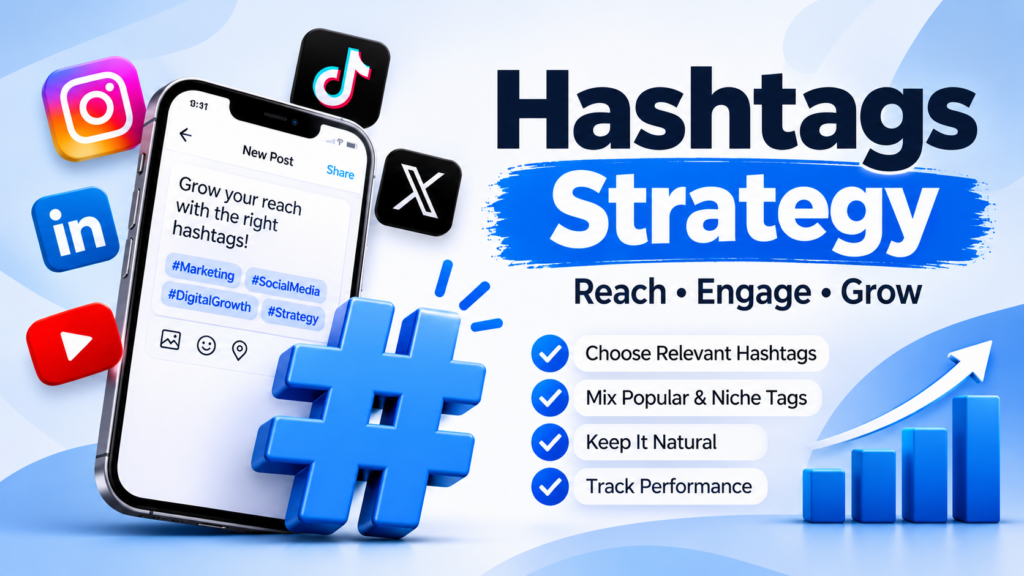
Hashtag Strategy: Do They Still Matter in 2026?
For years, social media advice sounded simple.
Add more hashtags. Use trending hashtags. Copy the biggest tags in your industry. Put them at the bottom of every caption and wait for reach.
That playbook is badly outdated.
In 2026, hashtags still matter, but not because they magically push weak content in front of thousands of people. Social platforms have become much better at understanding captions, video speech, on-screen text, engagement patterns, user interests, search behavior, and the wider context of a post.
That changes hashtag strategy completely.
A useful hashtag strategy now helps a platform understand your topic, connects content to searches and communities, supports campaign tracking, and gives users another path to discovery. It works best as one signal inside a stronger social media strategy.
The real question is no longer, “How many hashtags should I use?”
It is, “What job should this hashtag do?”
Yes, hashtags still matter in 2026.
But their role is smaller, more precise, and more platform-specific than it was several years ago.
A modern hashtag strategy should focus on relevance, search intent, community, campaign organization, and measurement. It should not depend on large blocks of generic tags such as #Success, #Business, #Love, or #Marketing simply because those terms have huge post volumes.
Current Sprout Social guidance describes hashtags as content signals rather than automatic reach shortcuts. Hootsuite also emphasizes that social discovery increasingly works like search, where keywords, captions, profiles, and hashtags all help platforms understand what content is about.
That is the right way to think about hashtag strategy in 2026.
Hashtags originally solved a basic problem.
Platforms needed a simple way to group conversations.
A user could click a tag and see posts connected to a topic. Brands could join events, campaigns, cultural moments, and communities.
That function still exists, but platforms now have much more information available.
An Instagram Reel can be understood through the caption, audio, visible text, account history, engagement, and user behavior. TikTok search can connect videos with queries even when a user does not search a hashtag. LinkedIn can interpret the subject of a professional post through its language. YouTube has strong title, description, thumbnail, viewing, and recommendation signals.
Hashtags now compete with richer signals.
That does not make hashtag strategy irrelevant. It means the tag must support the meaning already present in the content.
One of the biggest mistakes in hashtag strategy is expecting a hashtag to create demand that the content itself has not earned.
A weak post with perfect tags is still a weak post.
A strong post with no tags can still perform well.
The best hashtag strategy adds useful classification to content that is already relevant and valuable.
Think of hashtags as labels on a well-organized shelf.
The label can help someone find the right item. It cannot make the item useful.
Hashtags still have several valuable jobs.
They categorize content.
They connect posts to niche conversations.
They help users search a topic.
They support branded campaigns.
They make event content easier to group.
They can help social listening teams track conversations.
They can signal location, industry, community, or subject matter.
A useful hashtag strategy chooses tags based on which of these jobs matters for the post.
Hashtags do not guarantee reach.
They do not repair boring content.
They do not replace keywords.
They do not replace strong hooks.
They do not guarantee ranking in search.
They do not automatically create engagement.
They do not turn an irrelevant trend into a good brand opportunity.
A hashtag strategy becomes weak when hashtags are treated as a substitute for content strategy.
The bigger change in 2026 is not the death of hashtags. It is the rise of social search.
People increasingly search inside social platforms for reviews, tutorials, recommendations, products, local businesses, experiences, and explanations.
Hootsuite’s 2026 social media optimization guidance says discoverability is now strongly influenced by social search, with keywords, hashtags, and profile optimization all contributing to visibility.
That means hashtag strategy should work alongside keyword strategy.
If you publish a video about content planning, the caption should naturally explain the topic. The spoken words should match the subject. On-screen text can reinforce it. The profile should clearly describe the business. A few relevant hashtags can then support that context.
The hashtag is no longer carrying the entire discovery burden.
Instagram is where many marketers still use the oldest hashtag habits.
Huge hashtag blocks may make a post look active, but they can also create noise.
Current 2026 guidance from Sprout Social and Hootsuite generally favors a smaller group of relevant hashtags rather than filling every available tag slot.
For an Instagram hashtag strategy, think in layers.
One or two tags can describe the content topic.
One can reflect the niche or community.
One can support a campaign, brand, location, or event where relevant.
For example, a Manchester bakery sharing a wedding cake Reel might use tags related to wedding cakes, local weddings, and its own brand rather than a long list of generic food tags.
The strongest Instagram hashtag strategy is specific enough to describe the post, not just the account.
TikTok made hashtags famous through challenges and trend culture, but the platform is also a major search environment.
A TikTok hashtag strategy should therefore begin with the search phrase a viewer might actually use.
If the video explains how to write a research proposal, say that clearly in the video, show it in text, and use a caption that describes the topic.
Relevant hashtags can reinforce the subject, but stuffing the caption with loosely related trending tags can weaken clarity.
TikTok is especially sensitive to context.
The video, audio, caption, user response, and search behavior all work together.
For hashtag strategy, that means the tag should confirm the topic rather than disguise it.
LinkedIn hashtags still appear in posts, but professional relevance matters much more than adding a long list of broad business terms.
A B2B hashtag strategy should be restrained.
If you publish about employee retention, #EmployeeRetention or #WorkplaceCulture can provide context. Adding ten generic tags such as #Success, #Business, #Leadership, #Motivation, and #Growth often adds little.
LinkedIn users are reading for insight, expertise, professional relevance, and useful discussion.
Your opening line, argument, credibility, and comments are more important than decorative tagging.
A strong hashtag strategy on LinkedIn should therefore protect readability first.
Hashtags remain particularly intuitive on X because the platform helped popularize the format.
X’s official help guidance says hashtags categorize posts by keyword and make them easier to find in search. X also recommends no more than two hashtags per post as a best practice.
That recommendation fits the character and culture of the platform.
A good X hashtag strategy can be useful for conferences, live events, public conversations, campaigns, sports, entertainment, and fast-moving topics.
The main risk is hijacking a trending tag without understanding why it is trending.
Relevance matters more than visibility.
YouTube still supports hashtags in titles and descriptions.
Its official help documentation explains that users can search for hashtags and click them to find related videos. YouTube may also show up to three hashtags from a description near the video title.
That gives hashtags a real discovery role.
However, YouTube also says titles, thumbnails, and descriptions are more important for discovery than ordinary video tags.
That is an important hashtag strategy lesson.
Do not spend twenty minutes selecting hashtags while giving five minutes to the title.
For YouTube, the main topic should be clear in the title, thumbnail, description, spoken content, and audience response. Hashtags can support that system.
Threads is one of the clearest examples of how hashtag strategy is evolving.
Meta has been developing topic tags rather than encouraging old-style hashtag blocks. In 2025, Meta reported that Threads posts using tagged topics generally received more views than posts without one.
That does not mean every Threads post needs a tag.
It shows that a platform can keep the concept of topic classification while changing how the tag itself works.
For a 2026 hashtag strategy, Threads is a reminder that marketers should follow the platform’s native behavior rather than copy the same tactic everywhere.
Facebook hashtags are still clickable and searchable.
Current Sprout Social guidance says they can help categorize content, connect posts with campaigns, and support discoverability.
But Facebook is not a platform where most brands need long blocks of tags.
A Facebook hashtag strategy is often most useful for events, campaigns, local communities, branded initiatives, and highly relevant topics.
For everyday business posts, one or two meaningful tags may be enough, and sometimes none are needed.
Platform | Main 2026 Role of Hashtags | Practical Approach |
Topic and niche discovery | Use a small relevant set tied closely to the actual post | |
TikTok | Search context, trends, communities | Combine searchable language with relevant tags |
Professional context and categorization | Keep tags selective and readable | |
X | Real-time topics and event conversations | Use one or two focused tags |
YouTube | Searchable topic links | Use relevant hashtags, but prioritize title and description |
Threads | Topic discovery | Use native topic tags where genuinely relevant |
Campaign, topic, event, and community discovery | Keep tags purposeful and limited |
A strong hashtag strategy usually works with several types of tags rather than one giant list.
Topic hashtags describe what the content is about.
Examples include #ContentStrategy or #EmailMarketing.
Niche hashtags narrow the audience.
A broad tag such as #Fitness is less precise than a tag connected to strength training, running, rehabilitation, or a specific audience.
Branded hashtags connect content to a company, product, series, or community.
Campaign hashtags organize a specific promotion, launch, event, challenge, or user-generated content activity.
Location and event hashtags help connect content to a place, conference, festival, city, venue, or local audience.
Each type performs a different role.
A useful hashtag strategy combines them only when the post actually needs them.
Popularity looks attractive.
A hashtag with millions of posts appears to offer a huge audience.
But a huge audience is not always a relevant audience.
Your content may disappear quickly inside an extremely broad tag. More importantly, the people browsing that tag may have little commercial or community relevance to your business.
A local accountant using #Business may be technically accurate, but #SmallBusinessTax or a relevant location tag may better describe the content and audience.
Hashtag strategy should optimize for relevance, not vanity.
Sometimes.
Trending hashtags can be useful when your brand has a genuine reason to participate.
They are especially useful for live events, cultural moments, industry news, entertainment, product launches, and community conversations.
But do not force relevance.
Hootsuite advises brands to understand why a hashtag is trending before using it. That matters because a trend may be connected to tragedy, controversy, politics, criticism, or a community conversation where a promotional brand post would appear insensitive.
A good hashtag strategy asks three questions.
Do we understand the trend?
Does our audience care?
Can we contribute something relevant?
If the answer is no, skip it.
Branded hashtags are often misunderstood because they may not have huge search volume.
That is not always the point.
A branded hashtag can group user-generated content, product stories, employee posts, events, competitions, community contributions, and campaign participation.
The value is organization and participation.
For example, a fitness brand running a thirty-day challenge can use one memorable branded hashtag to collect community posts.
A hashtag strategy can therefore create value even when the tag itself is not a major discovery engine.
Hashtags should be readable.
When a hashtag contains several words, capitalizing the first letter of each word makes it easier to understand.
For example:
#SocialMediaStrategy
is easier to scan than:
#socialmediastrategy
This practice is often called Camel Case and can also make multiword hashtags easier for assistive technologies to interpret.
Accessibility belongs inside hashtag strategy, not as an afterthought.
Saving time is useful.
Copying the same fifteen hashtags under every post is not a strategy.
The tags may describe your business generally but fail to describe the individual piece of content.
A better hashtag strategy uses small groups connected to content themes.
A marketing agency might maintain separate pools for SEO, paid media, social media, website design, ecommerce, and content marketing.
The final tags are then selected based on the actual post.
That preserves consistency without becoming repetitive.
Hashtag analytics can be useful, but it is difficult to prove that one hashtag caused performance by itself.
A post may perform because of the idea, timing, format, creator, audience interest, caption, audio, shares, comments, or paid support.
Sprout Social’s 2026 hashtag analytics guidance recommends looking at metrics such as reach, engagement, users, popularity, and sentiment.
For hashtag strategy, the important lesson is to look for patterns over time.
Which tags appear consistently on high-quality posts?
Which branded tags generate participation?
Which niche tags bring relevant profile visits or comments?
Which campaign tags create user-generated content?
Test patterns rather than chasing one lucky post.
The first mistake is using too many tags simply because the platform allows them.
The second is selecting popular tags that have little connection to the content.
The third is hiding weak captions behind hashtag volume.
The fourth is using a trending hashtag without understanding its context.
The fifth is copying one hashtag block onto every post.
The sixth is measuring reach but ignoring audience quality.
The seventh is using hashtags without natural keywords in the caption, title, profile, or video.
The eighth is assuming every platform needs the same hashtag strategy.
The ninth is creating a branded hashtag that is difficult to spell, remember, or understand.
The tenth is never reviewing performance.
Content relevance matters more.
Audience fit matters more.
Strong hooks matter more.
Watch time matters more for video.
Useful captions matter more.
Searchable language matters more.
Shares, saves, comments, and meaningful interactions matter more.
Profile clarity matters more.
Consistent content themes matter more.
A hashtag strategy should support those fundamentals.
It should never become the part of social media planning that receives more attention than the actual content.
Before adding a hashtag, ask what function it serves.
Does it describe the topic?
Does it connect the content to a niche community?
Does it support a campaign?
Does it identify a location or event?
Does it help organize user-generated content?
Does it reflect language the audience actually uses?
If a hashtag does none of those things, remove it.
Then check the platform.
An X post may need one event hashtag.
An Instagram Reel may use a small set of niche and topic tags.
A YouTube video may use a few relevant hashtags while relying mainly on the title and description.
A Threads post may use one native topic tag.
This is what a platform-specific hashtag strategy looks like.
They can support discoverability, but they do not guarantee reach. Platforms use many signals, including content relevance, engagement, search context, viewing behavior, captions, and user interests.
There is no single number that works everywhere. Current guidance generally favors fewer relevant hashtags rather than large generic blocks. X officially recommends no more than two. Instagram and TikTok strategies often use a small, focused group, but testing your own performance is more useful than following a universal number.
Yes, but they are one part of discovery. Caption keywords, content quality, Reels performance, engagement, profile relevance, and search behavior also matter.
They remain useful for topic context, trends, challenges, and communities, but searchable language in the video, caption, and on-screen text also matters.
They can provide context and categorization, but professional relevance, useful ideas, comments, and readability matter more than using many tags.
Relevant hashtags can help viewers find connected videos, but YouTube’s own documentation emphasizes stronger discovery signals such as titles, thumbnails, and descriptions.
Yes, when it has a clear purpose such as grouping campaign content, user-generated content, events, community posts, or a recurring content series.
No. A hashtag strategy should be intentional. If the tag adds no search, campaign, topic, community, or organizational value, it may not be needed.
Hashtags still matter in 2026, but hashtag strategy has matured.
They are no longer a shortcut that can rescue average content or guarantee organic reach.
They work best as precise context signals inside a broader discovery system.
Social media platforms increasingly understand language, audio, visuals, behavior, engagement, and search intent. Your content needs to communicate its subject clearly even before a hashtag is added.
That means a strong hashtag strategy starts with the content itself.
Write for the audience.
Use searchable language.
Create useful posts.
Match the platform.
Choose tags that describe the real topic, community, campaign, event, or location.
Then measure whether those tags are helping the right people find and engage with the content.
The goal is not to use more hashtags.
The goal is to make every hashtag earn its place.
If your social posts are full of hashtags but reach, search visibility, and engagement still feel unpredictable, KM Marketers can help you build a clearer social media strategy around audience behavior, platform search, content planning, campaign goals, and measurable performance. KM Marketers supports businesses with social media marketing, content strategy, SEO, paid campaigns, website strategy, and digital growth, helping teams use hashtags as one useful signal rather than the entire strategy. Learn more at KM Marketers.
Your Trusted Marketing Partner!
KM Marketers is a digital marketing solutions provider helping businesses grow through SEO, social media, content marketing, and paid advertising. Our focus is on delivering measurable results, building strong online visibility, and driving quality leads for clients across different industries.
Email: info@kmassignmentservices.com
kmdigitalmarketing2025@gmail.com
WhatsApp: +60 16-522 4321
Head Office: Galleria Cyberjaya, Parking lot, Jalan Teknokrat 6, Cyber 5, 63000 Cyberjaya, Selangor, Malaysia.
Hours: Mon–Sat 10:00 AM to 07:00 PM
© 2026 KM Marketers. Powered by KM Software Services Sdn. Bhd. (1308207-U). All Rights Reserved.