
A practical 2026 guide to building search relevance on your website and credibility beyond it
Imagine two companies publish excellent guides answering the same customer question. Both pages are clear, useful, mobile friendly, and well written. One page has a strong title, logical headings, helpful internal links, original examples, and fast performance. The other page does too. Yet one consistently appears higher in search results while the other struggles to gain visibility.
Why? Because SEO is not only about what happens on the page. Search engines also look at signals beyond the page, including whether other relevant websites link to it, whether the brand is mentioned and trusted elsewhere, whether local customers leave useful reviews, and whether the business has built a credible presence across the web.
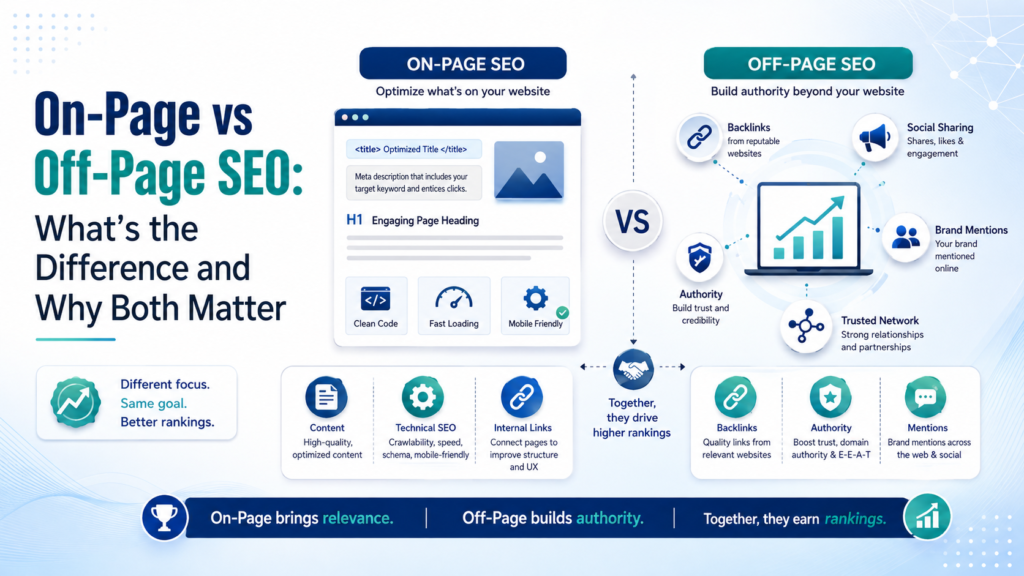
That is the difference between on-page SEO and off-page SEO. On-page SEO improves the content and experience you control on your own website. Off-page SEO strengthens the reputation and authority signals that come from outside your website. A complete strategy needs both.
Google does not use the industry labels “on-page” and “off-page” as two separate ranking systems, but its official SEO Starter Guide makes the same practical point: search visibility depends on useful content, understandable site structure, crawlable links, and signals that help Google and users discover and evaluate pages. In 2026, those fundamentals also remain relevant to AI-powered search experiences.
The easiest way to remember the difference is to ask one question: Where does the optimization happen?
On-page SEO happens mainly on your own website. It includes the words people read, the titles search engines interpret, the page structure, internal links, images, URLs, user experience, and many technical details that affect a specific page.
Off-page SEO happens mainly outside your website. It includes backlinks from other websites, digital PR, business citations, reviews, brand mentions, partnerships, expert contributions, and other forms of external recognition.
Neither one is a replacement for the other. On-page SEO can make a page highly relevant, but weak external authority can limit how competitive it becomes. Off-page SEO can earn powerful links and mentions, but those signals are wasted if the destination page is thin, confusing, slow, or unrelated to what users need.
Area | On-Page SEO | Off-Page SEO |
Main focus | Relevance, clarity, usefulness, usability | Authority, reputation, trust, external discovery |
Where work happens | Your website and individual pages | Other websites, platforms, publications, communities |
Examples | Content, title tags, headings, internal links, image alt text, page speed | Backlinks, digital PR, reviews, citations, brand mentions, partnerships |
Control level | Mostly direct control | Usually partial or indirect control |
Main risk | Over-optimization, thin content, poor UX | Spammy links, paid link schemes, irrelevant placements |
Best outcome | A page that clearly satisfies search intent | A page and brand that others recognize as worth referencing |
On-page SEO is often reduced to “put the keyword in the title,” but modern on-page SEO is much broader. Its job is to make each important page easy to understand, useful to the visitor, and logically connected to the rest of the website.
Before changing a heading or meta description, ask what the searcher actually wants. Someone searching “what is CRM software” needs education. Someone searching “best CRM for small construction companies” is comparing solutions. Someone searching “CRM implementation company near me” may be ready to speak with a provider. Those searches have different intentions and should usually lead to different kinds of pages.
Google recommends creating helpful, reliable, people-first content. That means a page should solve a real problem rather than exist only to target a keyword. Original examples, useful comparisons, practical steps, first-hand expertise, clear explanations, and accurate information can make a page far stronger than generic text written only to fill space.
A strong page title helps search engines and users understand what the page is about. The main heading should make the promise of the page clear, while supporting headings should divide the information into logical sections. Good headings also make long articles easier to scan on mobile devices.
Keyword use still matters, but natural language matters more than repetition. Google lists excessive, unnatural repetition under its spam policies. A page about on-page SEO does not become more useful because the phrase “on-page SEO” appears in every sentence. Relevance comes from covering the topic properly.
Internal links connect one page on your site to another. They help visitors move from a broad guide to a detailed service page, related article, case study, pricing page, or contact page. They also help search engines discover content and understand how topics relate.
Google recommends using descriptive, contextual anchor text and ensuring important pages receive at least one internal link from another page. Its link best practices also note that there is no magic number of links a page should contain. The right number is the number that genuinely helps the reader.
Relevant image file names, useful alternative text, concise URLs, mobile-friendly layouts, readable typography, and good performance all support the page experience. They may not all be direct ranking factors in the simplistic way SEO myths describe them, but together they make pages easier to access, interpret, and use.
Google recommends good Core Web Vitals for user experience. That is a useful reminder that on-page SEO should not stop at text. A page can contain brilliant information and still frustrate users if the layout jumps, important elements respond slowly, or the page takes too long to become usable.
Off-page SEO is everything you do to increase recognition, authority, and trust beyond your own website. Backlinks are the most discussed part, but they are not the whole strategy. A strong off-page presence can include editorial mentions, local citations, customer reviews, partnerships, professional directories, industry associations, podcasts, interviews, research references, and digital PR.
A backlink is a link from another website to yours. When a relevant, credible website chooses to reference your page, that link can help people discover you and can contribute to how search engines understand the page and site. This is why respected SEO resources such as the Ahrefs link building guide and Semrush off-page SEO guide focus heavily on earning useful links rather than collecting random ones.
The key word is earning. A backlink from a respected industry publication that cites your original research can be far more meaningful than hundreds of links from unrelated, low-quality directories. Relevance, editorial context, credibility, and the reason the link exists all matter.
Digital PR is one of the most sustainable ways to support off-page SEO. A business can publish original data, respond to journalist requests, release useful research, contribute expert commentary, create a practical tool, or tell a genuinely newsworthy story. When reputable publications reference that work, the business may gain referral traffic, brand awareness, and authoritative backlinks at the same time.
This works best when PR starts with something worth talking about. Sending the same generic press release to hundreds of websites rarely creates meaningful authority. A strong story, insight, data point, case study, or expert perspective gives publishers a reason to mention the brand.
For location-based businesses, off-page SEO also includes accurate business information and authentic customer reviews. A clinic, restaurant, solicitor, repair company, or local agency can benefit when its name, address, contact details, services, and reputation are consistent across relevant local and industry platforms. Reviews also influence real customers even when they are not thinking about SEO at all.
The objective is not to manufacture reviews. It is to create a repeatable process that makes it easy for genuine customers to share honest feedback and for the business to respond professionally.
Not every useful off-page signal has to be a traditional followed backlink. A brand can be discovered through podcasts, conferences, social content, supplier pages, partner websites, YouTube videos, expert roundups, professional associations, and communities. Some mentions may create links, some may create searches for the brand, and some may simply place the business in front of the right audience.
In July 2026, Google expanded Search Console reporting for social and video platforms, allowing creators and businesses to analyze how posts from platforms such as Instagram, TikTok, X, and YouTube perform in Google Search. This is a useful sign that search visibility increasingly crosses the boundary between a company website and the wider digital presence around it.
Think of your website as a specialist applying for a competitive job. On-page SEO is the CV, portfolio, qualifications, and interview performance. Off-page SEO is the references, recommendations, reputation, and industry recognition. A strong candidate needs to be good and needs credible evidence that others recognize that quality.
If the website has great off-page authority but poor on-page SEO, search engines and users may struggle to understand which page answers a particular need. If the website has perfect on-page optimization but no reputation, mentions, links, reviews, or history, it may have difficulty competing in a crowded market where several other sites also publish good content.
The strongest SEO strategies therefore create a loop. Good on-page content gives people something worth linking to. Good off-page promotion helps that content reach more people. Those visitors can create more brand searches, shares, mentions, links, enquiries, and sales. The website then gains more data about what customers care about, which can improve the next round of content.
Suppose an accounting firm wants to attract small-business clients in its city. The team creates a service page for “small business tax accounting,” a guide to year-end tax preparation, and a checklist for new business owners.
The on-page SEO work would include researching how local businesses describe their needs, writing genuinely useful content, creating clear titles and headings, linking the guide to the service page, adding relevant FAQs, improving page speed, making contact options obvious, and ensuring the pages work well on mobile.
The off-page SEO work might include obtaining an accurate listing in relevant local and professional directories, encouraging genuine client reviews, contributing a tax-planning quote to a local business publication, partnering with a chamber of commerce, appearing on a small-business podcast, and promoting an original tax checklist that other local organizations may reference.
The two sides reinforce each other. The helpful checklist gives other organizations something valuable to link to. The external links and mentions introduce new people to the firm. Those visitors land on pages that are already well organized and conversion-focused. That is far more powerful than building links to a weak page or polishing a great page nobody ever discovers.
For most websites, the sensible order is fix major on-page and technical problems first, then invest aggressively in off-page growth. There is little value in earning expensive publicity for a page that is broken, thin, slow, or unable to convert visitors.
Start by confirming that important pages can be crawled and indexed. Improve the pages that represent core services, products, and commercial topics. Make sure titles, headings, internal links, content quality, mobile experience, calls to action, and tracking are in place. Once the website can make good use of attention, build external visibility around it.
This does not mean waiting for “perfect SEO” before doing PR or outreach. Perfection never arrives. The goal is simply to avoid sending authority to pages that are not ready to benefit from it.
Off-page SEO creates more temptation for shortcuts because businesses cannot directly control whether other websites mention or link to them. That is exactly why low-quality link schemes remain risky.
Google explicitly lists buying or selling links for ranking purposes, excessive link exchanges, automated link creation, and other manipulative tactics in its spam policies. The safest long-term approach is simple: create reasons for relevant people and organizations to mention you.
Businesses often receive reports that celebrate the number of backlinks created. That number is easy to count, which makes it tempting as a performance metric. But quantity by itself says little about value.
A useful link usually has several qualities. It appears on a legitimate website. The source is relevant to your topic, audience, geography, or industry. The link sits in meaningful context. The page containing it can actually be discovered. The placement makes sense to a human reader. Ideally, the link can send referral traffic even if search engines did not exist.
Ask a simple question before pursuing a link: Would we still want this mention if it had zero direct ranking benefit? If the answer is yes because it puts your brand in front of the right audience, validates your expertise, creates referral traffic, or strengthens a real relationship, the opportunity is usually more strategically sound.
AI Overviews, AI Mode, and other generative search experiences have created new vocabulary such as AEO and GEO. That can make businesses feel they need an entirely new optimization playbook. Google’s 2026 AI optimization guide gives a more grounded answer: SEO best practices still matter because generative AI features in Google Search use its core ranking and quality systems.
For on-page SEO, this increases the value of clear, original, well-structured content that genuinely helps users. Pages should make key ideas easy to understand, support claims with evidence, use descriptive links, and provide unique information rather than repeating what already exists across the web.
For off-page SEO, authority and brand recognition remain important for a different reason: people and systems need signals that a source is worth paying attention to. High-quality mentions, expert citations, original research, strong reviews, and real-world reputation can all help build the wider credibility around a brand.
The lesson is not to chase a new acronym. Build strong pages, earn real recognition, and measure how audiences discover and use your content across search experiences.
Period | On-Page Priorities | Off-Page Priorities |
Days 1 to 30 | Audit important pages, fix titles and headings, map search intent, improve internal links, repair obvious crawl or mobile issues | Audit backlink profile, correct major business citations, identify relevant publications, partners, associations, and review opportunities |
Days 31 to 60 | Upgrade core service pages, publish one or two genuinely useful resources, improve conversion paths, add missing supporting content | Promote the new resources, pitch useful expert commentary, build partner relationships, request genuine reviews from eligible customers |
Days 61 to 90 | Refresh pages using Search Console data, strengthen internal links to pages gaining impressions, improve weak snippets and content gaps | Continue digital PR and outreach, evaluate referral traffic and earned mentions, pursue quality opportunities that proved relevant |
The exact balance depends on the website. A new site may spend more time building its content foundation. An established brand with strong pages but weak authority may focus more heavily on PR, partnerships, reviews, and link earning. A local business may prioritize reviews and citations while a B2B company may gain more from thought leadership and industry publications.
SEO measurement should connect visibility to business outcomes. Google Search Console is a strong starting point because it shows impressions, clicks, queries, pages, indexing information, and links. Pair it with analytics and your CRM or sales process so you can see what happens after organic visitors arrive.
What to Measure | Why It Matters |
Organic impressions and clicks | Shows whether more people are discovering your pages in search |
Non-branded query visibility | Indicates whether the site is reaching people who did not already know the brand |
Organic conversions | Connects SEO traffic to enquiries, bookings, purchases, signups, or other goals |
Top landing pages | Reveals which pages are creating search entry points |
Internal link coverage | Helps identify important pages that are isolated or poorly connected |
Earned referring domains | Shows whether new credible websites are actually referencing the business |
Referral traffic | Shows whether off-page mentions are sending real visitors, not just creating a link count |
Review volume and quality | Important for reputation and local customer confidence |
Brand search growth | Can indicate increasing awareness as wider marketing and PR activity compounds |
Be careful with vanity metrics. Domain scores from SEO tools can be useful for comparison, but they are third-party estimates, not Google metrics. Treat them as clues, not as business goals. A campaign that raises a score but produces no relevant visibility, traffic, reputation, or leads has not proved its value.
Myth 1: On-page SEO is just keywords. Modern on-page SEO includes intent, content quality, structure, internal linking, usability, media, performance, and how the page supports a real customer journey.
Myth 2: Off-page SEO means buying backlinks. Sustainable off-page SEO is closer to reputation building, PR, relationships, reviews, citations, and creating assets that deserve to be referenced.
Myth 3: More backlinks always mean better rankings. One relevant editorial link can be more valuable than hundreds of weak placements. Quality and context matter.
Myth 4: Great content will automatically earn links. Sometimes it will, but most businesses still need distribution. Helpful content must reach journalists, partners, customers, communities, and industry audiences before they can choose to reference it.
Myth 5: You can finish SEO once. Competitors publish new pages, products change, links disappear, customer questions evolve, search features change, and old content becomes outdated. SEO is an ongoing business process, not a one-time installation.
Before approving another month of content or link building, check whether your strategy can answer these questions clearly:
The difference between on-page SEO and off-page SEO is simple, but the strategy behind them is deeply connected. On-page SEO makes your website more relevant, understandable, useful, and conversion-ready. Off-page SEO builds the external reputation, references, and recognition that help people and search engines take that website seriously.
If you focus only on on-page SEO, you may create excellent pages that never build enough authority to compete. If you focus only on off-page SEO, you may spend money promoting pages that are not useful enough to deserve attention. The stronger approach is to build assets worth discovering, then create genuine reasons for the wider web to discover and reference them.
For businesses that want one team to connect website performance with search visibility, KM Marketers offers web development and digital marketing services that cover on-page SEO, off-page SEO, technical optimization, content, backlinks, and wider digital growth. The aim should never be to chase isolated rankings. It should be to build a website that earns attention, earns trust, and turns search visibility into measurable business opportunities.
Your Trusted Marketing Partner!
KM Marketers is a digital marketing solutions provider helping businesses grow through SEO, social media, content marketing, and paid advertising. Our focus is on delivering measurable results, building strong online visibility, and driving quality leads for clients across different industries.
Email: info@kmassignmentservices.com
kmdigitalmarketing2025@gmail.com
WhatsApp: +60 16-522 4321
Head Office: Galleria Cyberjaya, Parking lot, Jalan Teknokrat 6, Cyber 5, 63000 Cyberjaya, Selangor, Malaysia.
Hours: Mon–Sat 10:00 AM to 07:00 PM
© 2026 KM Marketers. Powered by KM Software Services Sdn. Bhd. (1308207-U). All Rights Reserved.