A practical 2026 guide to balancing content, community, advertising, and measurable growth without wasting your marketing budget
A business owner says, “We do not need a social media budget. Posting is free.” Another business owner says, “Organic reach is dead. Just put everything into ads.” Both statements sound decisive, and both can lead to bad marketing decisions.
Organic social media does not charge you a media fee to publish, but it still consumes strategy time, copywriting, design, video production, community management, approvals, tools, and staff attention. Paid social media can buy distribution immediately, but it cannot rescue a weak offer, unclear message, poor landing page, or brand profile that gives customers no reason to trust you.
The real question is therefore not “organic or paid?” It is “what job should each one do, how much should we invest in each, and when should the balance change?”
The opportunity is too large to ignore. DataReportal’s Digital 2026 Mid-Year Global Update reports about 5.79 billion active social media user identities worldwide, equal to roughly 69.9% of the global population. The same broader Digital 2026 reporting shows that social advertising has become a major part of global digital spend. View DataReportal’s Digital 2026 Mid-Year Global Update
For brands, that creates both an opportunity and a problem. Customers are there, but so are competitors, creators, friends, entertainment, news, and thousands of ads. The budget has to do more than buy impressions. It has to create relevance, trust, and action.
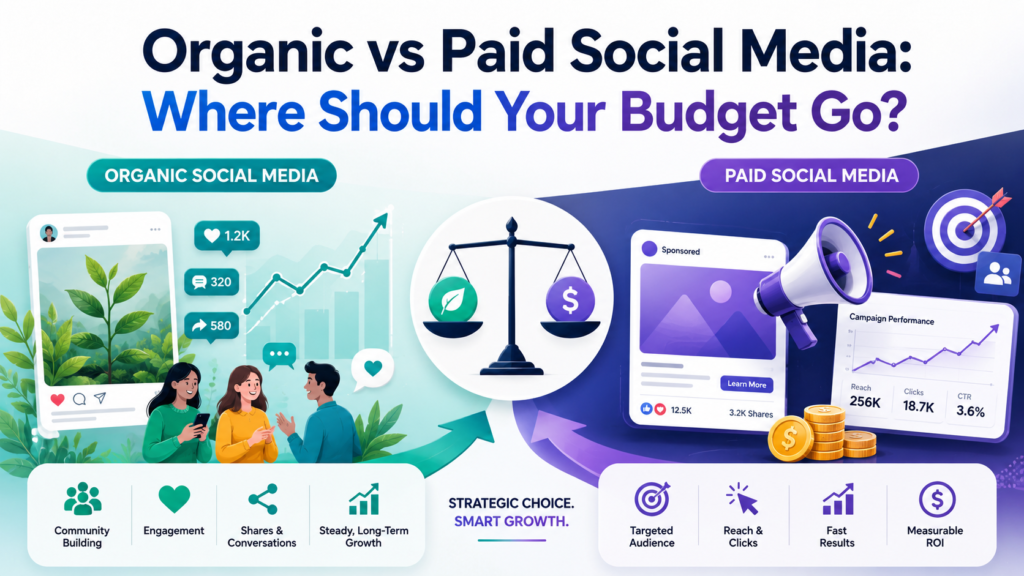
Organic and paid social media solve different problems. Organic is strongest at building a credible brand presence, creating relationships, learning what your audience responds to, answering questions, showing proof, and turning a profile into a living destination rather than an empty advertising shell. Paid social is strongest at buying targeted reach, reaching people beyond your existing followers, generating traffic or leads faster, retargeting warm audiences, and scaling messages that already work.
That means the right budget is rarely 100% organic or 100% paid. The better approach is to fund a system: create useful content, learn from real audience response, amplify the strongest ideas with paid media, measure business outcomes, and feed those lessons back into the next content cycle.
The exact split depends on your business stage. A new brand with weak content and no proof may need to invest more heavily in content production and organic credibility. A mature e-commerce brand with a proven product, strong creative pipeline, reliable conversion tracking, and clear unit economics may allocate much more toward paid acquisition. The ratio should follow readiness, not fashion.
Organic social media is the content and interaction a brand publishes without paying the platform to distribute that specific post as an advertisement. It includes normal feed posts, Reels, Stories, Shorts, carousels, founder posts, community replies, comments, direct-message interactions, employee advocacy, live sessions, and other unpaid participation.
The word “organic” often creates the impression that it costs nothing. In reality, the media placement is free, but quality content has a production cost. Someone has to research topics, write captions, film video, edit clips, design graphics, answer messages, track results, and keep the brand voice consistent.
Organic social earns attention rather than purchasing it. That makes it slower and less predictable, but it also makes it valuable. When people choose to follow, save, share, comment, or return to your content, they are giving you signals about what they care about. Those signals can become a powerful research layer for future campaigns.
Paid social media is distribution you purchase through a platform’s advertising system. Instead of depending only on followers and algorithmic discovery, you define an audience, objective, budget, creative, destination, and campaign structure, then pay for delivery according to the platform’s auction and optimization system.
Paid social can support awareness, video views, website traffic, app activity, lead generation, messages, catalogue sales, conversions, event registrations, recruitment, or retargeting. Its biggest advantage is control over distribution: you can deliberately reach new people or re-engage people who already visited your website or interacted with your content.
Its biggest weakness is that paid media can make a bad message fail faster. If the creative is weak, targeting is careless, tracking is broken, or the landing page does not convert, increasing spend simply increases the speed at which money is wasted.
Area | Organic social | Paid social |
Primary role | Build trust, community, relevance, and brand presence | Buy targeted distribution and scale business outcomes |
Direct media cost | No payment to publish the post | Requires advertising spend |
Hidden cost | Content, staff time, design, video, tools, moderation | Creative production, management, testing, tracking, landing pages |
Speed | Usually slower and cumulative | Can generate reach and data quickly |
Targeting control | Limited by followers, sharing, discovery, and algorithms | Audience, geography, behavior, interests, job attributes, retargeting and platform options |
Best use | Trust, education, community, proof, audience learning | Awareness at scale, traffic, leads, sales, retargeting, offer testing |
Main risk | Inconsistency, weak reach, content without business direction | Paying to amplify weak creative or an unproven offer |
Long-term value | Creates a reusable content library and community asset | Creates campaign data and scalable acquisition when economics work |
Organic content is often the first thing people inspect after seeing an ad. A prospect may click your profile, read recent posts, check comments, watch a few videos, look for customer stories, and decide whether the brand feels active and credible. If the account looks abandoned or consists only of sales graphics, the ad may have bought attention without creating confidence.
Organic also lets you test messaging at relatively low distribution cost. Suppose a software company posts five different educational themes over a month. One post about reducing manual reporting receives significantly more saves, comments, and qualified profile visits than generic “digital transformation” content. That is useful information. The team can turn the stronger idea into a webinar, lead magnet, sales message, landing page, and paid campaign.
Organic channels are especially important when the buying journey is long. Professional services, B2B products, healthcare, education, consulting, and high-consideration purchases often require repeated exposure before a customer is ready to act. A consistent stream of useful content gives the brand multiple opportunities to demonstrate expertise and reduce uncertainty.
Organic reach is valuable, but it is not fully controllable. A brand can create an excellent post and still reach only part of its follower base. Paid social solves the distribution problem by allowing marketers to put relevant creative in front of defined audiences at a chosen scale.
This is particularly useful when timing matters. A product launch, seasonal offer, webinar, new branch opening, recruitment campaign, or limited promotion cannot always wait months for organic reach to build. Paid distribution can create awareness immediately and give marketers faster feedback on creative, audiences, and offers.
Paid social also enables retargeting. Someone who watched a product video, visited a pricing page, added an item to a cart, or opened a lead form can often be addressed differently from someone who has never heard of the brand. That makes paid media useful not only for reach but also for moving people through the funnel.
Major platforms increasingly encourage integration rather than separation. TikTok’s April 2026 guidance on paid and organic optimization describes a system that connects high-performing organic assets with paid delivery. LinkedIn has similarly published guidance encouraging brands to build an organic foundation and amplify strong content through paid media. See TikTok’s paid and organic optimization guidance
Many marketing plans put $3,000 under “ads” and $0 under “organic,” even though a designer, videographer, copywriter, social media manager, community manager, and strategist may be spending dozens of hours every month creating the content. This makes the budget look more efficient than it really is.
A better budget separates three categories: content production, community/management, and paid media. For example, a business might spend $1,200 creating short-form video and graphics, $800 on management and reporting, and $2,000 on media. Its social media budget is $4,000, not $2,000.
This distinction matters because reducing content quality to “save budget” can make the ad budget less efficient. Paid distribution needs a constant supply of fresh creative. When ad fatigue appears, the solution is often not more targeting tricks; it is better creative, better offers, and more relevant customer insight.
There is no universal percentage that works for every brand. However, stage-based starting models can help teams have a more useful conversation. The examples below are planning frameworks, not rules. They assume “organic investment” includes content production and community/management rather than pretending those activities are free.
Business situation | Illustrative organic/content share | Illustrative paid-media share | Why |
New brand / weak social proof | 60–75% | 25–40% | Build a credible profile, learn messages, create proof, then test paid reach carefully |
Established brand / proven offer | 40–55% | 45–60% | Maintain content engine while scaling campaigns that already have evidence |
Performance-led e-commerce / strong creative system | 25–40% | 60–75% | Higher paid share can work when conversion tracking, margins, creative velocity, and retargeting are mature |
B2B / long sales cycle | 50–70% | 30–50% | Thought leadership and trust may require more sustained content; paid can target accounts and decision-makers |
Launch or seasonal campaign month | 30–50% | 50–70% | Temporary paid-heavy periods can make sense when timing and reach matter |
The important word is “illustrative.” A strong brand should change the mix based on evidence. If paid campaigns cannot convert profitably, more spend is not automatically the answer. If organic content is producing engagement but no movement toward business goals, more posts are not automatically the answer either.
In these cases, investing in better content may improve both organic performance and future advertising efficiency. Think of organic as the research-and-trust layer of the system.
In these cases, paid media can become the accelerator. But an accelerator works best when the engine is already running.
One of the easiest ways to waste social media budget is to boost posts simply because the platform recommends it. A post receiving likes is not automatically a good candidate for paid promotion. The content must match a business objective.
Before promoting any post, ask: What do we want the viewer to do next? Who specifically needs to see this? Does the creative communicate the value quickly? Is there a relevant landing page or next step? Can we measure the result?
A high-engagement meme might be excellent organic community content but poor lead-generation creative. Conversely, a customer case study with modest organic reach may be highly effective when targeted to the right professional audience. Organic performance is useful evidence, but it is one input, not the entire paid-media strategy.
The balance between organic and paid also changes by platform and audience. A brand should not copy the same allocation everywhere.
For many consumer and local businesses, Meta works well as a combined system. Organic Instagram and Facebook content can maintain visibility, show products or services, publish customer proof, and keep the profiles active. Paid campaigns can then extend reach, generate messages or leads, drive website sales, and retarget warm audiences. The strongest setup usually gives paid campaigns a steady supply of native-looking creative rather than treating ads as separate banner designs.
B2B brands often benefit from heavier organic investment in expert posts, founder viewpoints, employee voices, case studies, and educational content because credibility matters before a lead form is completed. Paid LinkedIn campaigns can then target professional audiences and amplify high-value content, events, reports, or offers. LinkedIn’s own marketing guidance has repeatedly recommended using organic learning to inform paid amplification.
TikTok is especially dependent on creative quality and platform-native execution. Organic posting can reveal which storytelling styles, hooks, personalities, and formats resonate. Paid tools such as Spark Ads allow brands to amplify existing organic-style content. TikTok’s 2026 paid-and-organic optimization feature makes the integration even more explicit: strong content and paid delivery are increasingly part of the same system rather than competing strategies.
YouTube organic content can have long-term value when videos answer searchable questions, demonstrate expertise, review products, or educate customers. Paid YouTube campaigns can accelerate reach or retarget interested viewers, but a weak channel with no useful library may struggle to convert curiosity into deeper trust. For education-heavy businesses, funding quality video production can be as important as funding media.
The examples below are deliberately simple and should be adapted to local costs, team structure, platform, margins, and campaign goals. They show how the same total budget can be divided differently depending on maturity.
A sensible starting allocation might place about $650 into content creation and management and $350 into focused paid tests. The priority is to build a credible page, collect testimonials, publish useful local content, create several strong short videos, and test one or two simple campaigns rather than spreading tiny ad amounts across every objective.
A balanced model might use around $1,400 for content/management and $1,600 for paid media. Organic work supplies a consistent creative pipeline and community presence. Paid campaigns focus on prospecting, retargeting, and a small number of measurable offers. The business reviews performance every two weeks and moves money toward audiences and creatives that generate qualified results.
A mature brand might invest $3,000 to $4,000 in content, creator assets, editing, and management, while placing $6,000 to $7,000 into media. The higher paid share is justified only if the business has proven conversion economics and enough creative volume to prevent fatigue. The content budget remains substantial because paid scale increases the need for fresh creative rather than reducing it.
The strongest strategy treats organic and paid as a feedback loop. Organic content discovers ideas. Paid media tests those ideas at scale. Campaign data reveals which audiences, objections, offers, and formats produce action. Those insights then shape the next organic content cycle.
This system is more efficient than asking one team to “post for engagement” while another team “runs ads for leads” with no shared learning.
Audit the existing profiles, define business objectives, verify tracking, review top historical posts and ads, identify three to five content pillars, and establish a realistic production rhythm. Paid spend should remain controlled while you test messages and confirm that landing pages and lead handling work.
Select the strongest organic themes and develop multiple paid creative variations. Test audiences, hooks, calls to action, and formats without changing every variable at once. Continue publishing organic content so the profile remains active and the creative pipeline does not depend on one successful advertisement.
Shift budget toward combinations that produce business value. Reduce spend on weak campaigns even if they generate cheap clicks. Increase investment in content categories that repeatedly create qualified interest. Document lessons so the next quarter starts from knowledge rather than from zero.
Organic and paid should not be judged by exactly the same metrics because they perform different jobs. However, both must ultimately connect to business outcomes.
Layer | Useful organic indicators | Useful paid indicators | Business connection |
Attention | Reach, views, watch time, profile visits | Impressions, reach, frequency, video views | Are the right people noticing us? |
Engagement | Comments, shares, saves, replies, DMs | Clicks, engagement rate, landing-page views | Is the message relevant enough to create action? |
Consideration | Website clicks, repeat viewers, enquiries, content downloads | CTR, cost per landing-page view, retargeting engagement | Are people moving closer to a decision? |
Conversion | Qualified inbound messages, assisted leads, organic conversions | Cost per lead, cost per acquisition, conversion rate, ROAS where appropriate | Is social media producing profitable or strategically valuable outcomes? |
Retention | Community participation, advocacy, repeat engagement | Customer retargeting, upsell/cross-sell campaign results | Are customers staying connected and buying again? |
The biggest mistake is optimizing for the cheapest visible metric. Cheap clicks can be worthless. High engagement can be irrelevant. A useful dashboard connects activity to lead quality, sales, retention, or another agreed business outcome.
AI tools can reduce the time required for caption drafts, content variations, editing support, ad concepts, reporting summaries, audience research, and creative ideation. Platforms are also adding more automated campaign features. This can lower production friction and increase testing speed.
But AI does not remove the need for a budget strategy. If anything, faster content production makes strategic discipline more important because teams can now create and spend faster. Someone still has to decide which customer problem matters, which claim is credible, which creative feels distinctive, whether the campaign is profitable, and whether the brand voice remains recognizably human.
The competitive advantage is not “using AI.” It is using automation to test faster while protecting customer insight, creative quality, measurement, and brand trust.
If your team can answer those seven points clearly, the budget conversation becomes much more productive. Instead of arguing about whether paid or organic is “better,” you can decide which one deserves the next dollar based on the job that needs to be done.
Organic social media and paid social media are not competitors for the same job. Organic creates the brand presence people investigate, the community they can join, the content that proves expertise, and the learning that reveals what audiences care about. Paid media buys controlled distribution, accelerates reach, retargets warm prospects, and scales messages that already have evidence behind them.
The best budget therefore changes with the maturity of the business. Newer brands often need more content, proof, and message testing before large media spend makes sense. Established brands with proven offers and reliable tracking can push more aggressively into paid acquisition. Launch periods may temporarily become paid-heavy, while trust-led industries may keep a stronger organic investment for the long term.
If you are unsure how to divide your social media budget, KM Marketers can help turn that decision into a measurable plan rather than a guess. The team supports social media strategy, content creation, community management, paid campaigns, creative testing, and performance reporting, allowing organic and paid activity to work as one connected growth system. The goal is not to spend more on social media; it is to make every part of the budget work harder toward visibility, trust, qualified leads, and sustainable business growth.
Your Trusted Marketing Partner!
KM Marketers is a digital marketing solutions provider helping businesses grow through SEO, social media, content marketing, and paid advertising. Our focus is on delivering measurable results, building strong online visibility, and driving quality leads for clients across different industries.
Email: info@kmassignmentservices.com
kmdigitalmarketing2025@gmail.com
WhatsApp: +60 16-522 4321
Head Office: Galleria Cyberjaya, Parking lot, Jalan Teknokrat 6, Cyber 5, 63000 Cyberjaya, Selangor, Malaysia.
Hours: Mon–Sat 10:00 AM to 07:00 PM
© 2026 KM Marketers. Powered by KM Software Services Sdn. Bhd. (1308207-U). All Rights Reserved.