
A business can have the better product, stronger specifications, lower price, faster delivery, and more experience than its competitors and still struggle to persuade customers.
Why?
Because customers rarely make decisions by comparing facts in isolation.
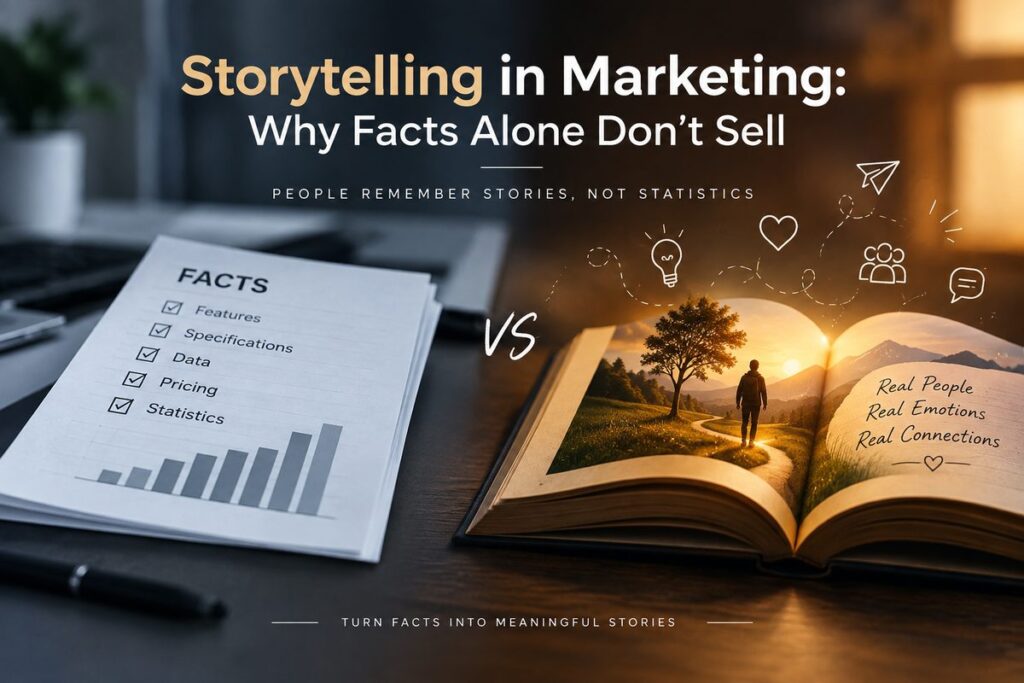
Facts matter. Price matters. Evidence matters. Features matter. But people also need to understand why those facts are relevant to their situation. They need to recognize the problem, imagine the outcome, trust the company, and see how the product fits into their own lives or businesses. This is where Storytelling in Marketing becomes powerful.
A statement such as “our software reduces reporting time” communicates information. A story about a finance manager who used to spend every Friday combining spreadsheets, missed family dinners during month-end reporting, and later reduced that workload through a new system gives the information context.
The feature has not changed.
The way the customer understands its value has.
Research into narrative persuasion helps explain why this happens. A recent 2026 review of narrative-persuasion research found that stories can influence attitudes and behaviours, particularly when audiences become immersed in the narrative and identify with its characters. Current research on narrative persuasion discusses these effects in greater detail.
That does not mean brands should replace evidence with emotional stories. Effective Storytelling in Marketing combines the two. The story makes the information meaningful, while facts, proof, demonstrations, and evidence give customers reasons to believe it.
Marketing storytelling is not simply beginning an advertisement with “Once upon a time.”
It means organizing information around people, problems, tension, decisions, change, and outcomes rather than presenting everything as a list of claims.
A traditional advertisement may say:
“Our accounting software includes automated reporting, cloud access, real-time dashboards, and integrations.”
A story-led version may begin:
“Every Monday morning, Sarah’s finance team spent three hours downloading reports from five different systems before the leadership meeting could even begin.”
The product features can still appear later.
But now the audience understands what those features solve.
Harvard Business Review has long argued that facts and corporate credentials alone may not be enough to persuade an audience if people are not motivated to listen. Its discussion of using stories to persuade highlights storytelling as a way to make an argument more engaging and understandable.
Strong Storytelling in Marketing therefore gives facts a human structure.
Consider two versions of the same message.
“Our platform has:
These may all be valuable features.
But the customer still needs to translate them into meaning.
“Last year, a growing consultancy discovered that three employees were still emailing different versions of confidential client files between each other. Nobody knew which document was current, and one former employee still had access to an old shared folder.
The company moved its project files into one controlled system where permissions could be changed centrally, teams worked from the same files, and backups ran automatically.”
Now the technical features have a situation around them.
The second version does not make evidence unnecessary. If the business claims specific security standards or performance levels, those claims should still be supported.
But the customer understands why the information matters.
That is one of the main roles of Storytelling in Marketing: transforming abstract features into recognizable consequences.
A number without context can be difficult to interpret.
Imagine a business says:
“Our service saves clients eight hours per week.”
That sounds useful.
But what does eight hours mean?
A stronger story might explain that a small business owner previously spent Monday mornings manually preparing stock reports and could not focus on sales until lunchtime. After automation, the report was ready before the team arrived.
Now “eight hours” becomes easier to imagine.
The customer can connect the number with a real working week.
This is why marketing should not treat facts and stories as competitors.
Facts answer:
What happened?
Stories help answer:
Why should I care?
Effective Storytelling in Marketing connects both questions.
The main character in a marketing story does not always need to be the company founder.
Often, the strongest character is the customer.
This is an important shift.
Many brands tell stories like this:
“We started in 2014. We worked very hard. We expanded. We won awards. We now have 50 employees.”
That may be useful company history, but it does not automatically explain why a potential customer should care.
Customer-centred storytelling asks different questions.
Who is the person experiencing the problem?
What are they trying to achieve?
What is making that difficult?
What are they worried about?
What have they already tried?
What changed?
When Storytelling in Marketing keeps the customer close to the centre of the narrative, the audience is more likely to recognize its own situation.
The company does not disappear from the story.
Its role changes from “hero” to “guide.”
Stories without tension are difficult to remember.
Marketing is similar.
If everything begins perfectly, there is no reason for change.
A useful business story usually contains some form of gap between the current situation and the desired situation.
For example:
A retailer has traffic but poor online sales.
A university receives enquiries but students abandon the application form.
A restaurant is busy but cannot understand which menu items are profitable.
A startup has a strong product but nobody recognizes the brand.
A construction company generates leads but sales staff cannot identify where they came from.
The problem creates movement.
The customer wants to get from one situation to another.
Good Storytelling in Marketing explains that gap before presenting the solution.
If a brand introduces its product before the audience understands the problem, the offer can feel irrelevant.
The word “emotion” sometimes makes B2B marketers uncomfortable.
They assume professional buyers make purely rational decisions.
But business decisions are still made by people.
A director choosing new software may worry about implementation failure.
A marketing manager may fear wasting budget.
A founder may worry about running out of cash.
An IT manager may worry about security.
An employee may simply be frustrated by repetitive work.
Emotion does not mean making every campaign dramatic.
It means recognizing what the outcome means to the person making the decision.
Research on narrative transportation describes how stories can create both cognitive and emotional involvement. A 2024 review of the research explains that transportation can involve attention, mental imagery, and affective engagement, and can contribute to changes in attitudes, beliefs, and behaviour. Research on narrative transportation provides a detailed overview.
Effective Storytelling in Marketing uses emotion to make consequences understandable rather than using emotion as manipulation.
A good story should never become an excuse for weak evidence.
Suppose a cybersecurity business says:
“A client came to us after losing £500,000 in one attack, and our solution guaranteed they would never be attacked again.”
Those claims require serious evidence.
Marketing stories should not invent customers, fabricate outcomes, exaggerate results, or imply guarantees that do not exist.
The stronger approach combines narrative with verifiable proof.
A case study might explain:
The original situation.
The problem.
The solution.
The implementation.
The measurable result.
The timeframe.
Any limitations that matter.
This is where Storytelling in Marketing becomes more credible.
The narrative keeps people interested.
Evidence keeps the message trustworthy.
Customers naturally expect companies to say positive things about themselves.
A business saying “our service is excellent” does not provide much independent reassurance.
A customer explaining what happened can be more powerful.
Research published in the Journal of Business Research examined story-based consumer reviews and found that narrative-style reviews could increase transportation and reflection, influencing behavioural intentions. Research on narrative consumer reviews provides the underlying studies.
That helps explain why testimonials become stronger when they tell a story.
Compare:
“Excellent company. Highly recommended.”
with:
“We originally contacted the agency because our paid campaigns were generating enquiries but almost none were qualified. The team rebuilt our targeting and landing-page process, and within the following campaign period our sales team began receiving fewer but much more relevant enquiries.”
The second testimonial provides context.
Good Storytelling in Marketing therefore turns social proof into customer experience rather than a collection of generic compliments.
Case studies are one of the easiest places to use storytelling because the basic story already exists.
A useful structure is:
Who was the customer?
What was happening?
What prevented progress?
Why did the problem matter?
What did the customer decide to change?
What did your business actually do?
What changed?
What measurable results support the outcome?
This structure is simple because it mirrors how people naturally understand change.
Weak case studies often begin by describing the agency or product for several paragraphs.
Strong case studies begin with the customer.
For Storytelling in Marketing, case studies are especially useful because they combine narrative, evidence, and social proof in one piece of content.
Some marketers assume stories belong mainly in consumer advertising.
Research suggests otherwise.
A study published in Industrial Marketing Management examined narrative transportation in B2B advertising and found that narrative advertising was associated with trust, personal connection, and advocacy among business decision-makers. The research also specifically examined senior executives. B2B storytelling and narrative transportation research provides more detail.
Think about a business buying enterprise software.
The decision may involve:
Technical requirements.
Security.
Price.
Implementation.
Support.
Integration.
Compliance.
Return on investment.
Facts are essential.
But the buyer also wants to understand what implementation will actually feel like.
A customer story can show that.
Strong Storytelling in Marketing makes complex B2B information easier to relate to without removing the technical detail serious buyers need.
A brand story is not simply a timeline.
“Founded in 2018” is a fact.
A useful brand story explains why the company exists.
What problem did the founders repeatedly notice?
What did customers struggle with?
What did existing alternatives fail to provide?
What does the company believe should be done differently?
Who does it want to help?
Those questions turn company information into meaning.
Harvard Business School’s material on brand storytelling describes stories as a way to fill brands with relevant meaning and discusses the importance of creating stories that are resonant, authentic, and differentiated.
That is important for Storytelling in Marketing because customers are not interested in a corporate autobiography unless that history helps explain the value and identity of the business.
Websites often contain large amounts of factual information:
Services.
Features.
Prices.
Qualifications.
Locations.
Technical specifications.
FAQs.
All of that can be useful.
Storytelling helps connect those facts.
For example, a service page could begin with the customer’s current frustration rather than immediately listing deliverables.
A portfolio page can show the challenge behind each project.
An About page can explain why the company approaches the market differently.
A product page can show how the customer uses the product in a real situation.
This does not mean turning a website into a novel.
Good Storytelling in Marketing can happen in a few sentences.
A clear before-and-after scenario may be enough.
The important thing is giving the reader something recognizable.
Businesses developing website content alongside their wider strategy can explore KM Marketers Content Creation Services, which covers website copy, articles, social material, and conversion-focused content.
Social media gives brands several storytelling formats.
A single post can tell a short customer story.
A carousel can show a problem step by step.
A short video can follow a transformation.
Stories or Reels can show behind-the-scenes activity.
A longer LinkedIn post can describe a business lesson.
A testimonial video can let the customer tell the experience directly.
The biggest mistake is believing every story needs expensive production.
Sometimes the most believable content is simple.
For example:
“Three months ago, this client came to us with one problem…”
That sentence already creates curiosity.
The audience wants to know what happened.
Good Storytelling in Marketing on social media creates movement rather than simply displaying another promotional graphic.
KM Marketers Social Media Marketing combines content, campaigns, community engagement, and advertising, while the company’s social media portfolio also describes storytelling as part of its approach to brand experiences.
An advertisement may have only seconds to communicate.
It can still contain a story.
Consider this simple structure:
Problem: “Still spending Friday afternoon building reports manually?”
Tension: “Your team updates five spreadsheets before management can see what happened this week.”
Change: “Connect the data once.”
Outcome: “Open one dashboard Monday morning.”
That is a miniature story.
It contains a current situation, frustration, change, and desired outcome.
Harvard Business Review’s 2024 discussion of storytelling in sales pitches emphasizes understanding the customer’s needs and creating a narrative that explains why the product or service is relevant to them.
Effective Storytelling in Marketing does not depend on length.
It depends on structure.
Imagine a company has reduced customer waiting time from 14 minutes to 6 minutes.
The number is strong.
Now add context.
Before the change, customers regularly abandoned the queue during the busiest hour.
Staff spent time handling complaints.
Managers had to add extra support during peak periods.
After the process changed, the average waiting time fell.
Now the statistic represents something operational.
This is especially useful for reports, presentations, case studies, and B2B marketing.
Do not hide the numbers.
Explain what those numbers changed.
That is one of the most useful applications of Storytelling in Marketing.
A story that matters to the CEO may not matter to an operations manager.
Imagine the same automation platform.
The CEO may care about reducing operating cost.
The finance director may care about reporting accuracy.
The operations manager may care about saving employee time.
The IT manager may care about integration and security.
The end user may care about avoiding repetitive work.
The underlying product is identical.
The relevant story changes according to the audience.
That is why customer research matters.
Sales conversations.
Support tickets.
Reviews.
Interviews.
CRM notes.
Social comments.
Search queries.
All can reveal what customers actually care about.
Strong Storytelling in Marketing begins with listening before writing.
Generic stories are not very useful.
Consider:
“Businesses everywhere face challenges in a rapidly changing environment.”
Almost any company could use that sentence.
A better opening is specific:
“When a construction company has twenty active sites, project updates can arrive through spreadsheets, WhatsApp messages, calls, and handwritten notes before head office sees them.”
A construction manager can recognize the situation immediately.
Specificity creates relevance.
The story does not need dramatic characters.
It needs recognizable reality.
This is why customer research improves both content and Storytelling in Marketing.
The better the company understands everyday customer situations, the easier it becomes to create stories that feel real.
Emotion is powerful, which creates responsibility.
Brands should avoid inventing tragedies, exaggerating customer fear, fabricating testimonials, or using emotional pressure to hide important information.
A story should clarify the decision.
It should not trick someone into making it.
If a product contains limitations, those limitations still matter.
If results vary between customers, do not present one exceptional case as a guaranteed outcome.
If a customer story has been simplified for privacy or readability, make sure the essential facts remain accurate.
Authenticity matters because trust is difficult to rebuild once audiences feel manipulated.
Long-term Storytelling in Marketing works best when the story is interesting because the customer’s problem is real, not because the marketer has exaggerated it.
Businesses do not need to become professional screenwriters.
A practical framework is enough.
Story Element | Question to Ask |
Customer | Who is experiencing the situation? |
Goal | What are they trying to achieve? |
Problem | What is preventing progress? |
Impact | Why does the problem matter? |
Decision | What needs to change? |
Solution | How does the product or service help? |
Outcome | What becomes better afterwards? |
Evidence | What facts support the result? |
Next Step | What should the audience do now? |
This framework keeps the customer at the centre while allowing facts and proof to support the message.
It is one of the simplest ways to apply Storytelling in Marketing consistently across channels.
Consider a digital marketing agency.
“We provide SEO, paid advertising, content marketing, social media management, website development, analytics, and monthly reporting.”
Everything may be correct.
But the customer has to work out why those services matter together.
“A growing property business was generating leads from Facebook, Google, and its website, but nobody could confidently explain which campaigns were creating serious enquiries.
Marketing reports showed clicks.
Sales had spreadsheets.
The website recorded forms.
None of the systems connected.
The company did not need another advertising channel. It needed one marketing process connecting campaigns, landing pages, tracking, lead quality, and reporting.
Once that process was rebuilt, management could finally see which activity deserved more budget.”
Now the same capabilities have context.
The reader understands the business problem before seeing the solution.
That is Storytelling in Marketing in practical form.
One common mistake is making the company the hero.
The customer disappears while the brand talks about itself.
Another mistake is adding unnecessary drama.
Business storytelling does not need villains, dramatic music, or exaggerated conflict to work.
Some companies tell interesting stories that have no connection with their product.
Others use emotion but provide no evidence.
Another mistake is writing a long story before explaining why the audience should care.
The opposite problem also occurs: businesses remove so much detail that the “story” becomes another generic testimonial.
Some marketers also copy stories from competitors instead of listening to their own customers.
The strongest Storytelling in Marketing uses genuine customer insight, specific situations, and evidence the brand can stand behind.
Most companies already have useful stories.
They simply have not documented them.
Ask the sales team:
What problem did the last ten customers mention first?
Ask customer support:
What causes the most frustration?
Ask account managers:
Which clients have changed most since working with us?
Ask product teams:
What feature solved a problem customers repeatedly reported?
Ask founders:
Why was the business created?
Ask customers:
What was happening before you contacted us?
The answers can become:
Case studies.
Videos.
Blog posts.
Social posts.
Email campaigns.
Advertisements.
Website copy.
Sales presentations.
The raw material for Storytelling in Marketing is usually closer than companies think.
A story still needs marketing objectives.
For awareness content, businesses may measure reach, video completion, engagement, branded search, or profile visits.
For consideration content, useful signals might include case-study views, guide downloads, email sign-ups, repeat website visits, or time spent exploring important content.
For conversion content, measure enquiries, qualified leads, bookings, purchases, and revenue.
Do not assume a story works simply because the internal team likes it.
Test it.
Compare different openings.
Compare customer stories with feature-led messages.
Study which case studies lead to sales conversations.
Ask customers what content influenced their decisions.
Marketing creativity becomes more useful when it can learn from performance.
The title of this article does not mean facts are unimportant.
Quite the opposite.
Facts become more persuasive when people understand their relevance.
Suppose a business can genuinely demonstrate:
32% faster processing.
£40,000 annual savings.
60 fewer support tickets per month.
Two hours saved per employee each week.
Those numbers are valuable.
Now explain what changed for the customer.
What could staff do with the additional time?
What did the savings allow the company to invest in?
How did fewer complaints affect the support team?
What was life like before the improvement?
This combination is much stronger than either facts or emotion alone.
The story attracts attention and creates meaning.
The evidence supports credibility.
Customers need information to make decisions.
They need prices.
Features.
Specifications.
Proof.
Reviews.
Comparisons.
Data.
But information becomes far more useful when it is connected to a recognizable human or business situation.
That is why Storytelling in Marketing matters.
A strong story helps the customer understand the problem, recognize themselves in it, imagine a better outcome, and see how the product or service can help create that change.
The company does not need to invent drama.
It needs to understand its customers.
Listen to real problems.
Document real experiences.
Use genuine evidence.
Explain change clearly.
Let facts support the story rather than expecting facts to create meaning on their own.
When businesses do this consistently, marketing stops sounding like a list of claims.
It starts sounding relevant.
And relevance is much easier to remember.
KM Marketers helps businesses combine strategy, content, social media, SEO, web experiences, and advertising into messages designed to connect with real audiences. KM Marketers’ Content Creation Services focus on blogs, website content, social media, and conversion-focused copy, while its Social Media Marketing Services combine creative content with audience strategy and measurable campaign goals. The aim of effective Storytelling in Marketing is not simply to make content sound more emotional. It is to make the value of the business easier for customers to understand and remember.
Your Trusted Marketing Partner!
KM Marketers is a digital marketing solutions provider helping businesses grow through SEO, social media, content marketing, and paid advertising. Our focus is on delivering measurable results, building strong online visibility, and driving quality leads for clients across different industries.
Email: info@kmassignmentservices.com
kmdigitalmarketing2025@gmail.com
WhatsApp: +60 16-522 4321
Head Office: Galleria Cyberjaya, Parking lot, Jalan Teknokrat 6, Cyber 5, 63000 Cyberjaya, Selangor, Malaysia.
Hours: Mon–Sat 10:00 AM to 07:00 PM
© 2026 KM Marketers. Powered by KM Software Services Sdn. Bhd. (1308207-U). All Rights Reserved.