
Understand technical SEO and discover how website structure, crawlability, indexing, site speed, security, and other backend factors influence Google rankings.
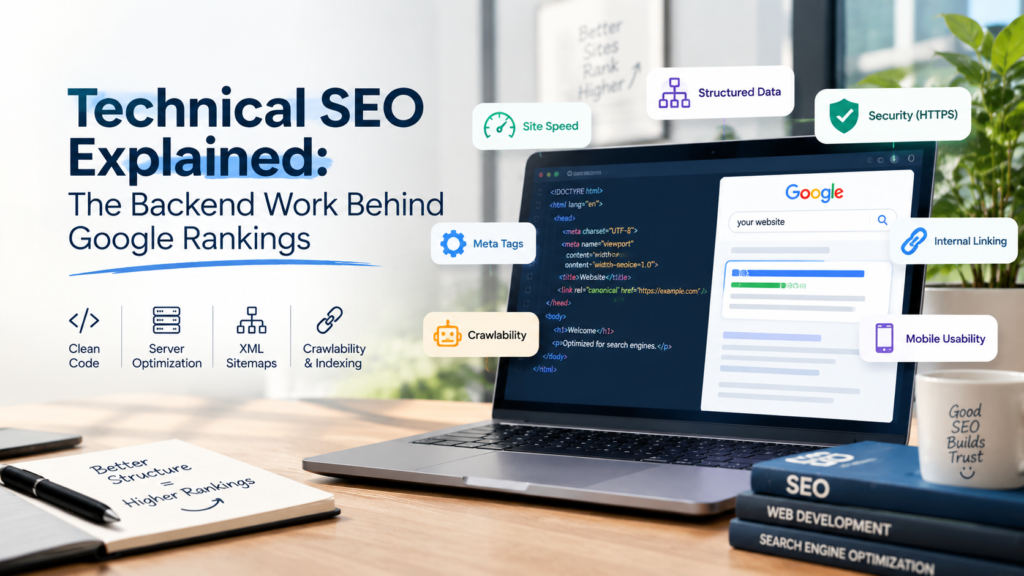
A practical 2026 guide to crawling, indexing, speed, architecture, structured data, and the invisible work that helps search engines trust your website
A great page can still be invisible. |
When business owners hear “SEO,” they usually think of keywords, blog posts, backlinks, and Google rankings. Those things matter. But underneath every visible search result is a technical layer that determines whether Google can discover a page, understand which version is important, process its content, and serve it efficiently to users.
That invisible layer is technical SEO. It includes crawlability, indexation, site architecture, redirects, canonical tags, XML sitemaps, robots directives, page speed, mobile behaviour, JavaScript rendering, structured data, HTTPS, duplicate-URL control, and dozens of small implementation details that can quietly help or quietly damage search performance.
Google explains Search as a process that begins with crawling, continues through indexing, and ultimately serves results from its index. Most pages are discovered automatically by web crawlers rather than manually submitted. That means a website has to make itself understandable not only to people, but also to the systems that discover and process it.
Technical SEO is not a magic ranking switch. Fixing a sitemap does not make weak content rank first. Improving Core Web Vitals does not replace relevance or authority. Instead, technical SEO creates the conditions in which strong content can be found, interpreted, measured, and competed fairly. Think of it as the infrastructure behind the marketing.
Technical SEO is the process of improving the technical structure and delivery of a website so search engines can efficiently crawl, render, understand, index, and serve its important pages while users receive a fast, secure, and reliable experience.
The simplest mental model |
A technical problem can affect one page or ten thousand pages at once. A badly written title may weaken one URL. A mistaken noindex directive, broken canonical setup, failed migration, blocked resource, or faceted-navigation problem can suppress an entire section of a website.
That is why technical SEO has disproportionate leverage. It is often the difference between publishing content and making that content reliably available to search systems. It also protects marketing investments during redesigns, CMS changes, domain moves, international expansion, e-commerce growth, and JavaScript-heavy development.
Google Search Essentials separates technical requirements from spam policies and broader best practices. Meeting technical requirements does not guarantee ranking, but failing them can stop pages from appearing as expected. For businesses, that makes technical SEO a risk-management discipline as much as a growth discipline.
Technical area | What it controls | Typical problem | Business consequence |
Crawling | Whether bots can reach URLs | Important pages orphaned or blocked | Pages may not be discovered |
Indexing | Whether pages are eligible for the index | Accidental noindex, soft 404s | Pages can disappear from results |
Canonicalisation | Which duplicate URL is primary | Filters/parameters create duplicates | Signals become fragmented |
Architecture & links | How pages connect | Deep pages, weak internal links | Poor discovery and context |
Performance | Loading and responsiveness | Heavy scripts/images | Weaker user experience |
JavaScript rendering | Whether rendered content is accessible | Key content only after client-side errors | Search systems see incomplete pages |
Structured data | Machine-readable meaning | Invalid or misleading markup | Lost rich-result eligibility |
Migration & redirects | How URL changes are transferred | Broken redirects / redirect chains | Traffic and authority losses |
Crawling is discovery. Googlebot follows links, reads sitemaps, revisits known URLs, and finds new or changed content. If an important page is not linked internally, is buried behind a workflow, or is accidentally blocked, search engines may struggle to reach it consistently.
Google’s developer guidance recommends making important URLs reachable through crawlable HTML links and using a sitemap to help Googlebot discover the site more intelligently. For JavaScript applications, each meaningful screen or piece of content should have its own URL rather than existing only as a state inside one generic page.
Technical SEO therefore begins with a basic question: can a crawler travel through the website in roughly the same logical way a user can? If your main service page can only be reached by typing its URL manually, that is not a strong architecture.
The robots.txt file controls crawler access to paths. It is useful for preventing unnecessary crawling of selected areas, but it is not a universal “remove this from Google” command. Google explicitly notes that a URL blocked from crawling can still sometimes be indexed as a URL without a snippet if other signals point to it.
If the goal is to keep a page out of Search, an index-control method such as a noindex directive must be allowed to be crawled so the crawler can actually see the instruction. Blocking the page in robots.txt and adding noindex at the same time can therefore be self-defeating.
Common mistake |
After a page is crawled, Google decides whether and how it should be indexed. A page can be accessible to users and still be excluded because of a noindex rule, duplication, poor canonical signals, errors, redirects, thin or low-value variants, or other processing decisions.
The noindex robots meta tag explicitly tells Google not to index content. That makes it useful for selected utility pages, but dangerous when applied accidentally to a template, category, product group, or entire site. Technical audits should compare which URLs the business wants searchable with which URLs Google is actually indexing.
Google Search Console is essential here because the URL Inspection and indexing reports show how Google sees specific URLs and which broad reasons may be preventing inclusion. Technical SEO becomes far more reliable when decisions are based on search-engine evidence rather than assumptions from the CMS.
An XML sitemap is a machine-readable list of URLs you want search engines to know about. Google describes sitemaps as a way to provide information about pages and files and recommends using fully qualified URLs. A single sitemap is limited to 50 MB uncompressed or 50,000 URLs, after which sitemap index files can be used.
A sitemap should not become a dumping ground for every URL the platform can generate. Ideally, it contains canonical, indexable URLs that represent pages the business genuinely wants to surface in Search. If the sitemap lists URLs that redirect, return errors, carry noindex directives, or canonicalise elsewhere, it sends inconsistent signals and makes monitoring harder.
Submitting a sitemap is also only a hint. Google states that submission does not guarantee crawling or indexing. The value is discovery, monitoring, and cleaner communication – not an instant-ranking button.
E-commerce sites, CMS platforms, filters, tracking parameters, print views, regional pages, HTTP/HTTPS variants, and trailing-slash differences can create several URLs that show substantially the same content. Canonicalisation helps search engines determine which URL should represent the group.
Google defines canonicalisation as selecting the representative URL from a set of duplicate or very similar pages. Signals can include redirects, the sitemap, HTTPS, and rel=”canonical” annotations. Importantly, Google treats a canonical declaration as a signal rather than an absolute command and may select a different URL if the signals conflict or another version appears more appropriate.
For marketers, the lesson is simple: canonical tags should match the rest of the architecture. Internal links, sitemaps, redirects, hreflang, and canonical tags should not argue with one another. Consistency makes it easier to consolidate signals and easier to measure performance.
One product, four possible URLs |
Site architecture is the relationship among categories, subcategories, service pages, products, articles, locations, and supporting resources. A logical structure helps users find information and helps crawlers understand which pages are important and how topics relate.
Google’s SEO guidance emphasises crawlable links. That sounds simple, but modern interfaces sometimes hide navigation behind scripts, filters, buttons, or search boxes that do not produce normal links a crawler can follow efficiently. Every high-value page should have a sensible path from another discoverable page.
Internal links also carry context. A relevant anchor such as “technical SEO audit” tells users and search systems more than “click here.” Strong internal linking is not about adding hundreds of links everywhere. It is about connecting related pages where the connection genuinely helps the user.
URLs do not need to be beautiful to rank, but they should be stable, descriptive enough for people, and logically generated. Problems arise when platforms create endless parameter combinations, session IDs, duplicate case variants, dynamically changing paths, or URLs that disappear whenever products move between categories.
For large e-commerce and marketplace sites, faceted navigation deserves special attention. Filters for size, colour, brand, price, rating, stock status, and sorting can create enormous numbers of URL combinations. Some combinations deserve search visibility; many do not. Technical SEO decides which should be crawlable, indexable, canonicalised, or otherwise controlled.
HTTP status codes are part of the web’s basic language. A healthy page normally returns 200. A permanent URL move typically uses a permanent redirect. A missing page should return an appropriate error response. Problems occur when servers return 200 for error pages, redirect every missing URL to the homepage, or create long chains of redirects.
Redirects become especially important during redesigns and migrations. If an old high-performing URL is replaced, the closest relevant new URL should normally receive the redirect. A migration without a URL map can break years of inbound links, bookmarks, indexed URLs, and accumulated search signals.
Technical SEO should therefore be involved before a migration, not after organic traffic drops. Crawl the old site, map priority URLs, preserve relevant content, test redirects in staging, update internal links, submit the new sitemap, and monitor Search Console after launch.
A slow website damages more than rankings. It delays product discovery, form completion, checkout, lead generation, and customer trust. Google’s current Core Web Vitals measure real-world loading performance, responsiveness, and visual stability using Largest Contentful Paint (LCP), Interaction to Next Paint (INP), and Cumulative Layout Shift (CLS).
Google recommends good Core Web Vitals for success with Search and for user experience more broadly. It also cautions against treating one score as the entire page-experience strategy. A technically perfect speed score cannot compensate for irrelevant content, and chasing 100/100 at any cost may produce diminishing returns.
The practical technical SEO job is to identify bottlenecks that affect real users: oversized images, slow server response, render-blocking resources, excessive JavaScript, third-party scripts, heavy fonts, unstable ads, poor caching, or bloated themes. Performance should be measured with field data where available, not only on a developer’s fast laptop.
Metric | What it reflects | Google good-experience threshold |
LCP | Loading performance | 2.5 seconds or less |
INP | Interaction responsiveness | Less than 200 ms |
CLS | Visual stability | 0.1 or less |
Mobile SEO is no longer a separate afterthought. A technically sound site should deliver equivalent important content, metadata, links, structured data, and functionality across the experiences users receive. Navigation, tap targets, forms, media, and overlays all affect whether a page is usable on a phone.
Google’s page-experience guidance encourages site owners to look beyond a single metric and consider Core Web Vitals, secure delivery, mobile display, intrusive interstitials, and whether users can clearly distinguish the main content. These factors are valuable even beyond direct ranking considerations because they affect what happens after the click.
Modern websites can rely heavily on JavaScript for navigation, product filtering, dashboards, interactive content, and single-page applications. Google Search can render JavaScript using an evergreen version of Chromium, but JavaScript sites still need careful implementation.
Google describes JavaScript processing in three broad phases: crawling, rendering, and indexing. Problems can appear when content requires user actions, URLs are not unique, rendering fails, important resources are inaccessible, or critical metadata is created inconsistently after initial load.
The key principle is resilience. Important content, links, titles, canonical signals, and structured data should be implemented in ways Google can reliably process. Developers and SEO teams should test rendered HTML and use URL Inspection rather than assuming that “it works in Chrome for me” means search crawlers receive the same result.
Structured data is standardised machine-readable markup that gives explicit clues about what a page contains. Google uses supported structured data to understand content and, when requirements are met, may use it for richer search appearances.
For an e-commerce site, structured data might describe products, offers, ratings, breadcrumbs, organisations, or other supported entities. For content sites, different supported types may apply. Correct markup can improve eligibility for rich results, but Google explicitly states that valid structured data does not guarantee a rich result.
The biggest mistake is treating schema as a place to claim information that is not actually visible or true on the page. Markup should represent the content honestly, follow the supported properties, and be validated with Google’s Rich Results Test before release.
Secure HTTPS delivery is now a basic expectation for business websites. Beyond search considerations, customers submit contact details, account credentials, payment data, documents, and other sensitive information through web interfaces. Certificate errors, mixed content, compromised scripts, and insecure forms damage trust immediately.
Security is also operational SEO protection. A hacked site can generate spam pages, malicious redirects, injected canonicals, or unwanted content. Google’s canonicalisation troubleshooting guidance even lists malicious hacking as one reason unexpected canonical URLs may appear. Keeping software updated, controlling administrator access, monitoring changes, and maintaining backups therefore protect both users and organic visibility.
E-commerce combines most technical SEO challenges at once: thousands of products, categories, filters, sorting options, pagination, out-of-stock items, discontinued products, product variants, structured data, reviews, images, internal search, campaign parameters, and frequent inventory changes.
A small store can often rely on good platform defaults. A large catalogue needs deliberate rules. Which filtered categories have real search demand? What happens when a product goes out of stock temporarily? What happens when it is permanently discontinued? Should variant URLs be independent pages or one canonical product? Are category pages internally linked? Are products orphaned? Are search-result pages being indexed accidentally?
This is why technical SEO should be involved in platform configuration and development decisions, not merely called after launch to “fix Google.” The earlier crawling and indexation rules are designed, the less expensive they are to correct.
International sites add language and regional complexity. If a business has separate versions for the United Kingdom, United States, Canada, and Australia, pages may be extremely similar while targeting different users. Search engines need clear signals about which version belongs to which audience.
Canonicalisation and hreflang need to work together rather than contradict each other. Google’s canonical guidance notes that regional variants in the same language can use canonicalisation together with hreflang to help the correct regional URL appear. International SEO therefore requires careful URL strategy, localisation, internal linking, and consistent annotations.
A website redesign is one of the highest-risk moments for organic visibility because visual changes often hide structural changes. Developers may rename URLs, replace navigation, remove old content, change CMS output, introduce JavaScript rendering, alter canonicals, or launch new robots directives.
A good migration process creates an SEO inventory before development is complete. Which pages receive traffic? Which have backlinks? Which rank for valuable searches? Which should be consolidated or removed? Every important old URL should have an intentional outcome: retained, improved, redirected, or deliberately retired.
After launch, the work continues. Crawl the new site, test redirect coverage, inspect canonical tags, compare sitemaps, validate robots directives, monitor indexing, review server errors, watch Core Web Vitals, and compare organic landing-page performance. The first days after migration are not the time to assume everything is fine.
Technical SEO cannot manufacture demand. It cannot make an irrelevant page useful, create expertise that does not exist, or earn genuine authority without valuable content and promotion. A perfectly crawlable empty page is still an empty page.
It also cannot guarantee a ranking. Google states clearly that meeting technical requirements and best practices does not guarantee crawling, indexing, or a particular search position. Rankings are produced by many systems and signals that go beyond technical setup.
The best SEO strategies therefore connect technical SEO with content, on-page optimisation, digital PR, links, brand authority, local search, conversion optimisation, and analytics. Technical SEO is the foundation; it is not the entire building.
Period | Priority | Typical actions | Success evidence |
Days 1-30 | Find blockers | Crawl site; review indexation, robots, canonicals, sitemap, status codes, Search Console | Critical blockers identified and prioritised |
Days 31-60 | Fix high-impact issues | Repair redirects, internal links, index controls, duplicate rules, templates, performance bottlenecks | Cleaner crawl/indexation signals; fewer errors |
Days 61-90 | Strengthen & monitor | Improve structured data, architecture, CWV, migration hygiene, reporting and ongoing QA | Stable technical health and measurable search improvement |
Technical SEO should be measured with evidence, not with the number of audit issues closed. If 200 low-value warnings disappear but your important pages are still not indexed, the audit has not solved the business problem.
Useful measures can include the share of priority URLs indexed, reductions in crawl and server errors, cleaner sitemap processing, stronger Core Web Vitals, improved crawl paths, fewer duplicate/canonical conflicts, successful migration retention, and organic clicks to pages that were previously technically blocked.
Always separate technical health from ranking outcomes. A technical fix may make a page eligible and understandable, but content quality and competition still determine how far it can climb.
The best technical SEO is almost invisible. Customers do not celebrate that your sitemap contains clean canonical URLs. They do not notice that your redirects preserve old links, your JavaScript renders correctly, or your structured data validates. They simply find the right page, see it load quickly, and use it without friction.
But when the technical layer fails, the effects are very visible: missing pages, lost traffic, broken links, duplicate search results, slow mobile experiences, failed migrations, disappearing products, and marketing teams publishing content that search engines never properly process.
That is why technical SEO should be treated as ongoing website maintenance, not a one-time checklist. Every CMS update, redesign, new feature, product filter, migration, integration, and front-end change can alter how search systems encounter the site. The strongest businesses make SEO part of development and quality assurance before problems reach production.
Want the technical side of SEO to support your marketing instead of holding it back? |
MAKE IT CRAWLABLE. MAKE IT INDEXABLE. MAKE IT FAST. THEN MAKE IT WORTH RANKING.
Your Trusted Marketing Partner!
KM Marketers is a digital marketing solutions provider helping businesses grow through SEO, social media, content marketing, and paid advertising. Our focus is on delivering measurable results, building strong online visibility, and driving quality leads for clients across different industries.
Email: info@kmassignmentservices.com
kmdigitalmarketing2025@gmail.com
WhatsApp: +60 16-522 4321
Head Office: Galleria Cyberjaya, Parking lot, Jalan Teknokrat 6, Cyber 5, 63000 Cyberjaya, Selangor, Malaysia.
Hours: Mon–Sat 10:00 AM to 07:00 PM
© 2026 KM Marketers. Powered by KM Software Services Sdn. Bhd. (1308207-U). All Rights Reserved.