
Turning social media followers into customers does not require making every post a sales advertisement. In fact, constant selling can make an audience lose interest. The stronger approach is to use content to build awareness, trust, and buying confidence, then give interested people a simple way to take the next step.
This guide explains how businesses can move from follower growth to measurable revenue without damaging the community they worked hard to build.
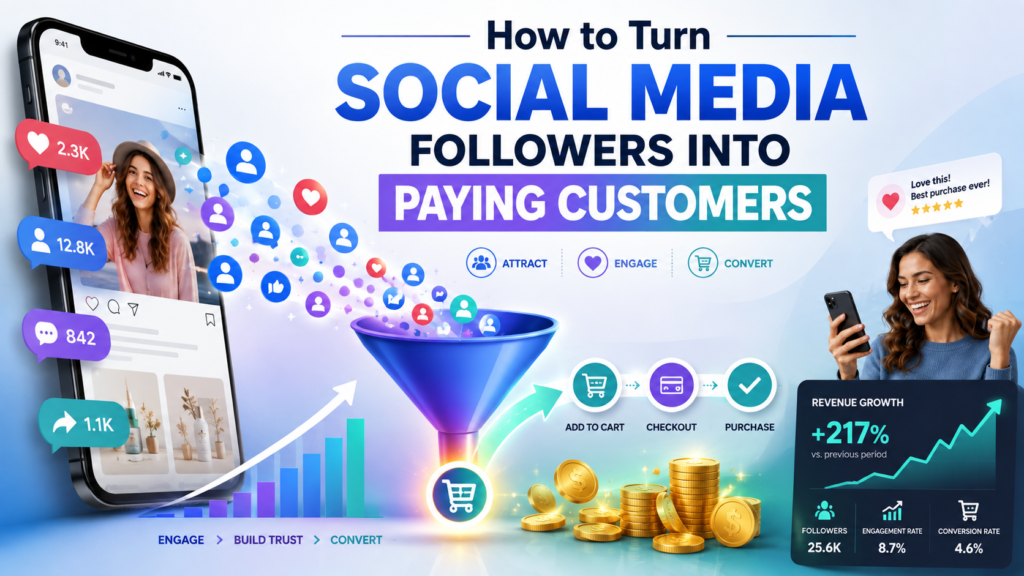
Someone can follow a business for many reasons.
They may enjoy the videos.
They may like the educational content.
They may be researching an industry.
They may have entered a competition.
They may be interested in buying eventually but not today.
They may simply like the personality behind the account.
That means a large audience does not automatically equal a large customer base.
The first step in converting social media followers is understanding that different people are at different stages of the buying journey.
Some have only discovered the brand. Others recognize the company but do not yet trust it. Some are comparing alternatives. A smaller group may already be looking for a reason to buy.
The content strategy needs to support all of those stages rather than treating every follower as if they are ready for a “Buy Now” message.
This is also why engagement metrics should not be judged in isolation. Ten thousand likes can look impressive, but one hundred qualified enquiries may create far more business value.
Before trying to generate customers, define what a good customer actually looks like.
This sounds obvious, but businesses often create content for an audience that is much broader than the people likely to purchase.
Imagine a company selling accounting software for small restaurants.
General business motivation posts may attract thousands of entrepreneurs, students, freelancers, and people interested in productivity. The audience grows, but many followers have no reason to purchase restaurant accounting software.
A better content strategy focuses more closely on problems restaurant owners recognize:
Now the content is attracting people much closer to the actual customer profile.
To turn social media followers into buyers, audience relevance normally matters more than raw audience size.
Write down the customer’s industry, location, typical problem, buying motivation, objections, and the situation that usually causes them to start looking for help.
Then ask whether the current content regularly speaks to those issues. If not, follower growth may be moving in the wrong direction.
Trust is one of the most important bridges between attention and purchase.
A new follower usually knows very little about the business. They may have seen one Reel or TikTok. They may have discovered a post through search. They may have noticed a recommendation.
Immediately asking for a large purchase ignores everything the customer still needs to understand.
Content should gradually answer questions such as:
Businesses can build that confidence through educational content, useful demonstrations, customer stories, case studies, behind-the-scenes material, FAQs, product explanations, comparisons, and examples of real work.
The objective is not to give away everything for free. It is to reduce uncertainty.
The stronger the trust relationship with social media followers, the easier the eventual sales conversation becomes.
This is particularly important for higher-value services where people rarely purchase immediately after seeing one social post.
Not every piece of content needs the same objective.
A useful way to plan social content is around three stages.
This attracts attention.
Examples include educational tips, short videos, industry observations, relatable problems, trends, useful checklists, and entertaining content related to the brand’s market.
The goal is discovery.
This helps people understand the solution.
Examples include product demonstrations, detailed guides, comparisons, FAQs, client results, case studies, objection handling, process explanations, and behind-the-scenes content.
The goal is confidence.
This gives people a reason to act.
Examples include consultations, free assessments, demos, limited offers, product launches, booking links, lead forms, trials, quote requests, and clear purchase calls to action.
The goal is movement.
A business struggling to monetize social media followers often has an imbalance.
Some accounts publish almost entirely awareness content. They generate views but rarely explain the service. Others publish almost entirely conversion content. Every post asks people to buy, which gives the audience little reason to keep paying attention.
Strong social media strategy combines all three stages.
KM Marketers Social Media Marketing focuses on strategy, content creation, community engagement, advertising, and performance measurement rather than treating social media as simple daily posting.
People should not have to investigate the entire account to work out how to become a customer.
A call to action tells the audience what to do next.
The mistake is trying to include every possible action in the same piece of content.
“Like, comment, share, follow, visit our website, subscribe to our newsletter and book a call” creates too many competing instructions.
When converting social media followers, choose the action that best fits the content and the person’s likely stage of awareness.
Someone watching a short educational video for the first time may be more comfortable downloading a checklist than booking a paid consultation. Someone watching a detailed case study after following the business for six months may be much more prepared to request a quote.
Calls to action should match intent.
“Link in bio” is only useful if the destination helps the visitor continue.
Imagine a post promoting a free marketing audit. The person is interested and clicks the link. They land on a general homepage containing web development, SEO, branding, social media, company history, blog posts, testimonials, and ten other options. Now the customer has to find the offer again.
Some will. Others will leave.
For campaigns designed to convert social media followers, a focused landing page can often provide a clearer journey.
The headline should match what the social post promised. Explain the offer. Show why it matters. Provide enough evidence to build trust. Answer the most likely objections. Make the next step clear.
This also improves measurement because the business can see how people arriving from a particular campaign behave after leaving the social platform.
Not everybody following a business is ready to make a purchase today. That does not mean the relationship has no value.
A lead magnet gives an interested person something useful in exchange for permission to continue the conversation.
The offer should be closely related to the eventual product.
A web-development company could offer a website performance checklist. A real-estate company could provide a buying guide. A marketing agency could offer a social media audit. A fitness business could provide a beginner training plan.
A useful lead magnet helps move social media followers from an algorithm-controlled platform into a relationship the company can continue through email, CRM follow-up, phone, or another approved channel.
Google Analytics describes lead generation as the process of identifying people showing interest in a business and specifically recognizes actions such as submitting enquiry or lead forms as measurable lead activity. Google’s lead-generation guidance provides a useful framework for measuring those actions.
A comment is not always just engagement.
Someone asking “How much does this cost?”, “Do you provide this in Dubai?”, “Can this integrate with Shopify?”, or “How long does the process take?” may already be showing buying intent.
Businesses sometimes reply with one-word answers and move on. Others go too far in the opposite direction and immediately send aggressive sales messages to anyone who interacts with a post.
A better approach is conversational. Answer the question properly. If more information is required, invite the person to continue privately. Ask what they are trying to achieve. Recommend the next appropriate step.
The aim is to help rather than pressure.
For service companies, the journey from social media followers to customers can happen almost entirely through conversations when community management is handled well.
Speed matters too. A person requesting a quotation may also be messaging three competitors. A reply two days later enters a very different sales situation from a reply while the person is actively considering the service.
Businesses know their own product works. Potential customers do not.
Social proof helps close that gap.
A good testimonial is more useful when it is specific. “This company is amazing!” sounds positive but communicates very little. A stronger customer story explains the original problem, what was done, and the result.
When social media followers repeatedly see evidence that other customers trust the business, purchasing begins to feel less uncertain.
Do not fabricate testimonials or present unusual results as if every customer should expect exactly the same outcome. Trust is difficult to build and easy to damage.
You can review KM Marketers’ Social Media Marketing Portfolio for an example of how campaign work, client feedback, and social media services can be presented together.
“Check out our services” is not always a strong reason to act.
A specific offer is easier to understand.
Instead of: We provide digital marketing services. Try: Book a 30-minute social media strategy consultation.
Instead of: We sell skincare. Try: Get the three-product starter routine for dry skin.
Instead of: We build websites. Try: Request a free website conversion review.
The offer helps social media followers understand exactly what they will receive.
It also makes campaigns easier to measure. You can compare which offer generates more enquiries, which attracts better-quality customers, and which produces the strongest revenue.
An offer does not always need a discount. Better offers can include convenience, expert guidance, bundles, faster onboarding, bonuses, assessments, trials, demonstrations, or access to something normally difficult to obtain.
Sometimes sending every user to an external website adds unnecessary steps.
Major social platforms increasingly provide native lead-generation tools that allow interested users to submit information without leaving the platform.
TikTok, for example, currently provides native and website-based lead-generation options. Its Business Account lead-generation guidance includes calls to action such as Get Quote, Sign Up, Special Offer, Apply Now, and Subscribe. TikTok’s lead-generation guidance explains the available approach.
TikTok also provides lead-generation solutions for native forms and website-based lead collection.
For businesses trying to convert social media followers, native forms can be useful when the next action is simple and reducing friction matters.
LinkedIn similarly provides lead-generation options for B2B campaigns. LinkedIn’s lead-generation guidance discusses lead forms and conversion-focused campaigns.
However, the easiest form is not always the best form. A high-value B2B service may need several qualifying questions. The objective is not simply to maximize the number of leads. It is to make it easy for the right people to express genuine interest.
Generating a lead is not the end of the funnel. Someone has to follow up.
This sounds obvious, but businesses sometimes spend significant advertising budgets generating enquiries that remain in spreadsheets, inboxes, or platform dashboards for days.
A lead should move into a defined process.
LinkedIn’s marketing-partner guidance highlights lead automation, enrichment, scoring, routing, and reporting as important steps between collecting a lead and converting that person into a customer. LinkedIn: Turn Leads Into Customers
This matters because not all social media followers become customers immediately.
A prospect may need several conversations. Another may need budget approval. Someone may be researching for a purchase three months away. A simple CRM process helps the business continue those relationships instead of starting from zero every time.
Cold audiences and warm audiences should not always receive the same message.
Someone who has never heard of the company may need education. Someone who watched several videos, visited the website, opened a product page, or downloaded a guide already knows more.
Retargeting allows businesses to create campaigns for people who previously interacted with the brand, subject to platform capabilities, consent requirements, and privacy rules.
That audience can receive content better suited to the consideration or conversion stage.
This creates a more logical journey for social media followers than repeatedly showing everyone the same introductory content.
Paid promotion works best when it supports the funnel rather than simply purchasing more impressions.
Follower count is useful. Reach is useful. Likes and comments can be useful. But they do not tell the entire commercial story.
Businesses should also measure:
Google Analytics 4 allows businesses to measure interactions as events and recommends specific events including generate_lead, qualify_lead, working_lead, close_convert_lead, and purchase for relevant customer journeys. GA4’s recommended-events documentation provides the framework.
Google Analytics also allows important events to be marked and used for conversion measurement across channels, including activity originating from social media.
This makes the business question much stronger than: “How many social media followers did we gain this month?”
Ask: “How many qualified enquiries came from social?” “How many became customers?” “How much revenue did those customers create?” “What did acquiring them cost?”
Those are the numbers that connect marketing with business performance.
Your most-viewed post may not be your most commercially valuable post.
A humorous Reel may receive 500,000 views and generate almost no enquiries. A detailed case study may receive 8,000 views but produce twenty qualified leads.
Both pieces can have value. The mistake is assuming the larger number automatically means better marketing.
When evaluating social media followers, trace different content types into later customer actions where measurement allows it.
This analysis can change the content calendar. You may discover that broad entertainment content is excellent for awareness but educational videos create better leads. Or customer stories may generate fewer views but much stronger sales conversations.
Use both when they support different stages of the funnel.
A business notices that sales matter and suddenly every post becomes: Buy now. Book today. Limited offer. Don’t miss out. Order here.
Eventually, people stop paying attention. The reason they followed the account disappears.
The better approach is to continue earning attention while creating clear opportunities for action.
Teach something useful. Answer real questions. Show the product. Demonstrate expertise. Tell customer stories. Show how work is done. Discuss industry changes. Then make relevant offers.
That balance makes social media followers more likely to continue engaging while gradually becoming more familiar with the company’s solutions.
KM Marketers Content Creation Services can support this wider approach when a brand needs social content, articles, web content, and conversion-focused messaging to work together.
Social media can do its job perfectly and the website can still lose the customer.
A person sees a video. Becomes interested. Clicks the link. Then the landing page takes too long to load, does not explain the offer, looks poor on mobile, or contains a fifteen-field enquiry form.
The social campaign generated the opportunity. The website lost it.
Turning social media followers into revenue therefore requires the wider digital journey to work properly.
Test important landing pages from a phone. Make sure the message matches the social post. Keep forms practical. Provide trust signals. Make contact options easy to find. Explain what happens after submission.
Social media should not operate as an isolated marketing department. Content, advertising, landing pages, CRM, email, sales, and customer support need to connect.
Some leads convert quickly. Others need time.
A person may genuinely want the service but be waiting for a new budget, project approval, payday, or internal decision.
Follow-up can help, but the communication needs to provide value.
Instead of repeatedly asking “Are you ready to buy?”, a useful follow-up might provide a case study related to their problem, an answer to a question raised earlier, a relevant guide, new product information, or a clear deadline if an offer genuinely expires.
The aim is to help the customer make a decision rather than pressure them into one.
This is where the difference between audience growth and customer development becomes clear.
The business is not simply collecting social media followers. It is building relationships with potential customers at different stages of readiness.
Stage | What the Audience Needs | Useful Content | Main Action |
Discovery | A reason to notice you | Short videos, useful tips, relatable problems | View/follow |
Interest | A reason to stay | Educational content, guides, demonstrations | Engage/visit profile |
Trust | Evidence you can help | Testimonials, case studies, FAQs, results | Visit website/message |
Lead | An easy next step | Assessment, guide, demo, consultation | Submit details |
Consideration | Help making the decision | Comparisons, objections, proof | Sales conversation |
Purchase | Confidence and convenience | Clear offer, checkout, booking | Buy/book |
Retention | Continued value | Support, community, useful updates | Repeat/refer |
This funnel explains why trying to convert every person immediately usually produces weak results. Different content should help people move forward naturally.
One mistake is focusing almost entirely on follower numbers.
Another is attracting an audience unrelated to the product simply because broad content generates more reach.
Businesses also hide the offer because they are afraid of appearing promotional. At the other extreme, some brands make every post an advertisement.
Another mistake is sending all campaigns to the homepage instead of a relevant landing page.
Poor response times can waste high-intent enquiries. Businesses also collect leads without having a CRM or follow-up process.
Another common problem is measuring likes and reach without connecting marketing activity to leads, sales, and revenue.
Finally, brands sometimes change their entire strategy after one post performs badly. Social media performance needs enough data to identify patterns. One successful or unsuccessful post does not automatically reveal the right long-term strategy.
A follower is valuable, but a follower is not automatically a customer.
The goal is to build a journey between those two points.
Start with the right audience. Create content around real customer problems. Build trust before pushing for a sale. Use clear calls to action. Create landing pages that match the social message. Capture leads when people are interested but not ready to purchase. Respond to messages quickly. Use social proof. Create specific offers. Retarget warm audiences where appropriate. Track what happens after the click.
Most importantly, measure business outcomes.
A brand does not need millions of social media followers to create meaningful revenue. A smaller audience containing the right people, supported by useful content and a clear conversion process, can be much more valuable than a huge audience that never moves beyond likes.
Social media should create more than visibility. It should help customers discover the business, understand its value, trust what it offers, and take the next step when the time is right.
If your business is generating engagement but struggling to turn that attention into enquiries and customers, KM Marketers provides social media strategy, content creation, community management, advertising, and performance-focused digital marketing support. The KM Marketers Social Media Marketing service focuses on building stronger audience relationships while connecting social activity with engagement, leads, and conversions. The aim is not simply to collect more social media followers, but to create a digital journey that helps the right people move from awareness to genuine business action.
Your Trusted Marketing Partner!
KM Marketers is a digital marketing solutions provider helping businesses grow through SEO, social media, content marketing, and paid advertising. Our focus is on delivering measurable results, building strong online visibility, and driving quality leads for clients across different industries.
Email: info@kmassignmentservices.com
kmdigitalmarketing2025@gmail.com
WhatsApp: +60 16-522 4321
Head Office: Galleria Cyberjaya, Parking lot, Jalan Teknokrat 6, Cyber 5, 63000 Cyberjaya, Selangor, Malaysia.
Hours: Mon–Sat 10:00 AM to 07:00 PM
© 2026 KM Marketers. Powered by KM Software Services Sdn. Bhd. (1308207-U). All Rights Reserved.