
A useful hashtag strategy now helps a platform understand your topic, connects content to searches and communities, supports campaign tracking, and gives users another path to discovery. It works best as one signal inside a stronger social media strategy.
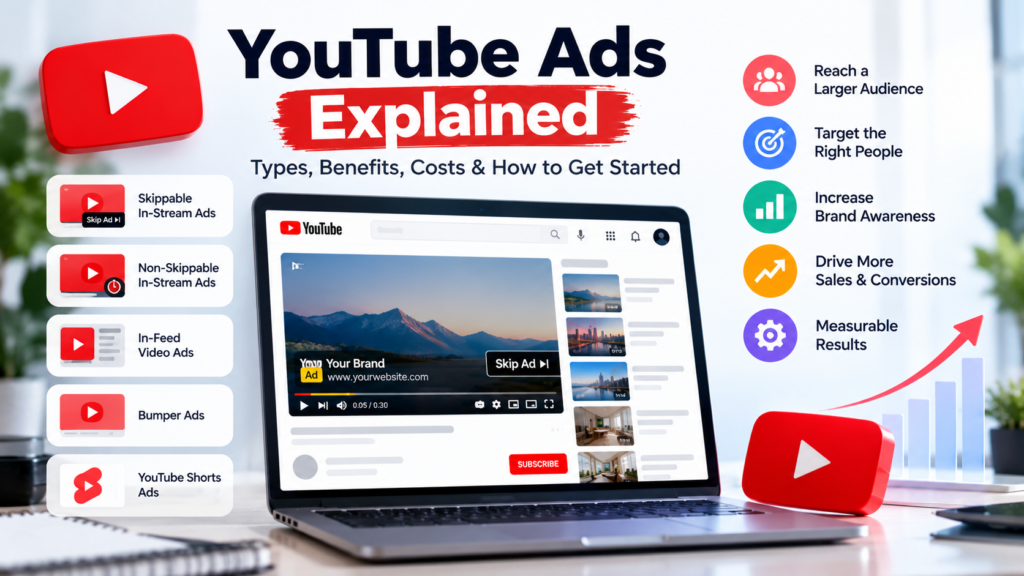
YouTube Ads Explained: A Beginner’s Guide for Small Businesses
YouTube advertising may appear daunting as a small business owner.
You might have already heard about Facebook and Instagram posts or even simple Google Search Ads. YouTube feels different. Video has to be created, audiences to select, campaign goals to get familiar with, budgets to manage, and a number of ad types which appear to perform entirely differently.
Next follows the largest question:
Is YouTube advertising actually practical for a small business?
It can be.
You do not require the television sized advertising budget to initiate experimentation in video advertising. All you need is a business purpose, knowledge of the customer you want to reach and video that provides people with a reason to listen.
The fallacy is to consider YouTube Ads as merely placing a video in front of a large number of people.
YouTube advertising is far more precise than good.
It is the process of delivering a proper message to the appropriate audience and providing viewers with an evident follow-up.
You are entirely new to the platform, and this is what you need to know prior to spending your initial advertising budget.
What Are YouTube Ads?
YouTube Ads are sponsored content that may be viewable on YouTube and, with a campaign configuration, other Google properties or video partners that are qualified.
They are operated using Google Ads.
That is not to say you just post a video to YouTube and pay to popularize it. You develop an advertisement campaign based on a specific business goal.
As an illustration, a small business can desire to:
build awareness;
generate website visits;
attract leads;
increase sales;
influence individuals to think about a product;
or grow pertinent opinions and participation.
The official Video Campaigns guide of Google provides that video campaigns can be applied to a variety of purposes like, but not limited to, awareness and traffic of websites, sales, and provide advertisers with control over factors like audiences, budgets, and measurement.
That distinction matters.
The goal must be placed before the other.
It is followed by the video.
Why Would a Small Business Advertise on YouTube?
Consider the usage of YouTube by people.
A customer may look to find out what other people have to say about a product prior to purchasing it.
The other individual may follow a tutorial since they are attempting to resolve an issue.
Another person may be viewing entertainment, business tips, traveling videos, fitness videos or education.
That opens various opportunities to businesses.
Homeowners who were researching renovations would be reached by a kitchen company.
A gym can make itself known to those who are concerned with fitness and exercise.
An example would be a software firm showing how its product will address a typical business issue.
The online retailer might demonstrate a product in use as opposed to a fixed image.
A local service company might present the faces behind the company and why the customers prefer it.
Video provides you with something that those methods, text and still images cannot always offer you with so easily: demonstration.
You may demonstrate the product.
Show the process.
Show the result.
Show the people.
Define something complex in a straightforward manner.
That may be helpful to small businesses that are struggling to establish a reputation and credibility.
First, Decide What You Want the Campaign to Do
Among the simplest methods of squandering an advertising budget is to initiate a campaign without determining what success is.
I desire more views might sound like an objective.
But what do you want those opinions?
Awareness and relevant video views might be appropriate in case of a new brand launch.
Unless you are an accountant and need to create consultations, the number of views is unlikely to be sufficient.
You might end up being more concerned with purchases, as long as you operate an online shop.
Google Ads now offers video campaign objectives which can be used to pursue sales, leads, website traffic, and YouTube reach, views, and engagements goals. The goal you choose determines the options you have in the campaign.
In its official Video Campaign Objectives guide Google describes the available options.
Complete this sentence before you can make anything:
“After someone sees this advertisement, I want them to…”
Visit our website.
Request a quote.
Buy the product.
Book an appointment.
Get familiar with our company.
See more of our videos.
When you cannot complete that sentence, then the campaign is likely to be unprepared.
The Main YouTube Ad Formats You Should Understand
It is at this stage where beginners are confused.
Not all YouTube ads appear and act in a similar manner.
The types of formats you have may also be based on the type of campaign objective and subtype you choose.
As a beginner, one should familiarize themselves with a number of common formats.
Skippable In-Stream Ads
They are video advertisements which may be displayed around the rest of the video content and allow viewers to skip after the necessary initial time.
You must have noticed them numerous times.
To a small business, the valuable lesson is:
The beginning of your video matters enormously.
When you begin your ad with a five-second slow logo changeover, then a viewer might have moved on before you can even tell them why the business is important.
Provide an incentive to keep watching.
Non-Skippable In-Stream Ads
In these adverts, the viewers must view the entire short message before proceeding to the content.
Since the viewers have no option of just passing over them, the businesses must make good use of the time.
A commercial that cannot be skipped is also no reason to get a complete company presentation in a couple of seconds.
Be to the point.
One product.
One benefit.
One idea.
One memorable message.
Bumper Ads
Bumper ads are brief advertisements which are intended to communicate briefly.
They may be helpful in awareness and reinforcement as they compel the business to convey a single idea and not a whole story.
Consider them as reminders and not presentations.
Your brand name.
A product.
A short benefit.
A memorable message.
That may be enough.
In-Feed Video Ads
Video advertisements in-feed may be placed in areas that users are browsing the YouTube instead of just being an interruption to the video they are already viewing.
This alters the challenge of creativity.
To select your content, the viewer has to have a reason.
A helpful thumbnail and an easy to understand headline are especially essential.
The official Google creating effective video ads advice directly touches on the significance of relevant content and gives the considerations of in-feed advertising.
YouTube Shorts Ads
Vertical video is becoming an important part of YouTube advertising through shorts.
This can open up a future opportunity to create appropriate ideas to fit in YouTube in businesses already producing social media short-form content.
Do not however think that merely re-posting any vertical video will transform it into an effective advertisement.
The video should have a business purpose.
The introduction still has to gain some attention.
The message must continue to be comprehensible.
And the following step must be clear.
Google already promotes Shorts under the deserving video campaigns, as well as the use of other formats, like skippable in-stream and in-feed advertisements. Its Video Views campaign guidance details the way these formats can collaborate in a campaign.
You Don’t Need a Hollywood-Quality Video
This is among the largest myths concerning YouTube advertising.
The small business owners often think of video advertising as being associated with large cameras, actors, studios, professional sets, and big budget.
It can.
Nevertheless, it does not need to.
Sometimes a simple video shot, captured in a high-quality smartphone, can be even more suitable than a costly advertisement which lacks any connection with the audience.
Consider a local plumber.
It may be beneficial to make a brief video that gives three indicators that a water heater requires attention.
One of the typical exercise errors could be shown by a personal trainer.
There might be a restaurant where one might see a dish, which is signature.
A skincare brand might show the usage of the product.
A software company might demonstrate the interface of the product in the course of a real task solution.
Video advertising requires definition and must have cinematic production only after that.
Ask the customer whether he is able to comprehend what you are selling.
It is more about using the most expensive camera than that.
The First Few Seconds Deserve Most of Your Attention
Your advertisement is not owed any attention by people.
You must strive to have it.
Consider this opening:
“Welcome to ABC Solutions. We were established in 2012 and pride ourselves on…”
And compare it to:
“Still spending three hours every Friday creating invoices manually?”
Which one provides better incentive to the target customer to continue watching?
Probably the second.
A great beginning can tend to do four things.
It determines an issue.
It shows an interesting result.
It poses a pertinent question.
Or it illustrates the product in action.
Do not leave the best bit of the advertisement to last.
There will not be a lot of viewers who will ever reach there.
Show the Product Instead of Only Talking About It
Video will be especially helpful when you can demonstrate your product or service.
Imagine that you are selling a stain-removal product.
You might use 30 seconds to explain to people how effective it is.
Or you might demonstrate it taking away a stain.
The advantage is conveyed much quicker through the demonstration.
The concept applies to other industries as well.
A website designer is able to demonstrate a pre-and post-website transformation.
A restaurant may display preparation of food.
A fitness company has the potential to demonstrate a course.
Viewers can be provided with a brief tour by a property company.
An example of how a feature can be demonstrated is by a software provider.
A result can be displayed by a cleaning company.
Always, where possible, show the viewers what you mean.
Talk to One Customer, Not Everyone on YouTube
The number of viewers on YouTube is huge.
That does not imply that your small business requires it all.
The customer of a business that sells accounting software to small retailers is completely different to that of a company that sells running shoes.
That should be reflected on your campaign.
Google Ads provides a possibility to target an audience depending on their demographics, interests, life events, and in-market behavior, among other audience strategies.
The official Video Campaign Targeting guide of Google describes the means of the audience available and how video campaigns can be used to reach various audience segments.
However, it should start with your own knowledge about the customer.
Ask:
Who are our usual purchasers?
To what issue are they attempting to find a solution?
What do they take an interest in?
What could they be studying?
What would cause them to be willing to think about our product?
In which place do we sell or deliver the service?
Do not reach a group just because there is an alternative.
The decision should be based on a reason.
Don’t Make Your Targeting Too Narrow
Targeting has another aspect.
Small businesses at times put so many restrictions to the extent that the campaign has little space to run.
They select a small span of ages, small place, various circumstances of the audience, and a number of more limitations.
Exactness is good, but over constriction is not necessarily good.
Location constraints can of course be logical in case your service is actually restricted in geographical scope.
In case your customer base is more widespread, however, the advertising system should have sufficient time to locate relevant people within reasonable limits.
Begin with what you have of your customer.
Then utilize campaign data to make better decisions.
Your Video Needs a Clear Call to Action
What would you do with the advertisement when it ceases?
Would you like the viewer to:
visit your website?
request a quote?
book a consultation?
shop now?
sign up?
watch another video?
subscribe or interact on your YouTube?
The viewer can not guess.
Think of the time you can see a useful 30-second ad of a local interior designer.
You like the work.
And that is the end of the video.
No next step.
Compare that with:
“Planning a renovation? Visit our website to book your initial consultation.”
Here the viewer who is interested knows what to do.
An obvious action depends on attention becoming a potential follow-up.
Send People to the Right Page
When your advert is promoting one specific product, then do not just redirect all of them to your home page.
Assume that the advertisement is of a free consultation.
The customer clicks.
They access your home page.
It features 12 services, a few menus and a company history, new blog posts and no apparent consultation offering.
You have caused an unwarranted work to the customer.
The opening page must carry on the same dialogue as the advert.
Assuming that the video is advertising a product, display that product.
In case it offers a consultation, describe the consultation.
In case it offers a free trial, ensure that the trial is simple to begin.
The click can be created through advertising.
Its landing experience must assist in its conversion.
What Should a Small Business Spend on YouTube Ads?
There exists no one right answer.
The cost of advertising is determined by your campaign goal, the way you put the bid, your audience, place, competition, creativity and the market.
The needs of a local business that advertises in one city are quite different compared to those of an internet-based retailer.
The economics of a high-value B2B service is also different with a low-cost consumer product.
Instead of asking:
“What is the perfect daily budget?”
ask:
“What can we realistically invest in learning whether this campaign can produce a valuable business result?”
Early campaigns are informative, not only in terms of results.
You might find that a particular video can work out much better than another one.
You can have viewers that watch and do not click.
It might be that people just click but the landing page is not converting.
Perhaps there is an audience that provides much better leads.
The initial budget must allow you to learn without undue pressure to the business.
Understand How YouTube Advertising Is Charged
The method of payment may vary based on the type of campaign, campaign goal, campaign format, and bidding plan.
In certain campaigns that are video-view-oriented, bidding may be based on the price of video view. Reach-oriented campaigns can be based on impression-based bids whereas conversion-oriented strategies could be based on conversion or conversion value.
This is why it is not advisable to decrease You Tube advertisement to:
“How much does one view cost?”
The view could be cheap yet of no use when the viewer does not have any interest in your business.
An expensive interaction can be worthwhile provided that it leads to a qualified lead or sale.
The current Video Campaign setup guide of Google describes the interaction between objectives, bidding, budgets, targeting and formats in the development of campaigns.
The costs that are important should depend on your objective.
Views Are Not the Same as Customers
It is good to see a view count rising.
But what was to come?
Were people going to the site?
Did they look on the brand?
Did they enquire?
Did they purchase?
Did they do what the campaign was meant to stimulate them to do?
Here is the place where small businesses must not go into vanity measures.
The opinions may be significant in cases where the target is awareness or engagement with the video.
However, when you launched the campaign to create sales, the amount of views does not provide you with information about whether the advertisement was commercial success.
Always put performance on track again.
Tracking Should Be Ready Before You Spend
Do not leave until the campaign is over how you are going to measure it.
When the objective is online sales, you must have a suitable means to quantify the pertinent conversion action.
In case of leads, determine what constitutes a lead.
When the aim is traffic to the website, identify what behavior of the web site is important.
When creating awareness, determine which measures of reach, view, engagement, or brand should be applied to the campaign.
Google Ads offers conversion metrics that can assist the advertisers in their quest to know what happens after the advertising interactions.
The technical configuration will depend on business, web site, campaign, privacy and consent mandates.
The rule is general:
Know what you are measuring before the campaign begins.
Test Different Videos Instead of Searching for the “Perfect” One
Your initial video does not necessarily have to be your last video.
Actually, it is likely to be not.
Suppose a local gym comes up with three commercials.
The equipment is presented in video A.
Video B follows a member’s experience.
Video C includes a trainer responding to a typical starter question.
Which of them will work the best?
You can guess.
Or you can test.
The same can be said about the opening hooks, calls to action, video lengths, offers, demonstrations, and innovativeness.
Testing aids in substituting opinion with evidence.
The trick lies not to alter everything at the same time.
When all the factors are altered, you might not be aware of what has influenced the variation.
Don’t Judge the Campaign After a Few Hours
Advertising budgets are monitored reasonably by small businesses.
That may cause overreacting.
In the morning a campaign is started.
At lunchtime, the owner becomes disappointed.
The targeting changes.
In the evening, the budget is changed.
The following day, the video is altered.
We have so many changes that very soon no one is even able to know what is working.
Monitor the campaign.
Verify any obvious errors.
Ensure destination is operable.
Watch the budget.
Confirm measurement is operating.
But allow your advertising ample time to create valuable information before making grand conclusions.
Evidence-based optimization is the foundation of good optimization, rather than panic.
One Video Cannot Speak to Every Stage of the Customer Journey
A person that has never heard about your business might require a different message than someone that has already thought about your product.
You might have to introduce a new audience to the problem and why your company is pertinent.
A more educated customer might desire to have a demonstration.
A person who is about to buy might require confirmation, evidence, or a better motive to make a purchase.
This is the reason why more mature video strategies tend to employ various messages at various steps of the journey.
On the first day, you do not have to develop a complex advertising funnel.
However, keep in mind that a single advertisement must not do all.
Common YouTube Advertising Mistakes Small Businesses Can Avoid
The insignificance of most of the non-persistent campaigns is not due to a clandestine technical environment.
The issues are usually a lot easier.
Beginning with no definite goal.
Playing the video at a slow pace.
Discussion of the company only.
Using weak or generic creative.
Shooting at the customer without knowing him.
Directing individuals to a page that is not relevant.
Following the money but neglecting business results.
One video to be used forever.
Changing campaigns constantly.
Fantasizing about sales to all viewers.
Increasing expenditure without knowing the reasons the campaign is or is not succeeding.
These issues can be resolved.
The advertisement on YouTube is becoming simpler in case you concentrate on the basics first.
A Simple Starting Plan
When this is your first YouTube Ads campaign, then make it something manageable.
Select a business goal.
Choose the customer who you would like to contact.
Make one definite offer.
Create a limited number of variations in video.
Make the introduction as relevant as possible.
Add an effective call to action.
Take viewers to a rational next step.
Establish an affordable budget that you can test.
Ensure that there is readiness to measure.
Then peruse the results.
What did they see?
What did they skip?
What generated clicks?
What brought about significant actions?
Which imaginative did better?
At what point were there dropouts in potential customers?
Your initial campaign need not have a lesson in everything.
It must learn you something useful which will help to make the second campaign better.
Where YouTube Ads Fit Into a Wider Digital Strategy
There should be no isolation of YouTube advertising.
Your video can be watched by a potential customer today and your business could be searched by a customer tomorrow.
They can come to your site.
Check your reviews.
Check your social media.
Compare yourself with other company.
Read one of your articles.
And come back later to decide.
That does not imply that the ad is the only aspect of the experience.
What occurs after someone learns about you is dependent on your website, branding, social media presence, content, search visibility, and customer journey.
This broader outlook can also be seen in the digital marketing strategy offered by KM Marketers where paid advertising can be found in the same category as social media marketing, SEO, content, web solutions and overall online growth strategy.
To a small business, this is important since the actual aim is not to have a video go viral.
To make relevant attention meaningful business activity.
Final Thoughts
YouTube Ads might seem rather complex after opening Google Ads, yet the fundamental plan is very simple.
Have an idea of what you want to accomplish.
Know who you wish to address.
Produce a video that cuts right to the point.
Provide a reason to care to the viewer.
Give instructions to them.
Test whether they do it or not.
Then enhance the campaign with actual data instead of conjectures.
You need not have a huge budget of production and dozens of videos to start. An expensive ad with no clear intention can be easily a weaker point of departure than a clear and relevant video with the target audience.
With the broader paid advertisement, and online marketing strategy that businesses are creating, KM Marketers offers online marketing services on paid campaigns, social media, content, search engine optimization, and online brand growth. When it comes to the technical aspect of YouTube advertising, official resources of Google on Video Campaigns, Video Campaign Objectives, and Video Campaign Targeting are helpful resources to have on hand as you plan your campaign.
Frequently Asked Questions
Are YouTube Ads suitable for small businesses?
Yes. YouTube advertisement can be used by small businesses with a view to awareness, relevant video views, web traffic, leads, and sales. It will depend on your audience, offer, creative, budget, customer value and measuring the desired result whether it is commercially worthwhile or not.
Do I need an expensive professional video?
Not necessarily. Quality of production is essential, yet more important than making each advertisement appear like a TV commercial is clarity and relevance. Some small businesses can start with a well-thought smartphone video with good-quality sound, helpful images, and a powerful message.
What types of YouTube Ads can businesses use?
Google Ads can be used with such formats as skippable in-stream, non-skippable in-stream, bumper, in-feed ads, and Shorts, depending on the chosen campaign goal and configuration. The formats available may depend on the type of campaign subtype, and the current Video Campaign Objectives documentation at Google should be checked when planning a campaign.
How much do YouTube Ads cost?
No definite general cost. The pricing is determined by bidding strategy, objective, audience, competition, location, ad format, and performance of campaign. Establish a budget that suits your own business financials and goals as opposed to relying on a projected online figure that will fit your campaign.
Can YouTube Ads generate leads and sales?
They may be implemented as the components of campaigns focused on leads, sales, and web traffic. Nonetheless, advertisement does not come with guarantees of conversions. The end outcome depends on your targeting, creativity, offer, landing experience, measurement setup and broader sales process.
How long should a YouTube video ad be?
No one perfect length of campaign exists. The right length is determined to an extent by the format and message. A brief awareness message can take a few seconds whereas the demonstration of a product can take longer. Pay attention to conveying the idea in an effective way instead of stretching a video to fit a random time.
Should I use YouTube Shorts Ads?
When you have a vertical, mobile-first video, and a message to convey to your audience, shorts can work. Shorts is now supported by Google in qualifying video campaigns. That creative must still be created with a purpose in mind as opposed to merely repurposing short-form content because it already exists.
Where should I learn the technical setup for YouTube Ads?
The best place to start is the official Create a Video Campaign guide by Google since the choices of campaigns and terminology might evolve as time goes by. It addresses the goals, budgets, targeting, ad groups, bidding, and video creation in the existing Google Ads workflow.
Your Trusted Marketing Partner!
KM Marketers is a digital marketing solutions provider helping businesses grow through SEO, social media, content marketing, and paid advertising. Our focus is on delivering measurable results, building strong online visibility, and driving quality leads for clients across different industries.
Email: info@kmassignmentservices.com
kmdigitalmarketing2025@gmail.com
WhatsApp: +60 16-522 4321
Head Office: Galleria Cyberjaya, Parking lot, Jalan Teknokrat 6, Cyber 5, 63000 Cyberjaya, Selangor, Malaysia.
Hours: Mon–Sat 10:00 AM to 07:00 PM
© 2026 KM Marketers. Powered by KM Software Services Sdn. Bhd. (1308207-U). All Rights Reserved.